
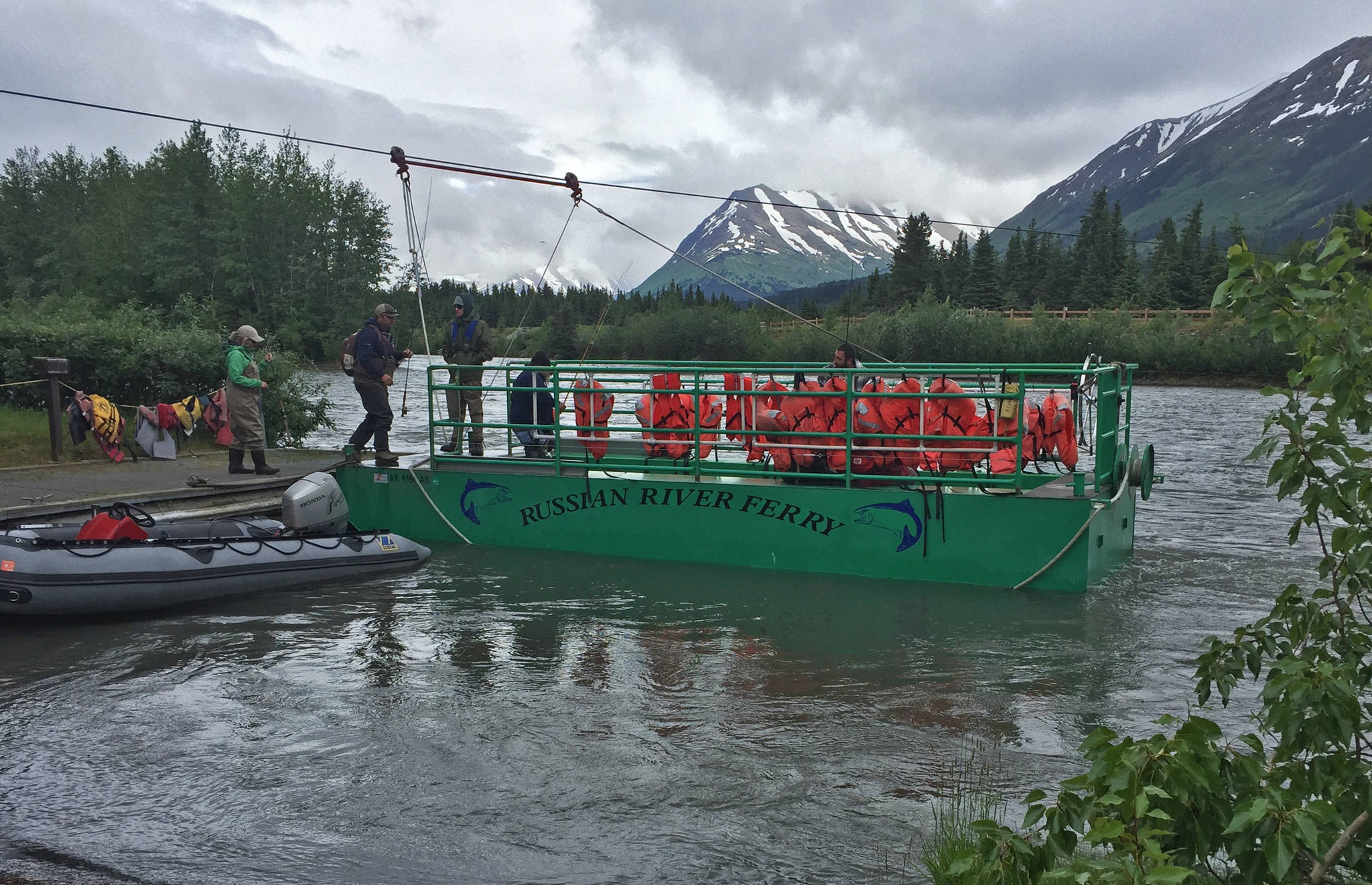
Anglers board the Russian River Ferry on the Kenai River just downstream of the confluence with the Russian River on Monday near Cooper Landing. (Photo by Elizabeth Earl/Peninsula Clarion)

Anglers board the Russian River Ferry on the Kenai River just downstream of the confluence with the Russian River on Monday near Cooper Landing. (Photo by Elizabeth Earl/Peninsula Clarion)

Russian River Ferry — a piece of history, still afloat

The only thing that remains of a lodge that used to attract people from all over the world to stay near the Russian River is the ferry across the Kenai River.

Every year, thousands of people board a simple flat-bottomed boat to cross the Kenai in search of sockeye salmon. The other way to get there is through the U.S. Forest Service’s campground, driving down to the far side and hiking in via a boardwalk. The ferry runs on a cable across the river and takes less than five minutes.

Though the Kenai National Wildlife Refuge manages the boat launch area and the land around the river, the ferry itself is managed by a concessionaire — the Anchorage-based Alaska Recreational Management. The familiar green boat with the blue salmon emblazoned on the side has been there for about 25 years, said Bruce McCurtain, Alaska Recreational Management’s general manager.

He said one thing guests often comment on is the ferry’s mode of transport — it has no engine at all.

“The current does every single bit of it,” he said. “People always say, ‘Oh my goodness, the motor is so quiet I can hardly hear it,’ and I say, ‘The motor is the Kenai River.’”

The ferry requires two people to make its trips to and fro, who have to be Coast Guard-licensed captains and deckhands, despite the boat’s lack of motor. It does take some skill to negotiate the flat-bottomed boat through the slackwater at the edge of the river into the current, but once there, it’s a relatively easy ride, designed for most people to be able to operate, McCurtain said.

Fred Henton established a lodge at the confluence of the two rivers in 1945 built the first ferry. He initially built it on the south side illegally on the refuge — then called the Kenai National Moose Range — and moved it to the north side of the river in 1946. The lodge changed hands a number of times until 1988, when the operator lost the ferry contract and shut down. The lodge, which was then called Sportsman’s Lodge, was closed and torn down after the Alaska Department of Fish and Game bought the property to turn it into a boat launch.

The ferry has lasted, though the original wooden boat was replaced.

“It is a completely unusual kind of system,” McCurtain said. “The entire reason that there’s a ferry there is that there’s a clearwater system running into the Kenai there.

(The ferry) is still a unique, very viable way to get to a red salmon fishing river. There’s not many places that have red salmon runs like the Russian River and the Kenai have.”

In a given year, anywhere from 25,000–40,000 will use the ferry to cross the river to fish, McCurtain said. Once the boat is loaded with anglers, the captain will gently nose the boat into the current, using the angle to carry it in to the fast-flowing Kenai and across to the far bank. When it’s time to return, the captain will reverse.

It’s one of the highest-traffic areas on the Kenai River, though, with anglers all along the banks and rafts, drift boats and kayaks frequently passing through on their way downriver. McCurtain said Alaska Recreational Management keeps a rescue boat at the dock with the ferry and occasionally has to do water rescues for boaters who get into trouble. Generally, things go smoothly, but the ferry captain has to make sure he or she times the trips carefully to ensure that there isn’t a boat coming downstream.

“It’s dangerous, and that’s why we pay skippers the big bucks, to use good judgment on when to pull that boat across,” he said.

The Russian River Ferry can be accessed from the parking lot at approximately mile 55 of the Sterling Highway just west of Cooper Landing.

Reach Elizabeth Earl at eearl@peninsulaclarion.com.

More in News

David Ross is sworn in as Kenai Police Chief on Tuesday, May 31, 2016 at Kenai City Hall. The Alaska Association of Chiefs of Police named Ross the 2025 Police Chief of the Year, recognizing over two decades of service. Photo by Megan Pacer/Peninsula Clarion
Kenai police chief named 2025 Police Chief of the Year

The Alaska Association of Chiefs of Police recognized David Ross for his more than two decades of leadership.

The cast of Nikiski Middle School’s upcoming performance of “Alice in Wonderland” is pictured on Dec. 2, 2025. The upperclassmen-directed play opens on Friday, with additional showtimes Saturday and next weekend. Photo courtesy of Carla Jenness
Nikiski Middle School debuts student-led “Alice in Wonderland”

The show opens on Friday, with additional showtimes this weekend and next.

On Tuesday, the Kenaitze Indian Tribe unveiled Kahtnu Area Transit, a public transportation service open to the entire Peninsula Borough community. Photo courtesy of Kahtnu Area Transit
Kenaitze Indian Tribe unveils Kahtnu Area Transit

The fixed bus route offers 13 stops between Nikiski and Sterling.

The Kenai Chamber of Commerce and Visitor Center hosts the annual Christmas Comes to Kenai on Nov. 28<ins>, 2025</ins>. The beloved event began over 40 years ago, and this year over 1,000 attendees enjoyed hot chocolate, fireworks, pictures with Santa and shopping. Photo courtesy of the Kenai Chamber of Commerce
 Photo courtesy of the Kenai Chamber of Commerce
The Kenai Chamber of Commerce and Visitor Center hosted the annual Christmas Comes to Kenai on Nov. 28. The beloved event began over 40 years ago, and this year over 1,000 attendees enjoyed hot chocolate, fireworks, pictures with Santa and shopping.
Kicking off a month of holiday festivities

Last weekend’s holiday events, including the annual Christmas Comes to Kenai and the Soldotna Turkey Trot, drew folks from all over the Kenai Peninsula.

Starting Dec. 2, Aleutian Airways will offer roundtrip flights between Anchorage and Unalakleet every Tuesday, Friday and Sunday.
Aleutian Airways to offer roundtrip flights between Anchorage and Unalakleet

Starting Dec. 2, Aleutian Airways will offer three roundtrip flights per week.

The Trump administration’s “Big Beautiful Bill” act requires the Bureau of Ocean Energy management to hold at least six offshore oil and gas lease sales in Alaska between 2026-2028 and 2030-2032. The first of these sales — known as “Big Beautiful Cook Inlet 1,” or BBC1— is scheduled for March 2026. Photo courtesy of the Bureau of Ocean Energy Management
Cook Inletkeeper launches petition against federal government

The organization is calling for transparency in Cook Inlet offshore oil and gas sales.

Winter dining has always carried more weight than the menu might suggest. In the off-season, eating out isn’t just about comfort food or convenience; it’s a way of supporting local businesses as they hold steady through the slower months. Photo credit: Canva.
The ripple effect: How local spending builds stronger communities on the Kenai Peninsula

From cozy cafés to fine-dining bistros, purchases made close to home sustain local jobs and services

Courtesy Harvest
On the Kenai Peninsula, a dormant liquefied natural gas export plant could be repurposed to receive cargoes of imported LNG under a plan being studied by Harvest, an affiliate of oil and gas company Hilcorp. The fuel would be transferred from ships to the tanks on the left, still in liquid form, before being converted back into gas and sent into a pipeline.
Utilities say Alaska needs an LNG import terminal. Consumers could end up paying for two.

Planning for two separate projects is currently moving ahead.

A map shows the locations of the 21 Alaska federal offshore oil and gas lease sales proposed by the Trump administration. (Map provided by the U.S. Bureau of Ocean Energy Management)
Trump administration proposes offshore leasing in almost all Alaska waters

A new five-year offshore oil and gas leasing plan proposes 21 sales in Alaska, from the Gulf of Alaska to the High Arctic, and 13 more off the U.S. West Coast and in the Gulf of Mexico.

Most Read