
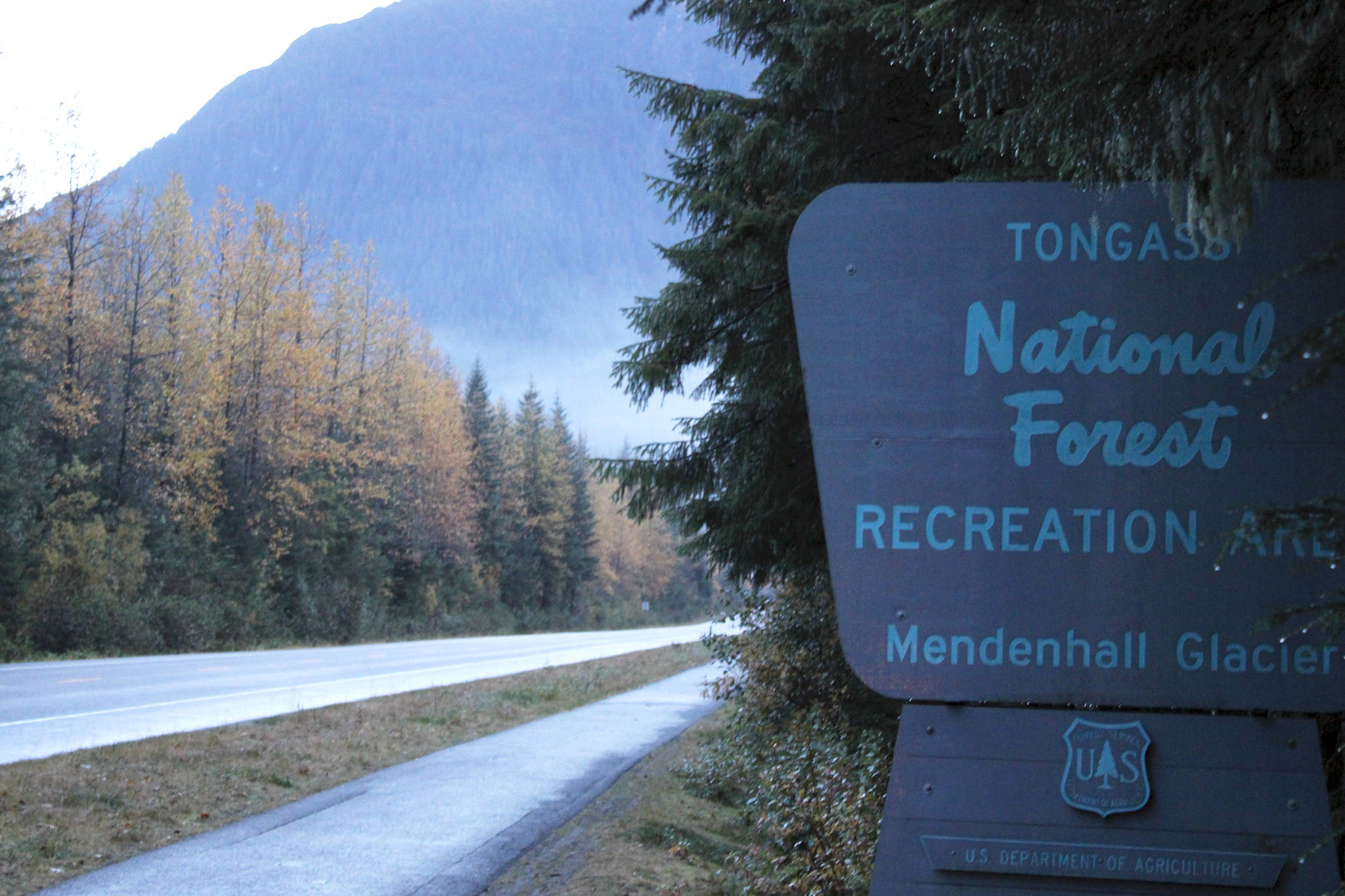
Alaskans on both sides of the issue reacted strongly Friday to the news protections on the Tongass National Forest known as the Roadless Rule are likely to be lifted in as little as 30 days.
A deluge of news releases and statements began going out Thursday afternoon following the U.S. Department of Agriculture’s announcement the Final Environmental Impact Statement for Rulemaking on the Tongass National Forest was soon to be released. Even before the statement was released, environmental groups condemned the U.S. Forest Service’s recommendation to exempt the forest from the rule that bans road construction and timber harvesting on millions of acres of public lands.
Roadless Rule advocates’ assumption the Forest Service, which is an agency of USDA, would move to lift the rule entirely proved correct. The impact statement identified “Alternative 6,” complete exemption of the Tongass from the rule, as the preferred alternative. The USDA has to wait 30 days before it can issue its final decision.
Exemption of the rule is something Alaska’s congressional delegation and Gov. Mike Dunleavy have previously pushed for.
“We thank Agriculture Secretary Sonny Purdue and his team for conducting a thorough evaluation and proposing a reasonable accommodation for Alaska, and we look forward to release of the Final Alaska Roadless Rule,” Dunleavy said Friday in a statement.
[Groups decry Roadless Rule rollback for the Tongass]
While easing regulations on the Tongass has long been supported by some who say it would boost resource development, the forest’s unique ecosystem plays a crucial role for other industries in Southeast such as fishing and tourism, conservationists say, as well as providing a critical resource in the fight against climate change.
The Southeast Alaska Conservation Council Thursday was joined by several other environmental organizations in issuing a statement condemning the rollback.
“If implemented, the plan to roll back the Roadless Rule will open the gates to industrial-scale old-growth clearcutting, with irreversible consequences to the ecosystem on which Southeast Alaskans rely for their salmon and deer,” the statement said.
Released by SEACC and signed by representatives from Audubon Alaska, Women’s Earth and Climate Action Network, Earthjustice, Alaska Wilderness League, Native Movement and Sierra Club Alaska, the statement highlights the value of preserving the Tongass for both economic and cultural reasons.
“The Tongass is the traditional homelands of the Tlingit, Haida and Tsimshian peoples. A healthy Tongass is essential for Alaska Native communities that rely on hunting, fishing, and foraging, now more so than ever due to limited ferry service and the pandemic, the statement said. “Many have raised concerns that rolling back the Roadless Rule in the Tongass will affect their lives and work.”
Organized Village of Kake President Joel Jackson, who was featured in a video made as part of the SEACC statement, traveled to Washington, D.C,. in November of 2019 to testify against lifting the Roadless Rule. He said tribal governments weren’t treated as equal sovereign governments in their discussions with USDA and the Forest Service. Jackson told the Congressional panel the OVK and other tribes had pulled out of the agreement to be a cooperating agency because they felt disrespected by Forest Service representatives.
[Tribal leaders share Roadless Rule frustrations]
“Well, I’m disappointed but not surprised,” Jackson said in an interview Friday. “(Full exemption) is what they were pushing. I don’t have too much faith in the process anymore.”
Critics of the Roadless Rule pointed to its blanket approach to forest management and said there are already state and federal regulations that provide several layers of environmental protection.
The 2016 Tongass Tiber Reform Act and the Alaska National Interest Lands Conservation Act limited timber harvests and the rule had the inadvertent effect of hampering development of renewable energy like hydro-electric power, said Jim Clark, former chief of staff to Gov. Frank Murkowski and a lawyer for the timber industry.
[Is mining a solution for Southeast?]
The main beneficiaries of full exemption would be renewable energy, hydro-power and mining, Clark said in an analysis of full exemption he wrote and provided to the Empire. Lifting the roadless rule would assure road access to minerals by companies that can meet rigorous national environmental standards, he wrote.
In an email, Clark said full exemption would not lead to widescale timber harvest, as some environmental groups have claimed.
“Full exemption will permit timber sales in areas currently not authorized by the Roadless Rule,” Clark wrote. “This is offset and checked by the fact that SEACC and related groups will continue (to) litigate every sale, thereby making certain that all resource protection laws are being followed.”
Clark isn’t wrong about litigation.
In their joint statement, SEACC and its partners said “we oppose any weakening of the Roadless Rule in the Tongass, and will challenge the lifting of restrictions against old-growth logging at every turn.”
Resource development in Southeast received a lot of attention this week at the Southeast Conference Annual Meeting. Speakers and attendees there, including the state’s congressional delegation, promoted the expansion of responsible resource development as a potential economic driver for the region.
But the calls for responsible development followed shortly after videos surfaced of executives behind the controversial Pebble Project describing close relationships with government officials.
Southeast Conference Executive Director Robert Venables, another longtime proponent of lifting the rule, said in an email Friday the announcement allowed for more flexibility in the Southeast economy.
“This is 2020, not the clear-cutting logging days of decades ago,” Venables said. “The reality is that it takes two to 10 years to get a sale put together and by the time the sale goes out, it’s well-vetted and justified (with sufficient environmental safeguards in place).”
However, the emphasis on the resource industry is the wrong direction for Alaska, according to advocates of the fishing industry who feel threatened at the prospect of activities that might disrupt critical fish ecosystems.
[Public gets heated over Roadless Rule alternatives]
“It’s clear the State of Alaska, the old-growth clear-cut logging industry, and others want a return to the days of reckless logging that sacrifices our fish, wildlife and forests without regard for the costs to Southeast Alaska’s fishing and tourism economy,” said Austin Williams, Alaska Director of Law and Policy for Trout Unlimited in a statement.
The nonpartisan group Taxpayers for Common Sense issued a statement against lifting the Roadless Rule, calling it an “unjustified giveaway to the timber industry at the taxpayers’ expense.”
TCS was also critical of the Forest Service’s cost-benefit analysis, saying “the analysis neglected to include several costs like increased losses from timber sales and increased road costs.”
“The omission was compounded by shoddy math that overstated the benefits presented by nearly seven times. These combined errors obscured the fact that existing Roadless protections save taxpayers money,” the group said.
The review process left a bitter taste in the mouth of some of the tribes who were involved.
Richard Chalyee Éesh Peterson, president of Central Council of Tlingit and Haida Indian Tribes of Alaska, told the Empire Friday working with the Department of Agriculture made him lose faith in the process.
“Why would I have faith in those,” Peterson said of other state and federal protections. “(The Roadless Rule) was in place and there was a process that was totally ignored for the hubris of politicians. They took away our faith in the process. We weren’t saying all or nothing, they did.”
Jackson made similar comments about trusting other existing regulations.
“They completely ignored the comments they asked for at the beginning,” Jackson said, pointing to out that 96% of the public comments received by the Forest Service favored leaving the rule in place.
“It’s sad that they didn’t listen to anybody and are going ahead with this,” he said. “Talking about mining is a real concern to me. When they talk about mining in the Tongass, it’s just worrisome for us, the potential going to affect our way of life.”
Contact reporter Peter Segall at psegall@juneauempire.com.
Follow him on Twitter at @SegallJnuEmpire.
