
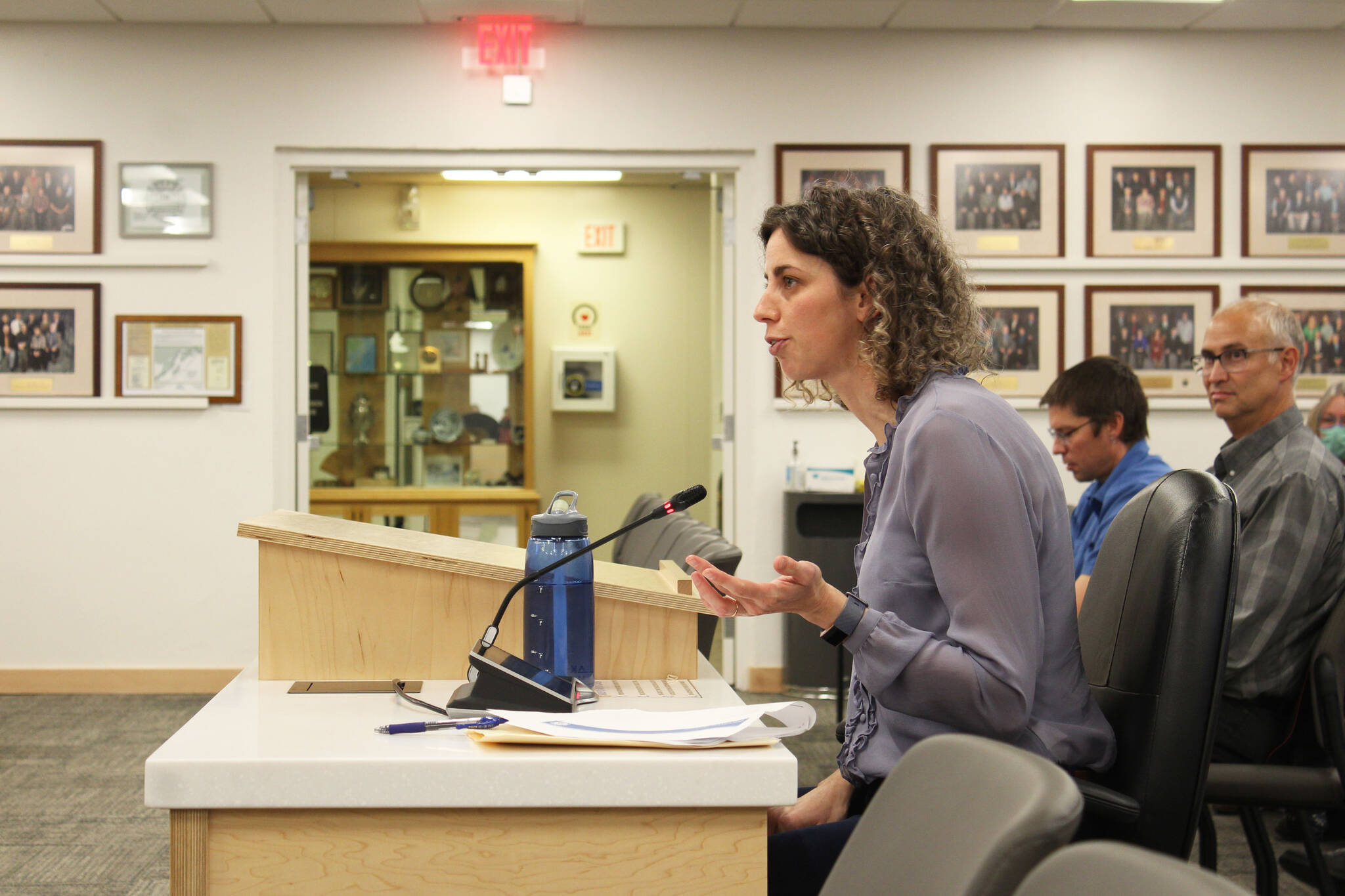
The Kenai Peninsula Borough Assembly will consider at its next meeting whether or not to offer tax exemptions for independent power producers, such as one company proposing to put a solar farm on the Kenai Peninsula.
Renewable IPP, a company that develops, constructs and operates utility-scale solar farms, first approached the assembly about a solar farm on the peninsula last fall. The project, if it goes through, would be the biggest solar farm in Alaska, made up of 60,000 solar panels capable of powering 4,500 homes.
Renewable IPP CEO Jenn Miller has said the farm would cover about 160 acres and be roughly 20 times the size of the largest solar farm currently in the state. The farm would have a rated output of 20 megawatts, but Renewable IPP would install 30 megawatts of solar panels to boost production on cloudy days.
Assembly President Brent Johnson, who is sponsoring the ordinance up for consideration next week, wrote in a March 24 memo to assembly members that the ordinance would amend borough code such that independent power producers, or IPPs, would be eligible for a tax exemption for up to 15 years. Johnson wrote that the ordinance was introduced in response to interest in developing a solar farm on the Kenai Peninsula.
The ordinance defines independent power producers as companies that own and operate a power generation facility larger than two megawatts and that sell electricity to a public utility regulated by the Regulatory Commission of Alaska.
When Miller first presented the project to assembly members, she said the company was looking for a property tax exemption of around 80%. The Kenai Peninsula Borough mill rate in Sterling is about nine, about 2.35 mills of which could be eligible for exemption under the ordinance.
Mill rates are used to figure out how much someone will pay in property taxes during a certain fiscal year. To calculate how much property tax they expect to pay, an individual must divide the mill rate by 1,000 and then multiply that by their property’s taxable value.
If fully exempted from the eligible two mills, Renewable IPP’s property tax exemption would be around 25%. Though the exemption is not what Renewable IPP originally asked for, Miller said during an April 5 assembly meeting, the ordinance language that would make the exemptions last for up to 15 years “certainly helps.”
“The project would pay $3.8 million in property taxes over its 25-year life,” she said. “That’s down from — if it was not exempted at all — it would pay $4.6 million.”
Assembly member Tyson Cox pointed out during the assembly’s April 5 meeting that the land Renewable IPP is interested in developing stands to bring in $3.8 million to the borough if the project goes through, but nothing if the project does not go through.
The Renewable IPP project, Miller has told assembly members, would plug into an existing electric grid, like HEA, and then the utility distributes electricity to its customers. Reducing the amount of money HEA spends on fuel prices by diversifying with something like solar power, Miller said, brings prices down for HEA and as a result for HEA customers.
Per the ordinance being considered by the assembly, Alaska statute gives municipalities discretion to partially or totally exempt property used for economic development from taxation over a certain period of time. Among other things, the ordinance describes the potential to make electricity in the borough more resilient and cost effective through diversification.
Gov. Mike Dunleavy announced in February legislation that would create a renewable portfolio standard in the Alaska Railbelt that would set targets for the production of renewable technology. The proposed portfolio describes what Dunleavy’s office called a “firm commitment” to transitioning to 80% sustainable power by 2040. That initiative is also cited in Johnson’s legislation.
Kenai Peninsula Borough Mayor Charlie Pierce has maintained since the project was first presented, however, that Renewable IPP should present data on how the project would positively affect borough utility users. The inclusion of a fiscal note with the ordinance, Pierce said in April, should describe what the net gain would be.
“Until you can answer that question, I don’t think you’ve finished the responsibility you have in bringing this ordinance forward,” Pierce told assembly members in an April 5 meeting.
A public hearing on the ordinance is scheduled for the assembly’s May 3 meeting.
Reach reporter Ashlyn O’Hara at ashlyn.ohara@peninsulaclarion.com.
