
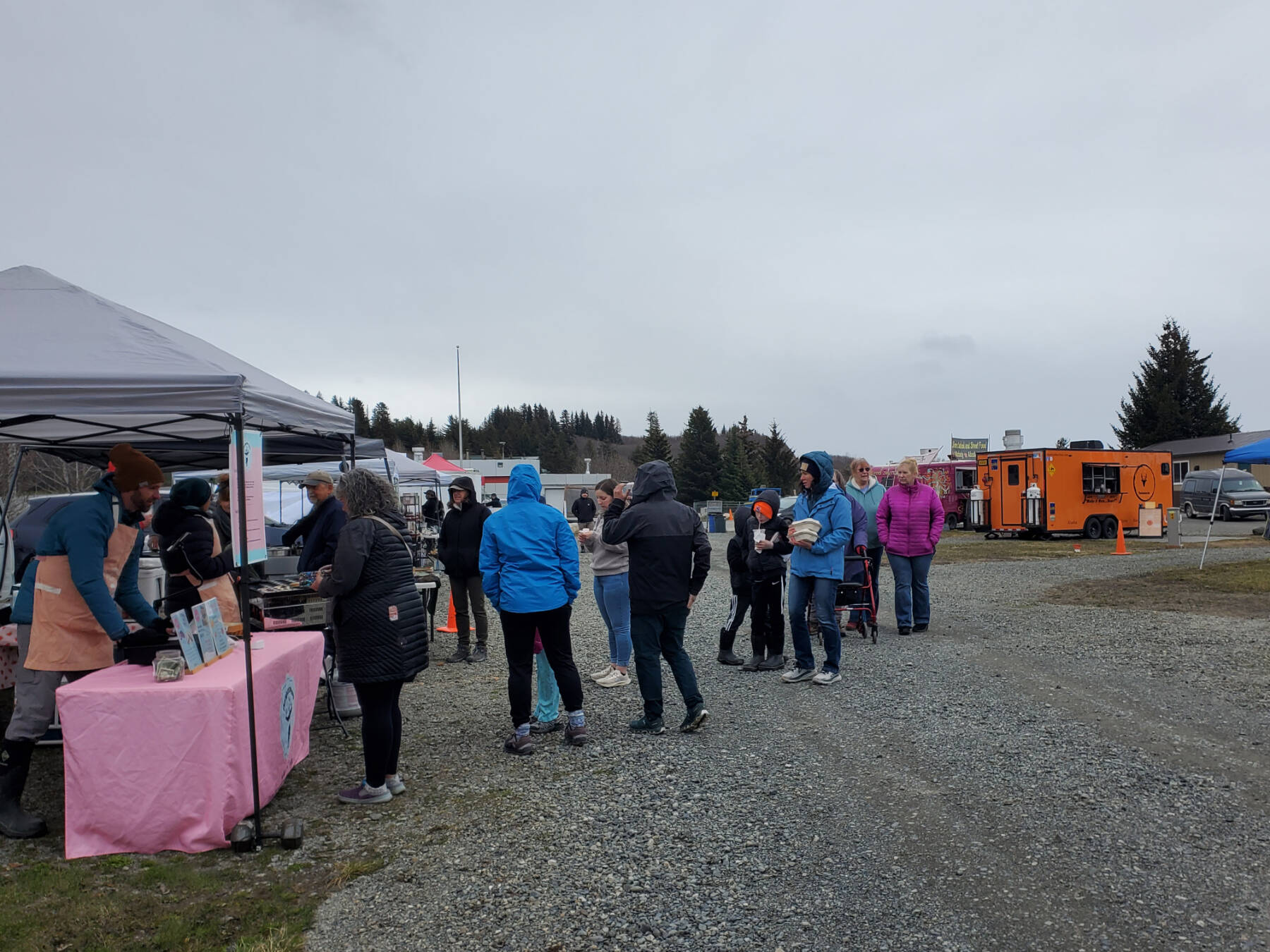
A new ordinance introduced Aug. 11 by the Homer City Council seeks to create a new category in the city code regarding movable retail structures.
Ordinance 25-54 would officially recognize the “growing interest” in temporary and movable structures, such as food trucks and small retail shops, and notes that the existing definition of mobile food service in Homer City Code 8.11.020 supports self-contained food service establishments but does not address other temporary retail structures.
The ordinance argues that this limits opportunities for “diverse commercial uses.” Creating a new category in the city code on “movable retail structures,” the ordinance said, would provide greater flexibility for entrepreneurs with limited resources to establish small businesses, such as mobile retail shops, without requiring permanent foundations.
Allowing movable retail structures will contribute to expanding the city’s tax base by enabling new business opportunities and attracting visitors to commercial areas, the ordinance said.
The ordinance notes that the City of Sitka defines movable structures as “structures built on a chassis with wheels, skids, or other mechanisms designed to facilitate mobility, not permanently affixed to a foundation,” providing a model for broadening Homer’s regulations.
The ordinance was brought forward by council members Donna Aderhold and Jason Davis. Davis owns and operates his meadery, Sweetgale Meadworks & Cider House, out of a downtown Homer property just off of Main Street. In addition to his meadery, he rents the former building of Timeless Toys to The Happy Closet Co. and allows a mobile food truck, Shiva Boom, to operate on the property.
Davis said he was surprised to learn that the city doesn’t allow people to put up “small, movable buildings” for retail establishments. He said initially the issue seemed to be that all structures needed to be connected to water and sewer in town, although later research proved that there were already businesses operating without this stipulation. Davis said the new ordinance hopes to “basically treat other forms of mobile retail more or less the same as food trucks.”
An Aug. 5 memorandum from City Manager Melissa Jacobsen outlines the context of the ordinance further. She notes that at the July 28 city council meeting, council member Davis introduced Resolution 25-070 to direct the Planning Commission to amend city code to allow temporary retail structures on vacant lots in the Central Business District.
Jacobsen wrote that after discussion and postponement of the resolution to Aug. 11, city staff — including Community Development Director Julie Engebretsen and Jacobsen — collaborated with council members Davis and Aderhold to develop “a more streamlined solution that aligns temporary retail structures with mobile food service regulations, eliminating the need for the broader zoning code changes proposed in Resolution 25-070.”
Jacobsen wrote that currently, Chapter 8.11 regulates mobile food services as “self-contained, movable establishments not requiring permanent utility connections,” but notes that no clear framework exists for other temporary retail activities, such as mobile shops selling clothing or crafts. The existing Itinerant Merchant’s License (HCC 8.08) is outdated, she wrote, requiring burdensome processes like criminal background checks and high fees ($1,020 for 180 days).
She notes that current code also does not address mobile structures, making it “unsuitable for modern entrepreneurs.”
Jacobsen wrote in her memorandum that Ordinance 25-54 would create Chapter 8.13, Temporary Retail Services. The proposed addition to city code would regulate self-contained small commercial buildings, no larger than 150 square feet, that are designed to be readily movable from location to location, without being permanently affixed to any site or permanently connected to any water or sewer utility service.
The ordinance is still awaiting a decision from the council and will have a public hearing on Aug. 25.
