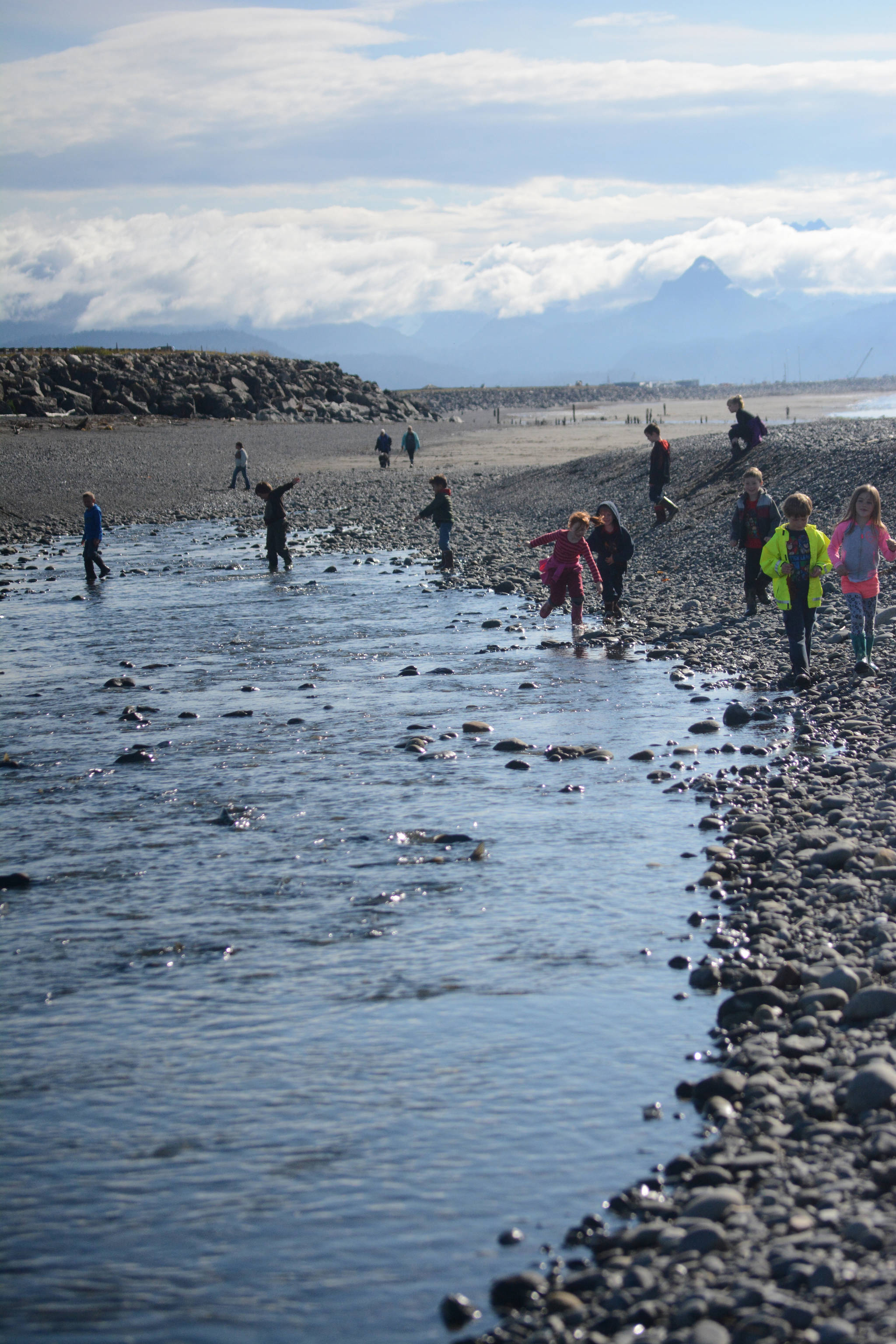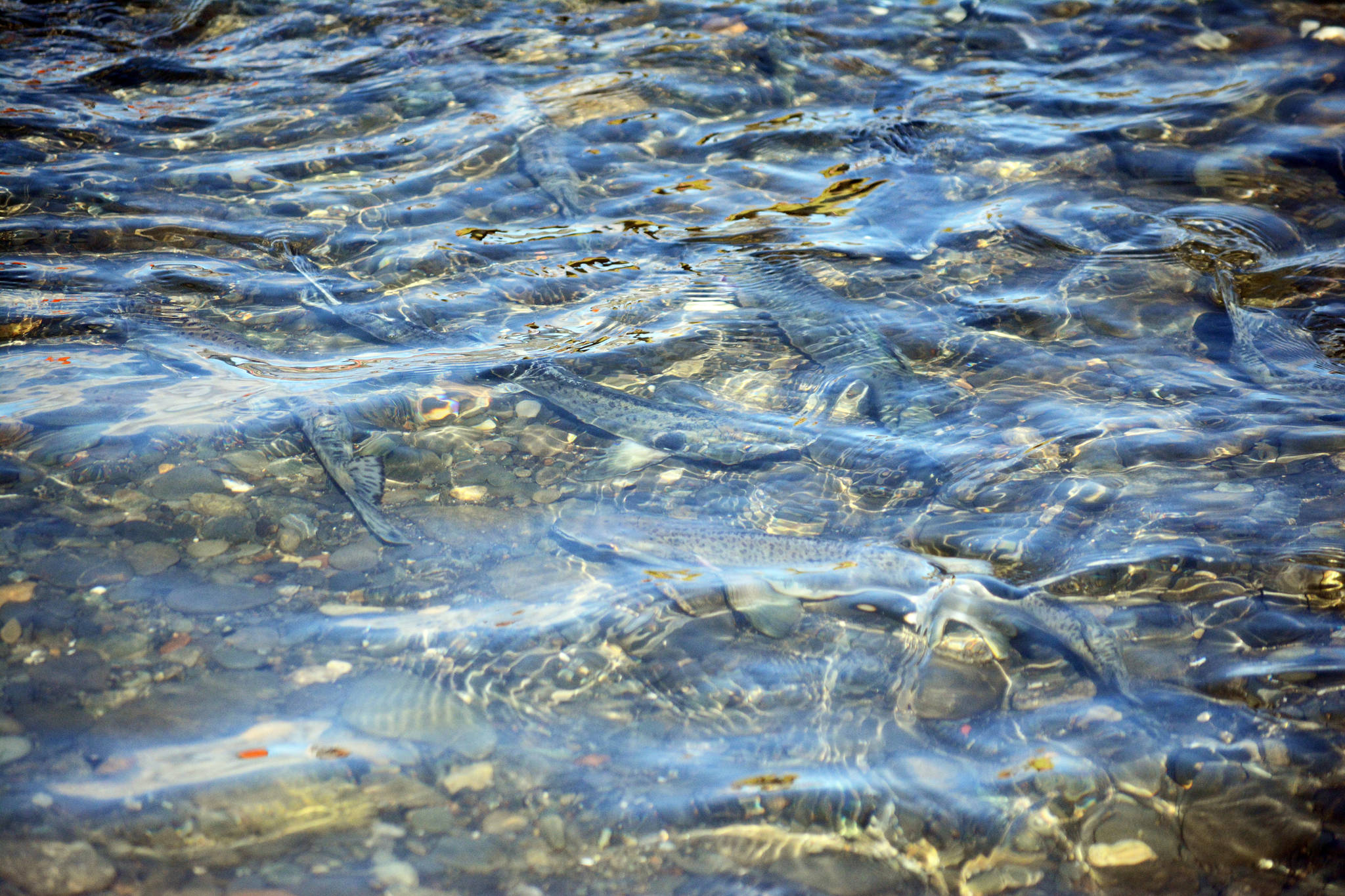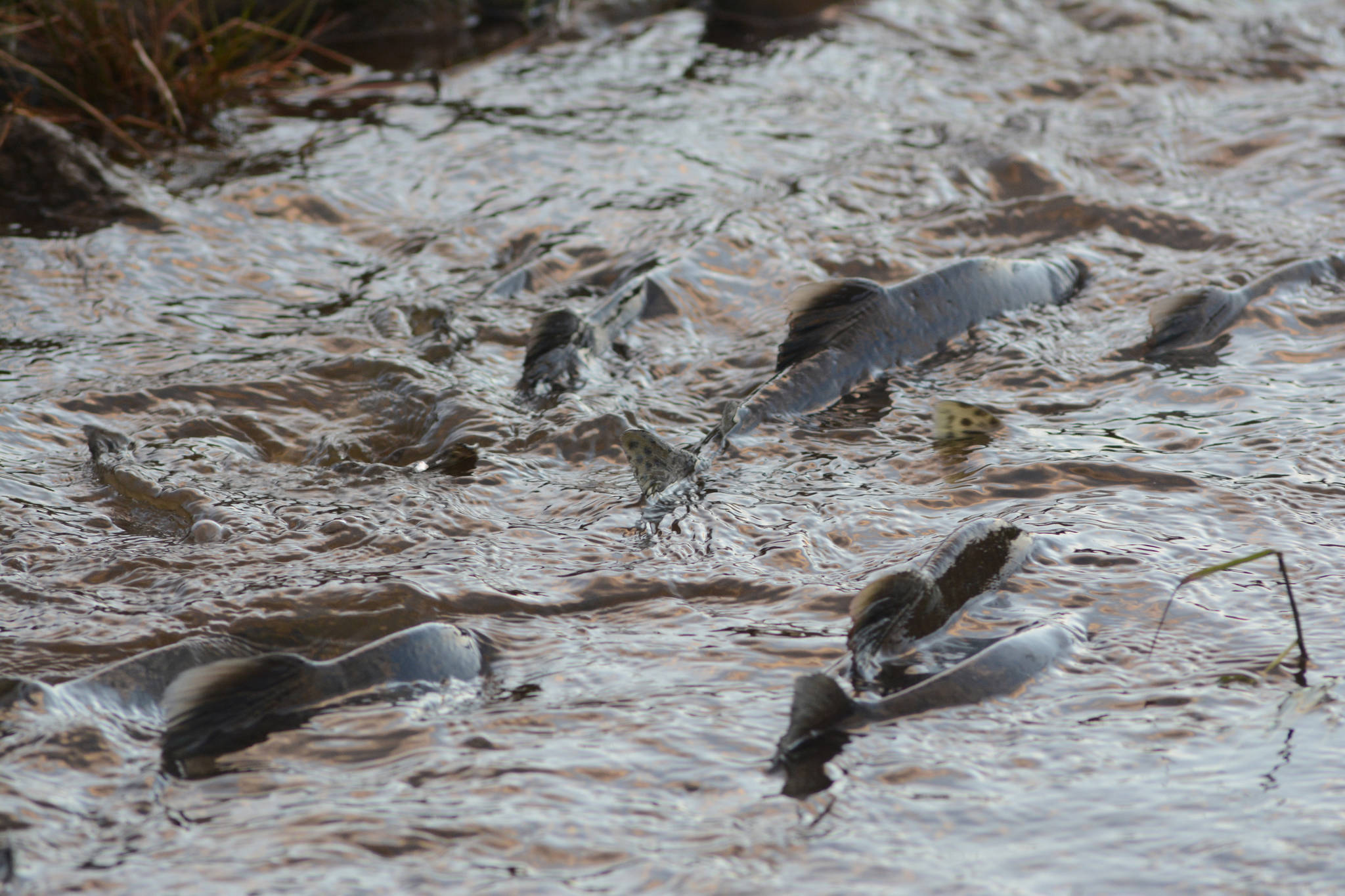
All around Kachemak Bay the past weeks, people have reported large runs of pink salmon in places never seen before — at least in significant numbers. Last week at Beluga Slough, pink salmon ran all the way up into the slough and in a drainage ditch leading to the city’s stormwater drainage system. At Mariner Park on the Homer Spit last Friday, children from Little Fireweed Academy working on the Burning Basket ran up a small creek leading into the slough and yelled “Salmon! Salmon!” at pinks passing by.
Up the bay at Diamond Creek, hikers at the popular beach trail reported pink salmon running up the creek. At the Seldovia Slough and in Sadie Cove also came reports of huge runs of pinks. Sadie Cove resident Nancy Hillstrand, who’s lived here 44 years, said the head of Sadie “was absolutely plugged, probably 10,000 of them.”
“It’s just amazing. It’s a glut. It’s a pink stink,” she said.
Pink salmon returns also have been strong at the Cook Inlet Aquaculture Association hatcheries in Tutka Bay and Port Graham, said executive director Gary Fandrei of Kenai.
“We’ve seen good returns to Port Graham, much greater than expected, and also much greater than expected to our Tutka Bay hatchery,” he said.
Glenn Hollowell, finfish area management biologist for the Alaska Department of Fish and Game, Homer, said he started hearing reports of pinks in Beluga Slough last week. When he went to check, he said he saw so many “that I came back with a knife and tray and started plucking otoliths,” or ear bones.
So why so many? Holloweill cited two causes: a huge pink run in 2015 and a warm winter for 2015-16.
In 2015, 6.5 million pinks were harvested in lower Cook Inlet, nearly seven times the annual harvest of 883,000. In the winter of 2015-16, Homer had 110 days where the average daily low temperature was above 32 degrees F, almost four times the average number of above-freezing days of 29.
Pinks mature on a 2-year cycle, meaning all the fry hatched in 2015 would return as mature adults. Small numbers of pinks that spawned in places not normally seen and that went unnoticed two years ago laid eggs, and their progeny came back, big time.
Salmon eggs need warm, aerated water to hatch, Hollowell said. If the shallow creek and slough beds freeze, the eggs die. A female pink lays an average of 1,400 eggs, with a survival rate of 3-10 percent returning as adults. One female could produce up to 140 surviving adults. If 100 pinks slipped into Beluga Slough and spawned, that could mean 14,000 returned two years later.
“Just because we haven’t documented fish in Beluga Slough doesn’t mean they haven’t made it or not,” Hollowell said. “The fish that came in 2015 hit the jackpot.”
Beaver Nelson, a lifelong Alaskan and commercial fisherman who has been in Homer since 1968, said there could be another reason so many pinks have come into unusual places like the slough: there are so many pinks in Kachemak Bay and Cook Inlet that they’ve strayed into new territory.
“You get a giant run like this, they start looking for fresh water and then they start colonizing every little available place there is,” Nelson said. “They’re pretty desperate. The cricks are loaded. That’s what they do.”
That’s possible, Hollowell said.
“There is a certain amount of natural stray. … Salmon find their way into places, new habitat,” he said.
“It’s kind of what salmon do,” Fandrei said. “They get a good year and they wander around and look for new areas to explore. I’m not surprised.”
Pinks in particular are pretty hardy and don’t need to go too far up a stream to find places to lay eggs. They also can spawn in intertidal waters like Beluga Slough, where freshwater from the lake mixes with tidal salt water from the bay. Hollowell didn’t think salmon would be able to swim up a culvert under Lake Street and into the lake.
Hillstrand, an environmentalist who describes herself as “a fish culturalist who’s very concerned for the resource,” has been critical of the hatchery programs at Tutka Bay. She said she thinks huge pink salmon runs will stress the carrying capacity of Kachemak Bay, reducing other marine populations like crab and shrimp.
“It’s just not good for the ecosystem,” she said. “We’re supposed to be rehabilitating the stressed stocks. This is a suppression of the stressed stocks.”
Hillstrand said she suspects some of the pinks may come from hatchery stock. Hollowell took otolith samples to investigate that theory.
“I know the concern down there is maybe these are fish that have strayed in from the hatchery program” Fandrei said. “We do have marks on our fish.”
At hatcheries , the water temperature gets raised periodically in salmon fry pens — “thermally printing them” is the phrase. The changes in water temperature cause bands to form on the otolith or ear bones, and each hatchery in theory will have a unique thermal mark, like Morse code, Hollowell said.
Last week Hollowell took 96 otolith samples, all from dead, spawned out fish found along Beluga Slough.
“I suspect we’re going to find it’s predominantly wild fish, like we see in Humpy Creek,” he said.
With so many pinks colonizing new territory, does that mean an even greater glut in 2019? Hollowell said that depends on if the 2017-18 winter is warm.
“I suspect if we continue to have warm winters, we might see pinks in places we hadn’t seen them before,” Hollowell said.
Reach Michael Armstrong at michael.armstrong@homernews.com.