
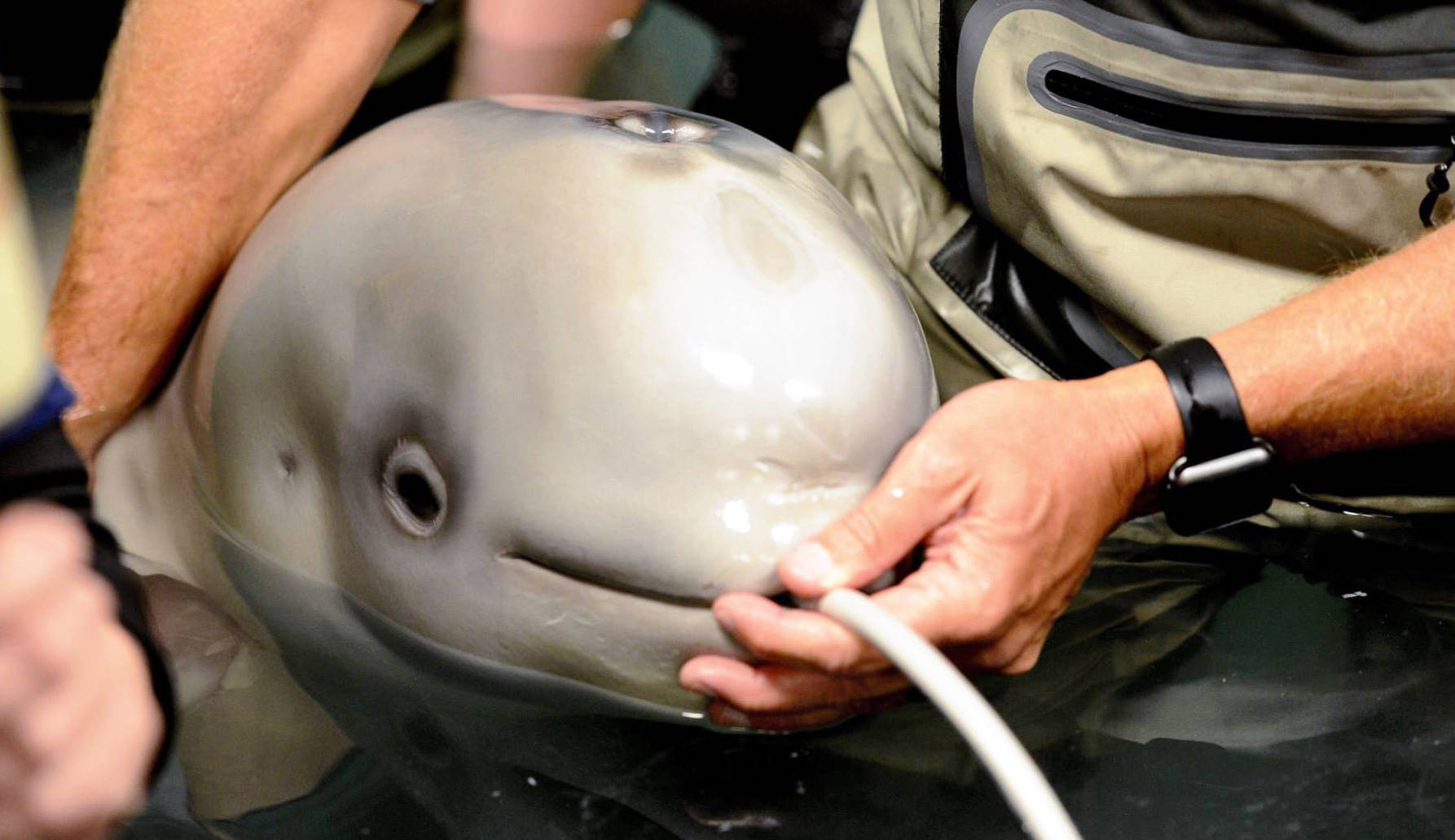
In this October 2017 file photo, volunteers at the Alaska SeaLife Center feed beluga calf Tyonek, who was rescued on Sept. 30, 2017, after he was stranded in Trading Bay. The first Cook Inlet beluga under human care, Tyonek now lives at SeaWorld San Antonio in Texas. (Photo courtesy of Alaska SeaLife Center).                                In this October 2017 file photo, volunteers at the Alaska SeaLife Center feed beluga calf Tyonek, who was rescued on Sept. 30, 2017, after he was stranded in Trading Bay. The first Cook Inlet beluga under human care, Tyonek now lives at SeaWorld San Antonio in Texas. (Photo courtesy of Alaska SeaLife Center).

In this October 2017 file photo, volunteers at the Alaska SeaLife Center feed beluga calf Tyonek, who was rescued on Sept. 30, 2017, after he was stranded in Trading Bay. The first Cook Inlet beluga under human care, Tyonek now lives at SeaWorld San Antonio in Texas. (Photo courtesy of Alaska SeaLife Center). In this October 2017 file photo, volunteers at the Alaska SeaLife Center feed beluga calf Tyonek, who was rescued on Sept. 30, 2017, after he was stranded in Trading Bay. The first Cook Inlet beluga under human care, Tyonek now lives at SeaWorld San Antonio in Texas. (Photo courtesy of Alaska SeaLife Center).

One year after rescue, stranded beluga calf continues recovery

By KAT SORENSEN

Peninsula Clarion

A year after his rescue from a mudflat near Trading Bay, Tyonek the Cook Inlet beluga whale is continuing the rehabilitation process and growing at his new home at SeaWorld San Antonio in Texas.

Tyonek is the first whale from the endangered Cook Inlet population to survive in human care. After the four-week-old whale was rescued on Sept. 30, 2017, Tyonek was brought to the Alaska Sea Life Center in Seward, where he was cared for on a 24/7 basis. He was moved from the Sea Life Center to San Antonio in March 2018.

According to a press release from SeaWorld, Tyonek has reached many encouraging milestones in the year since his rescue and subsequent move south. He’s progressed from being severely underweight, weighing only 140 pounds at 5’3” long, when he was first rescued, to weighing 400 pounds and measuring 6’10” long. He recently started eating fish like herring and capelin as a supplement to his daily bottle feeding.

Tyonek is also benefiting from interactions with SeaWorld San Antonio’s nine other beluga whales.

“We see Tyonek mimicking other whales’ behaviors and playing with toys,” said Dr. Steve Osborn, senior veterinarian at SeaWorld San Antonio. “Tyonek is also swimming and playing, sitting face-to-face, bumping and pushing up against other belugas, all positive signs as he continues to grow and learn.”

This social interaction was one of several reasons that Tyonek was moved to SeaWorld San Antonio. At the beginning of 2018, NOAA Fisheries determined that Tyonek was non-releasable because of nutritional and social dependence and lack of survival and socialization skills needed to lead a successful life in the wild.

“The most important factor for placement of Tyonek was his age and social needs,” said Kate Brogan with NOAA Fisheries Public Affairs when it was announced that Tyonek was being moved to San Antonio. “SeaWorld of Texas has the most appropriate social group to integrate Tyonek, comprising of several mature females that may act as surrogate mothers as well as two young male calves that will provide additional companionship for him as he continues to grow.”

Now, according to SeaWorld, Tyonek is demonstrating common social behaviors and interactions with other belugas.

“Tyonek’s successful rehabilitation and growth is the result of an amazing team effort involving federal authorities, numerous organizations, and rescue and recovery experts in multiple states,” said SeaWorld Chief Zoological Officer Dr. Chris Dold. “Experts from several organizations collaborated to give Tyonek a second chance at life, and his growth, acceptance from the beluga pod and recent milestones are a testament to this team-curated care from many passionate and dedicated professionals.”

Since 1979, the Cook Inlet beluga whale population has declined by nearly 75 percent and is designated as endangered under the Endangered Species Act. NOAA scientists estimated in 2016 the population at about 328, in comparison to 1,300 in 1979.

“We want to thank the Alaska SeaLife Center and our partners in the marine mammal conservation community for the dedicated care that helped rehabilitate Tyonek,” said Assistant Administrator for NOAA Fisheries Chris Oliver. “The permanent placement of Tyonek at SeaWorld San Antonio — and the scientific knowledge gained by learning from him for years to come — will benefit Cook Inlet beluga research and recovery.”

More in News

Jake Dye / Peninsula Clarion
Kenai Peninsula Borough Mayor Peter Micciche speaks during a meeting of the Borough Assembly in Soldotna, Alaska, on Tuesday, May 21, 2024.
Assembly will ask state legislature for authority to enact caps on real property tax assessments

Mayor Peter Micciche said a 34% increase over three years has created “real financial hardships” for many in the borough.

Ryan Tunseth speaks during a meeting of the Kenai Peninsula Borough Assembly in Soldotna, Alaska, on Tuesday, April 1, 2025. (Jake Dye/Peninsula Clarion)
Assembly accepts state funding for community assistance program

The funding will be disbursed to unincorporated communities in the Kenai Peninsula Borough for projects under the state Community Assistance Program.

tease
Soldotna artist awarded Rasmuson Foundation grant

Lester Nelson-Gacal will use the funds to create a handmade, illustrated book about his father’s final year.

State of Alaska Department of Law logo. Photo courtesy of the State of Alaska Department of Law
Kenai man sentenced for sexual abuse of minor, possession of child pornography

Joshua Aseltine was sentenced on Dec. 4 to serve 28 years in prison.

Alaska Department of Natural Resources logo (graphic)
State proposes changes to material sales regulations

The Department of Natural Resources is proposing changes to regulations related to material sales and conveyances to state agencies.

A map depicts the Cook Inlet Area state waters closed to retention of big skates through Dec. 31, 2025. Photo courtesy of the Alaska Department of Fish and Game
Cook Inlet area closed to big skate bycatch retention

The closure is effective in Cook Inlet Area state waters through Dec. 31.

A diagram presented by Seward City Manager Kat Sorenson during a Kenai Peninsula Borough Assembly meeting on Dec. 2, 2025, shows the expected timeline for the Port of Seward Vessel Shore Power Implementation Project. Screenshot
Seward shore power project moves into preliminary design phase

The project will create jobs, reduce cruise ship emissions and provide a backup power grid.

The U.S. Forest Service Porcupine Campground offers gorgeous views of the Kenai Mountains and Turnagain Arm, as seen here on July 20, 2020, near Hope, Alaska. (Photo by Michael Armstrong/Homer News)
Department of Natural Resources seeks public input on proposed Kenai Peninsula State Forest

DNR is gathering community perspectives during several meetings this week.

David Ross is sworn in as Kenai Police Chief on Tuesday, May 31, 2016 at Kenai City Hall. The Alaska Association of Chiefs of Police named Ross the 2025 Police Chief of the Year, recognizing over two decades of service. Photo by Megan Pacer/Peninsula Clarion
Kenai police chief named 2025 Police Chief of the Year

The Alaska Association of Chiefs of Police recognized David Ross for his more than two decades of leadership.

Most Read