
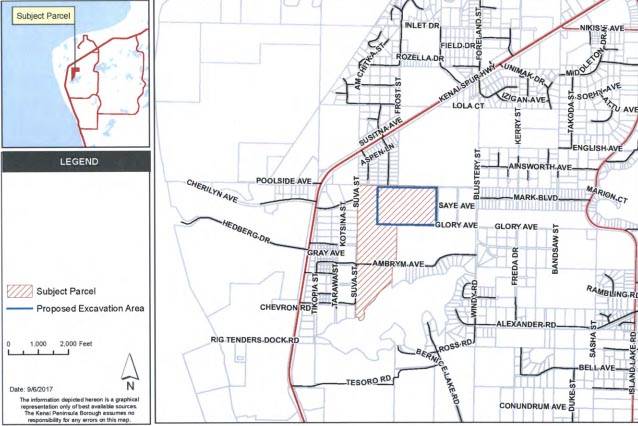
Residents of several adjacent subdivisions in Nikiski will likely have a new neighbor soon: a gravel pit.
Many residents in the Kenai Peninsula Borough outside the cities live with gravel pits a stone’s throw from their front doors. Homeowners on Ciechanski Road off Kalifornsky Beach Road pass a gravel pit on their way home; residents on Murwood Road across K-Beach Road do the same, as do Funny River residents who live past the first mile of the road.
Gravel pits are often the targets of public ire, as they can be loud and busy with trucks coming and going along residential roads. Residents of the Tachatna Park and Forest subdivisions, just across the Kenai Spur Highway from the North Peninsula Recreation Center, protested loudly to the Kenai Peninsula Borough Planning Commission during the discussion over the proposed conditional use permit for gravel extraction from operator Remote Alaska Solutions.
Tachatna Park residents Sean and Michelle Maguire wrote to the Planning Commission asking them to consider several impacts on the neighborhood, including noise, traffic, effects on the water table and safety at the point of entry into the neighborhood.
“(Operator) Remote Alaska Solutions is proposing to use Tachatna Ave. from Kenai Spur Highway, which is on the edge of a dangerous ninety-degree corner that has already taken lives of local residents in the past … add slow and large vehicles and trucks pulling in and out of Tachatna and you have now increased the driving danger level for that corner,” they wrote.
Forest subdivision residents Wayne and Marveen Coggins echoed the concerns about the traffic and added concerns about property values decreasing in the area.
“The permitting process seems bent to help the developer to recoup his investment at the expense of us who own homes there,” they wrote. “We have been diligent to make our mortgage payments every month for the last 13 years (and) find it very sad to think that our equity could be substantially reduced by this project.”
The Planning Commission considered the conditional use permit over several meetings since September and approved it at the Nov. 27 meeting by a 6-4 vote, with several members absent. The permit conditions include stipulations meant to address neighbors’ concerns, like limiting operations to between 7 a.m. and 8 p.m. and spraying the road to control dust.
Outside the city limits of Kenai, Soldotna, Seward and Homer, there are no strict zoning codes. Individual neighborhoods can petition the borough to become a local option zone, which involves a petition process and Kenai Peninsula Borough Assembly approval. Gravel pits require conditional use permits and plans of operation, but as long as they meet the borough’s permit requirements, there aren’t many restrictions on where a pit can be located. The Planning Commission can deny conditional use permits, but risks litigation if the applicant has met all the permit conditions.
The borough planning department is now in the beginning phases of revising the borough’s gravel pit codes, said Planning Director Max Best.
“We’re putting together a good work team,” he said. “… We have a laundry list of things we’ve heard as planning every time, things we’d love to dive into and fix.”
The borough assembly last took on a major revision to the gravel pit code in 2006, adding more permitting requirements and procedures for operators, including avoiding digging into the water tables, controlling noise, dust and hours of operation, among other changes. The process that time was in part driven by concerns about gravel pits in a neighborhood along Ciechanski Road.
One of the instigations for the 2016 revision to the borough code for local option zones was neighbors using the zoning code as a sword to keep gravel pits out of their neighborhoods. People have applied in the past and not wanted any restrictions other than the gravel pit not being allowed to operate, but the zoning code for single-family residential areas includes other restrictions as well.
The department and the Planning Commission often hear concerns about gravel pits near homes, particularly on the issues of noise and water contamination. One of the revisions included in 2006 was a requirement that gravel pit operators operating within the water table conduct monitoring operations. No one has yet applied to do that, Best said — operators have preferred to stay away from the water table — but water safety is one of the issues they’re planning to look at.
The borough planning department does inspections annually on all the gravel pits it has issued conditional use permits for, but there are more than 300 pre-existing gravel pits that the borough has no authority over, Best said.
Reclamation is another issue that neighbors have taken issue with in the past. Technically, as soon as operations are complete in a gravel pit, owners are supposed to restore it in accordance with a reclamation plan submitted to the borough. Some sites also require a bond, which the borough holds as a security so it can restore the land if the operator doesn’t. Bonding is another issue the planning department plans to look at, Best said.
“If there was a bond, we could go in and fix it up,” he said. “Another thing we’re asking for (from the operator) is, ‘What is it going to look like when you’re done?’”
Assembly President Wayne Ogle, who lives near the proposed Nikiski gravel pit site and raised concerns about it to the Planning Commission, is working with the planning department to convene a formal group on gravel pit regulations.
Reach Elizabeth Earl at elizabeth.earl@peninsulaclarion.com.
