
Editors Note: This article has been corrected to correct the spelling of Layton Van Lier’s name.
During the seven-year period that the Kenai River Guide Academy has been mandatory for Kenai River guides the changing fishery has affected what people fish for, how they fish and when they fish, but the one constant has been that people still want to fish glacial blue waters of one of the most popular sport fisheries in the state.
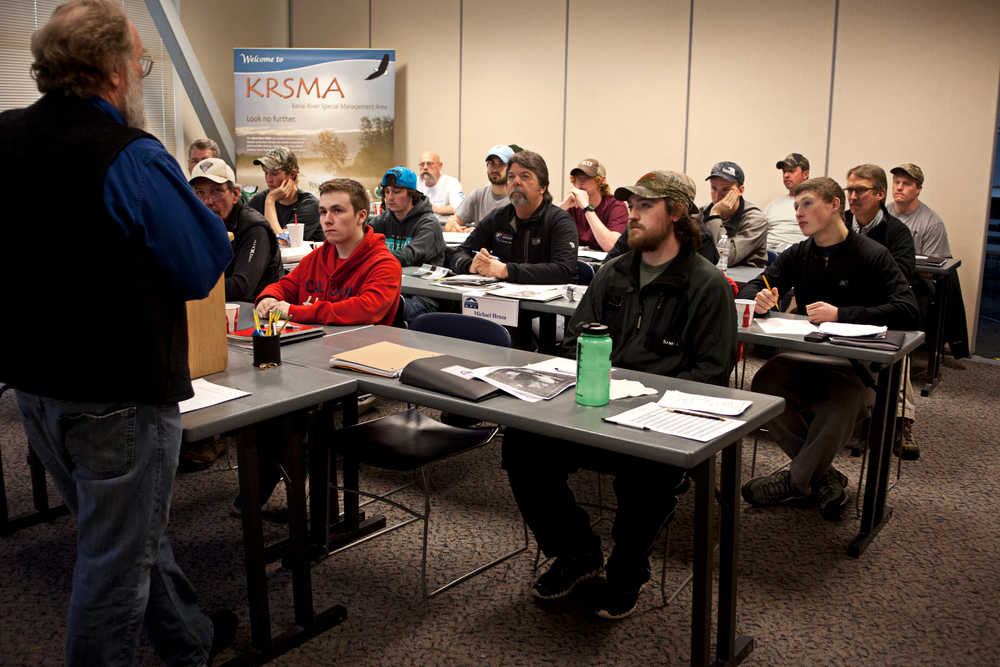
The five-day academy covers everything from proper licensing, angler ethics and fishing regulations to river history, wildlife behavior and stream ecology. Each of the 20 guides who registered for the course passed. Their reasons for taking course ranged from needing a backup river to take fishing clients on to following in the footsteps of a family member. But, several said, whatever they fished for, they were uninterested in guiding for the Kenai River king salmon.
The demographic of guide hopefuls who take the course has changed in recent years, said Gary Turner, director of Kenai Peninsula College Kenai River Campus.
The academy is held in a classroom at the college each year and guides are given the option of staying on-campus.
“Up until probably a year ago, (it) was mostly a focus on motorized (boats) and kings,” Turner said. “Of course, they did other fishing, there were middle and upper river drift boat guides that also came through but probably 70 percent or more were motor-kings.”
Turner said the last two classes seemed to be full of guides who planned to guide for sockeye or trout and kings if they were available.
“They want to expand their resume because the industry is being restricted because of run strength, Turner said.
In late February ADFG announced a preseason closure of fishing for early run Kenai river king salmon citing a preseason forecast that was less than half of what managers needed to reach the lower end of their escapement goal.
The struggling king salmon runs were a topic of conversation after several sessions.
Jake Kooly and Layton Van Lier, both of Soldotna, said they would not be guiding for king salmon during the 2014 season.
“Everybody knows how far down it has gone,” Kooly said. “If there’s another industry that’s going to boom, it’d be the sockeyes. It’s the only thing left,” Kooly said.
Van Lier, who said he would be joining his father’s guide business Alaska Fishing and Lodging, said the family would not be guiding for king salmon next season.
“Last year there were a whole bunch of cancellations, so we just really didn’t want to deal with it this year,” he said.
The decline in king fishing opportunity did not stop either from wanting to become a guide.
Kooly, 18, said he’s been around the Kenai River his entire life.
This year, Kooly said, his boss at Soldotna-based Trustworthy Hardware decided to hire him as a sockeye salmon fishing guide.
“I’ve just loved fishing my whole life and I thought it was a career and a good opportunity for me, that’s why I took it,” Kooly said. “In the winter time, I work for Trustworthy and in the summer time, I’ll just work at the guide service.”
The guide academy class makeup has trended toward younger guides and those who have no experience on the Kenai River in recent years as the course cycled through its timeline of requiring all Kenai River guides to be certified.
The requirements were broken into a tiered system; guides who had been on the river for fewer than six years had to complete the course by May 2008, fewer than 11 by 2009 and 11 years or more by 2011. Any new guides had to take the course before they could get a permit.
Pamela Russell, Alaska State Parks permitting officer said she had not started seeing any of the newly minted guide graduates yet; however, typically license applications do not pick up until late spring.
“The Kenai River ones, the guides come in and see me, or most of them do. They start picking up end of April, May is really big. I don’t know how much that may change with the king salmon restrictions,” Russell said.
The permits are costly, $750 for residents and $1,650 for non-residents annually.
“That’s kind of just the tip of the iceberg for those licenses. They need an Alaska Department of Fish and Game guide license, First Aid, there’s a lot of steps to be completed,” Russell said.
Turner said the guide academy had successfully graduated 629 guides — though less than half of that are currently guiding on the Kenai River.
According to state parks data the number of guides registered to fish on the Kenai has been in steady decline since 2007 when it peaked at 396 guides before dropping to 284 during the 2013 fishing season.
Gary Chamberlain, owner of Great Totem Charters in Sterling, said he saw several younger faces in the class.
“These guys are kind of new and fresh and most of them haven’t really done hardly anything on the river,” Chamberlain said. “Most of them, I think, from what I’ve heard and when they talk to me afterward, they really enjoy hearing a lot of stuff from — I guess you’d call it older and more experienced guides.”
The shift in age is bittersweet for Chamberlain.
“I feel some of them probably won’t be around too long,” he said. “We get a lot of, like those younger kids — one is in high school, a couple of them just graduated. Most of the, that I’ve seen, I think they’re here to try and make a little bit of money for college. For a young guy in this day and age, I don’t see a real big future. Some of us … we’re too old to try and do something else. These younger ones, they have more opportunities to try and go up and get a better future or education.”
Some guides, like Ard Stetts, owner and guide at Life on the Line, said they could see a future in fishing for something other than kings on the Kenai River.
Stetts said he was getting certified for multiple reasons.
Stetts said he specializes in fly and spey fishing and primarily fishes in the Yentna drainage, an area that flows into the Susitna River, and the Skwentna drainage, which sits in the southwest corner of the Matanuska-Susitna borough.
There, he can fish for days without seeing anyone else, Stetts said. But, as the area floods, it becomes harder to fish.
“I wanted like a safety valve, a fail-safe thing,” Stetts said. “I probably won’t use it because of all the (regulations).”
The complexity of regulations on the Kenai River was something of a running joke during some of the sessions.
Stetts said reading through the Kenai River regulations required a translator — or the ability to pick up a new language.
On the Kenai River, Stetts said, seeing Alaska Department of Fish and Game officials was nervewracking.
“When you see (Fish and Game) coming down here, it’s like you’re seeing red and blue lights in your rearview mirror and you’ve got 20 pounds of high grade pot in your trunk,” he said. “You have to be paranoid.”
Rob Barto, a U.S. Fish and Wildlife Service law enforcement officer taught a class that involved several scenarios that guides could be confronted with on the river.
Barto said the class was designed to help guides understand the complex rules and regulations on the river and how to act professionally in some situations on the river that could provoke confrontation.
“Any time you can get the young guides with the old guides and hopefully they can talk a little bit, things get better,” he said.
The large class size did not surprise Barto, who said the Kenai River was a special place.
“There’s going to be some skinny times, so to speak, for the next five to six years. But it’s going to rebound and the folks who want to fish in the future want to do it right. I thought there’d be more, frankly.”
The next guide academy is scheduled to begin April 28; however, all 25 spots have been reserved and a waitlist is in place.
