
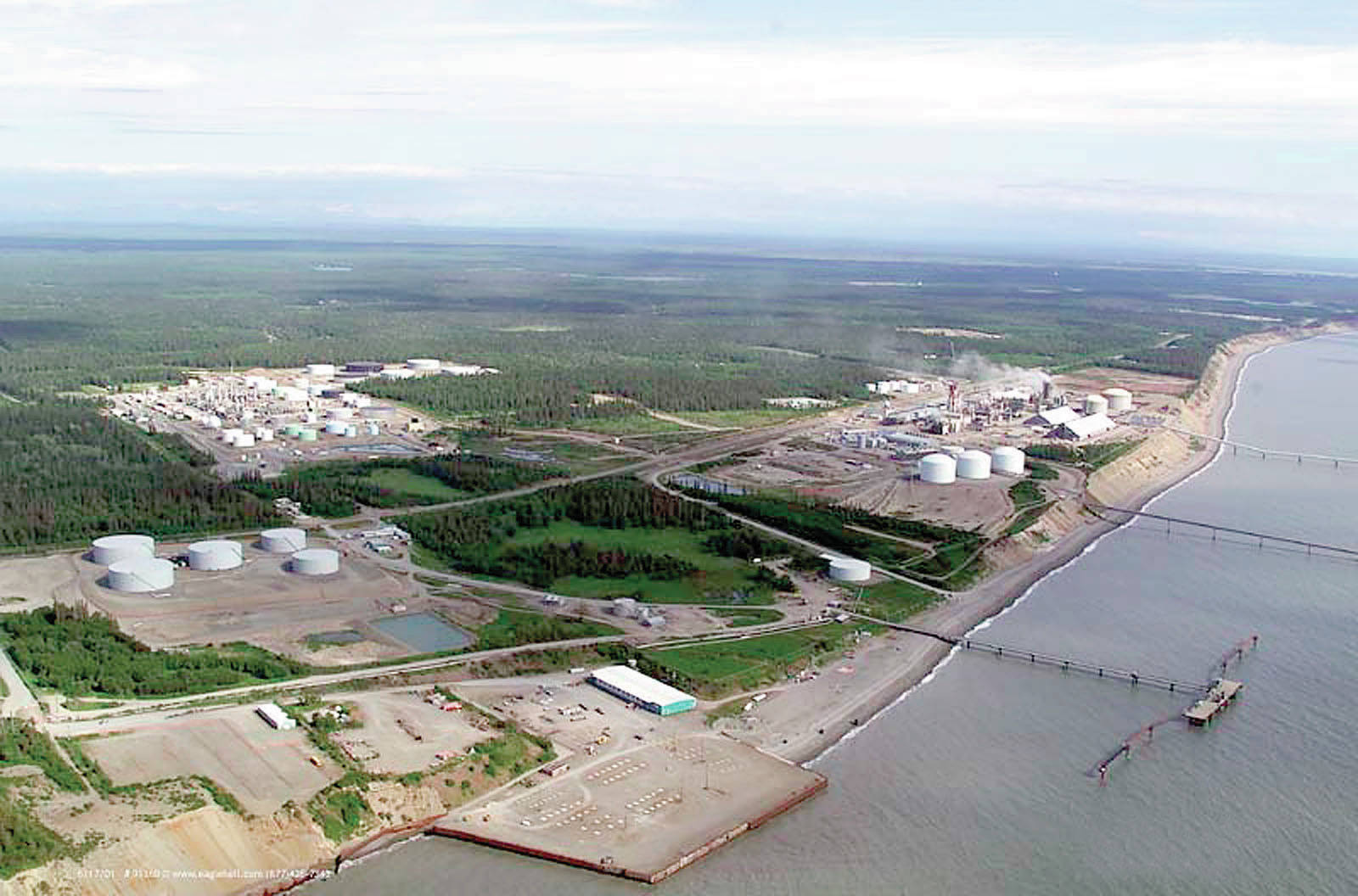
Will Nikiski residents ever see an LNG pipeline in their backyard?
The answer to that remains unclear, but those still involved with the project are hoping that the completion of the Environmental Impact Statement (EIS) and the acquisition of necessary permits from the Federal Energy Regulatory Commission will be enough to attract potential investors, producers and customers.
Jesse Carlstrom, communications manager for Alaska Gasline Development Corp (AGDC), said in an email that the corporation’s board of directors and stakeholders will convene later this spring to review their assessment of Alaska LNG’s economic competitiveness with other LNG projects around the world. According to Carlstrom and others in the AGDC, as well as the AK LNG Project Advisory Committee, AGDC will only continue to pursue the project as long as it is still an economic benefit to the state.
There is precedent for this approach, as AGDC interim President Joe Dubler explained during a hearing with the Senate Resources Committee on March 22. Dubler said that the Alaska Stand Alone Pipeline (ASAP) project is currently on a permanent hold after AGDC determined that operating the ASAP pipeline would require annual subsidies and thus would be a net negative for the state’s budget. If AGDC makes a similar assessment of the LNG project, it could spell the end for any hopes that natural gas will be exported out of Nikiski.
The Alaska LNG pipeline has been in the works since at least January of 2014, when AGDC signed a Heads of Agreement (HOA) with ExxonMobil, BP, ConocoPhillips, and TransCanada Corp. The HOA was essentially a non-binding letter of intent that signaled the cooperation of these entities in forming the commercial structure of the project. It was a signal to the people of Alaska that these major energy corporations were on board with exploring the feasibility of the Alaska LNG pipeline. In the four years since this agreement was signed, the political and economic landscape in Alaska has changed drastically.
In 2015 the state bought out TransCanada’s share of the project, and in 2016 BP, ExxonMobil and ConocoPhillips backed out of the project as well, leaving the state and AGDC to continue working on the project alone. Dubler said in the March 22 hearing that “economics at the time precluded Front-End Engineering and Design (FEED) initiation.” When asked by Sen. Kawasaki, D-Fairbanks, to elaborate on why the energy companies decided to back out, Dubler explained that costs associated with acquiring permits and determining environmental impact, a process Dubler called “de-risking,” is not a cost that investors typically see as worthwhile. Dubler said that it is traditionally the responsibility of the owner or producer of a resource to “de-risk” the project before investors come into the picture.
The governor’s office has also changed administrations twice since the project was first introduced, and Gov. Mike Dunleavy’s team has made it clear that reducing the state’s budget is a top priority. When the administration released its budget for fiscal year 2020, it included a significantly reduced $10.1 million budget for AGDC. Dubler said during the March 22 hearing that this funding is sufficient to complete the environmental impact statement by March of 2020. AGDC has cut back on expenditures by closing their Houston office and consolidating their Anchorage office, Dubler said during the March 22 hearing. To date, AGDC has spent more than $260 million on the Alaska LNG project.
In March 25 interview with the Clarion, Dunleavy was hesitant to commit to the project.
“If AGDC through their economic study determines that it (Alaska LNG) is not economical or it’s not feasible, I’m not sure why we would continue with a non-economic project,” he said. Dunleavy went on to say that he will wait on ADGC’s report, which is due out in about 50 days, before making a final decision.
There are portions of land in Nikiski that BP, ExxonMobil, and ConocoPhillips purchased when they were still involved in the LNG project. Those lands are still owned by the three energy companies even though they gave up their share of the project in 2016. BP and ExxonMobil recently signed a non-binding agreement with AGDC on March 11 that indicated their renewed interest in advancing the Alaska LNG project, but the fate of the lands that have already been purchased has yet to be determined.
AGDC and the state are taking a step back to re-evaluate the economic feasibility of the project and have chosen to focus their currently available resources on completing the Environmental Impact Statement. The EIS remains valid for up to seven years, meaning that completing the process will leave the door open for further development on the LNG project in the years to come. So, while the LNG project is still in the proverbial pipeline, Dubler said that actual pipelines will not be going into the ground any time soon.
