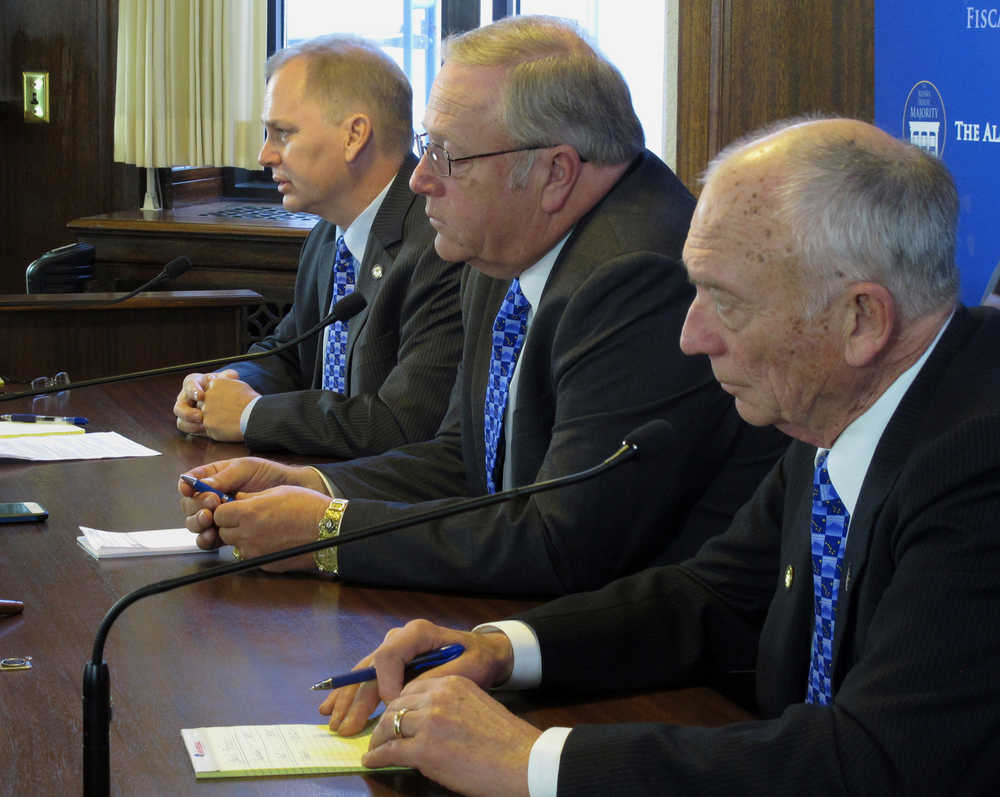
Members of the Alaska House majority speak to members of the media on the first day of the Legislature's third special session this year on Saturday, Oct. 24, 2015, in Juneau, Alaska. The focus of the special session is on the proposed buy out of TransCanada Corp. from the gas project the state is pursuing. Pictured from the top are Reps. Mark Neuman, Mike Chenault and Steve Thompson. Neuman and Thompson are co-chairs of the House Finance Committee; Chenault is the House speaker. (AP Photo/Becky Bohrer)

Members of the Alaska House majority speak to members of the media on the first day of the Legislature's third special session this year on Saturday, Oct. 24, 2015, in Juneau, Alaska. The focus of the special session is on the proposed buy out of TransCanada Corp. from the gas project the state is pursuing. Pictured from the top are Reps. Mark Neuman, Mike Chenault and Steve Thompson. Neuman and Thompson are co-chairs of the House Finance Committee; Chenault is the House speaker. (AP Photo/Becky Bohrer)

Legislative session’s focus narrowed to TransCanada buyout

  • By Becky Bohrer
  • Saturday, October 24, 2015 10:10pm
  • News

JUNEAU, Alaska — Gov. Bill Walker’s administration began making its case for why the state should buy out one of its partners in a proposed liquefied natural gas project as legislators opened a special session on the issue Saturday.

A decision on whether to buyout TransCanada Corp. and approve buyout-related costs is all that remains on the agenda after Walker announced Friday that he was pulling the other agenda item — a gas reserves tax — after receiving written assurances from two of the state’s producer-partners, BP and ConocoPhillips, that they would be willing to make gas available to a gas project if they are not participating. Terms still must be finalized.

Walker said he hoped the remaining producer partner, Exxon Mobil Corp., would make a similar commitment.

Saturday began with an overview briefing by the administration and consultants on gas project-related issues, with the administration arguing that a buyout of TransCanada would give the state a greater say in the project.

The House Finance Committee held its first hearing on the proposal Saturday afternoon.

As a candidate last year, Walker was critical of the process under which the state was pursuing the project with BP, Exxon Mobil, ConocoPhillips, TransCanada and the Alaska Gasline Development Corp.

Under the arrangement, TransCanada would hold the state’s interest in the pipeline and gas treatment plant. The state can exercise an option by year’s end to buy a portion of that interest, but Walker wants a full buyout, in which case the state would reimburse the company for its development costs, plus 7.1 percent interest.

Walker’s bill seeks about $158 million in buyout- and project-related costs, including $13.6 million for state agency work on the project.

While a buyout could mean higher investment costs for the state of $7 billion to $8 billion, Alaska could get to up to $400 million more a year in cash flows during operation based on an expectation that the state could finance cheaper than TransCanada, legislators, aides and others were told during the overview by Deepa Poduval, with consultant Black and Veatch, which is working with the administration.

During legislative debate surrounding the pipeline project in 2014, TransCanada’s involvement was cast as a way for the state to not have to bear as much in upfront costs. It also gave the state and TransCanada a way out of a prior, failed gas line arrangement without a messy fight.

Senate Minority Leader Berta Gardner, D-Anchorage, said TransCanada effectively is acting as a banker under the arrangement. In fiscal terms, she said she doesn’t see a downside at this point to buying their position out.

Republican legislative leaders said they need to better understand the implications of any buy out and the assumptions used by the administration.

The Legislature has its own consultants that will help review the administration’s proposal.

Senate Finance Committee co-chair Anna MacKinnon, R-Eagle River, said the Legislature has to look at such things as whether this would advance a pipeline and how the state will pay for its share of the financial obligation.

House Speaker Mike Chenault, R-Nikiski, said the Legislature needs to make sure the decision made is sound for business, “because if it’s not, it puts Alaska in more jeopardy than what we currently are in.”

Alaska is grappling with multibillion-dollar deficits amid low oil prices.

The long hoped-for gas line is seen as key to Alaska’s future fiscal fortunes.

More in News

File.
Soldotna aims to change short-term rental tax and permitting

Public hearings for two ordinances addressing existing short-term rental regulations will occur during the next city council meeting on Jan. 14.

Low clouds hang over Cook Inlet north of Anchor Point on Oct. 23, 2025. (Photo by Yereth Rosen/Alaska Beacon)
Inletkeeper condemns federal management of Cook Inlet oil lease sale

The agency alleges an environmental study by the Bureau of Ocean Energy Management was conducted with a “serious” lack of transparency.

The Kenai Chamber of Commerce announced the winners of the 13th annual gingerbread house competition on Dec. 20, 2025. This creation by Sierra won the 2-5 year old age category. Photo courtesy of the Kenai Chamber of Commerce
Wrapping up the holiday season

The Kenai Chamber of Commerce’s Angel Tree program and gingerbread house competition spread Christmas cheer to hundreds locally.

The Challenger Learning Center is seen here in Kenai<ins>, Alaska,</ins> on Sept. 10, 2020. (Photo by Brian Mazurek/Peninsula Clarion)
Kenai City Council considers possible uses for Challenger Center

One option would assess the facility’s potential as the new public safety building.

A snowmachine rider takes advantage of 2 feet of fresh snow on a field down Murwood Avenue in Soldotna, Alaska, on Monday, Dec. 12, 2022. (Jake Dye/Peninsula Clarion)
Ice fishing opens on some Kenai National Wildlife Refuge lakes

Snowmachines are permitted for ice fishing access on Hidden, Kelly, Petersen, Engineer and Watson lakes.

The waters of Cook Inlet lap against Nikishka Beach in Nikiski, Alaska, where several local fish sites are located, on Friday, March 24, 2023. (Jake Dye/Peninsula Clarion)
Kenai asks for fishery economic disaster declaration

The Kenai City Council requested that Gov. Dunleavy declare a disaster and support a recovery plan for the Upper Cook Inlet East Side Set Net fishery.

The Kenai Peninsula Borough School District logo. (Photo courtesy of Kenai Peninsula Borough School District)
District superintendent dispels rumors about student construction

Superintendent Clayton Holland said student involvement in Seward High School construction is “based on rumor, not fact.”

Anchorage-based singer and songwriter Keeley Boyle is pictured in Anchorage<ins>, Alaska,</ins> on Sept. 26, 2023. Boyle, who was raised on the Kenai Peninsula, will use a $10,000 grant she received from the Rasmuson Foundation to create an album of songs about her grandparents’ home in Nikiski. Photo courtesy of Jovell Rennie
Musician hailing from Kenai receives Rasmuson grant

Keeley Boyle will record an album of songs about her grandparents’ Nikiski home.

Commercial fishing and recreational vessels are docked in the Homer harbor on Oct. 23, 2025. The commercial fishing industry endured a series of challenges over the year, some of them imposed by the new Trump administration. (Photo by Yereth Rosen/Alaska Beacon)
Alaska fisheries in 2025: turmoil, economic and environmental challenges and some bright spots

NOAA cuts, economic headwinds and invasive species pose problems, but there was some recovery in crab stocks and salmon harvests.

Most Read