
Peter Segall / Juneau Empire File
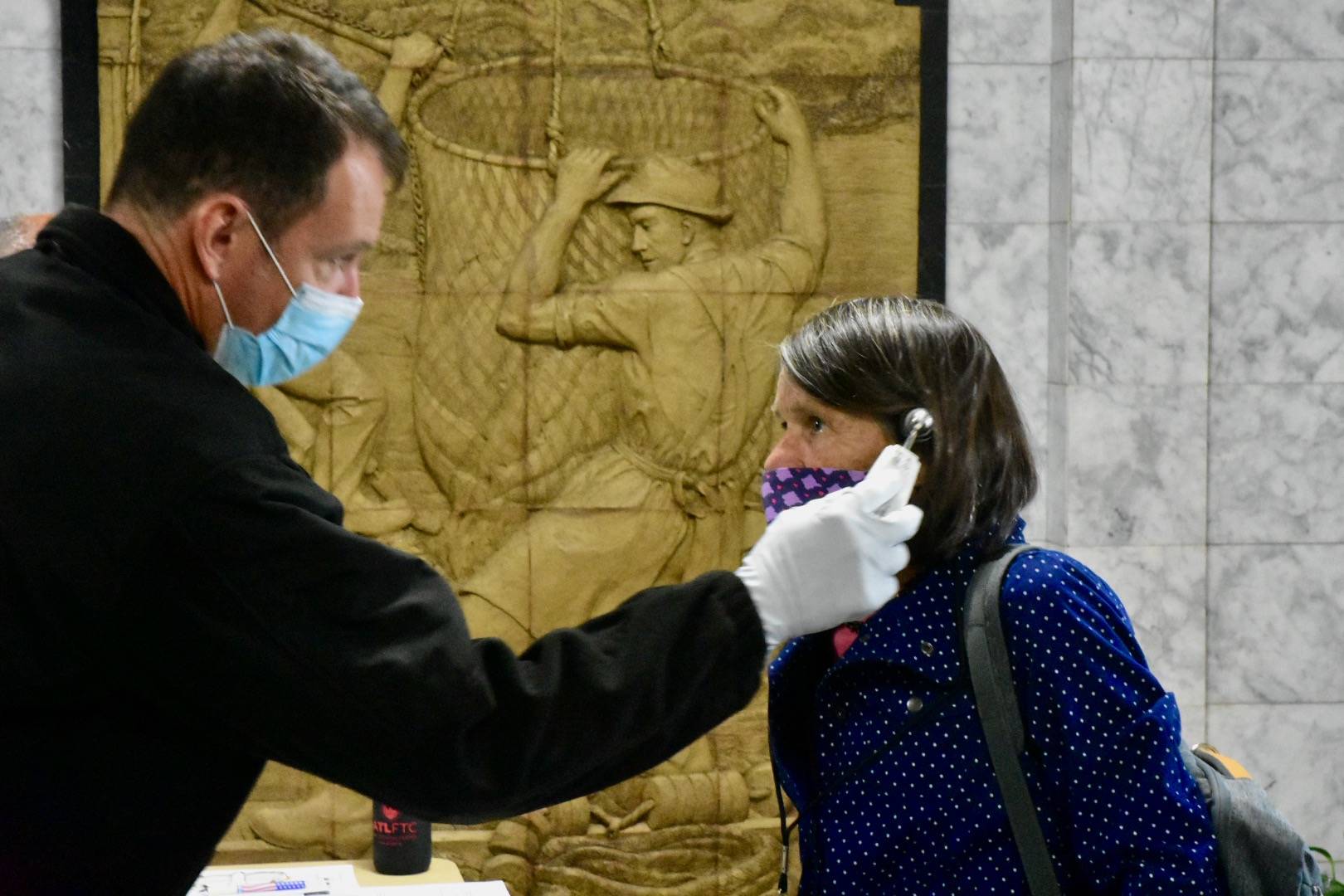
Rep. Jennifer Johnston, R-Anchorage, gets her temperature taken as she enters the Alaska State Capitol on Monday, May 18, 2020. New policies will require all staff and legislators to wear masks in chambers.

Peter Segall / Juneau Empire File Rep. Jennifer Johnston, R-Anchorage, gets her temperature taken as she enters the Alaska State Capitol on Monday, May 18, 2020. New policies will require all staff and legislators to wear masks in chambers.

Legislative Council sets mask policy for upcoming session

Only one representative out of twelve legislators voted against the mask policy.

When the Alaska State Legislature convenes in mid-January, lawmakers will be wearing masks — or they’ll be doing the business of the people from their office.

“We’re just trying to make it as safe as possible. I have been surprised to learn how many of our employees as well as legislators have underlying health issues,” Sen. Gary Stevens, R-Kodiak, who is chair of the Legislative Council, said in a phone interview. “It’s a serious issue, wearing a mask. There are people who disagree with that, but this is now our policy.”

The council met electronically on Monday to set out rules and guidelines for the upcoming session, assisted by the state’s chief medical officer Dr. Anne Zink. The council voted the Safe Floor Session Policy and its enforcement policy in identical 11-1 votes, with Rep. DeLena Johnson, R-Palmer, being the sole opposed vote in each case. This will remain the policy unless a future Legislative Council changes it, Stevens said.

“Safe or not safe is always a continuum,” Zink said. “It is by far the clinical consensus at this time that wearing a mask prevents you from spreading or getting the virus that carries COVID-19.”

Measures lined out in the policy include forbidding congregating, remaining seated when speaking, plexiglass dividers being put in place and barring the media from the chambers or galleries to mitigate possible spread of disease.

[No polar bears in Juneau: Dip canceled for pandemic]

“We did decide to ask the media not to be on the floor of the House or Senate,” Steven said. “I’m sorry we had to do that. It was the only way we could find the way to do that.”

Additionally, policy states that members of the Legislature who refuse to have their temperature taken or answer health screening questions will be denied entry to the state Capitol. Members who refuse to wear a mask may work in their office but will be barred from the chambers. Sen. Tom Begich, D-Anchorage, likened the mask rules to current rules that prevent a man not wearing a necktie from being on the floor of either chamber.

“If you refuse to wear a mask or take a test, you can’t wander the building,” Stevens said. “You can go to your office and work.”

Other accommodations may be made if a legislator refuses to wear a mask.

“Constitutionally, we have to make sure no legislator is excluded from voting. There’s an entirely separate system that’s just for voting. That’s the crucial thing: That people have access to voting,” Stevens said. “The reality of course is that it’s not as perfect as being in-person. But under the circumstances, it’s the best we can do.”

The political body is constitutionally obliged to meet in person, Steven said.

“Constitutionally we can’t meet remotely until we pass a bill. If things are reasonable we’ll probably stay there for 90 days,” Stevens said. “The one thing we have to do is the budget. I believe we should really concentrate on the budget and kick that out as early as possible.”

The Legislature will bring between 200-300 people to Juneau, Stevens said.

“They’re coming from all over the state. Some places it’s pretty good, some places are pretty bad,” Stevens said. “We’re coming into a city that’s been very hospitable to us.”

Stevens said he’s not going to Juneau’s bar, and he’s encouraging those that work for him to abstain as well.

“We have an obligation to Juneau. We want to make sure we’re not inflicting anything on Juneau,” Stevens said. “We’re hoping that people will follow local regulations.”

Read the enforcement policy below:

Contact reporter Michael S. Lockett at (757) 621-1197 or mlockett@juneauempire.com.

More in News

David Ross is sworn in as Kenai Police Chief on Tuesday, May 31, 2016 at Kenai City Hall. The Alaska Association of Chiefs of Police named Ross the 2025 Police Chief of the Year, recognizing over two decades of service. Photo by Megan Pacer/Peninsula Clarion
Kenai police chief named 2025 Police Chief of the Year

The Alaska Association of Chiefs of Police recognized David Ross for his more than two decades of leadership.

The cast of Nikiski Middle School’s upcoming performance of “Alice in Wonderland” is pictured on Dec. 2, 2025. The upperclassmen-directed play opens on Friday, with additional showtimes Saturday and next weekend. Photo courtesy of Carla Jenness
Nikiski Middle School debuts student-led “Alice in Wonderland”

The show opens on Friday, with additional showtimes this weekend and next.

On Tuesday, the Kenaitze Indian Tribe unveiled Kahtnu Area Transit, a public transportation service open to the entire Peninsula Borough community. Photo courtesy of Kahtnu Area Transit
Kenaitze Indian Tribe unveils Kahtnu Area Transit

The fixed bus route offers 13 stops between Nikiski and Sterling.

The Kenai Chamber of Commerce and Visitor Center hosts the annual Christmas Comes to Kenai on Nov. 28<ins>, 2025</ins>. The beloved event began over 40 years ago, and this year over 1,000 attendees enjoyed hot chocolate, fireworks, pictures with Santa and shopping. Photo courtesy of the Kenai Chamber of Commerce
 Photo courtesy of the Kenai Chamber of Commerce
The Kenai Chamber of Commerce and Visitor Center hosted the annual Christmas Comes to Kenai on Nov. 28. The beloved event began over 40 years ago, and this year over 1,000 attendees enjoyed hot chocolate, fireworks, pictures with Santa and shopping.
Kicking off a month of holiday festivities

Last weekend’s holiday events, including the annual Christmas Comes to Kenai and the Soldotna Turkey Trot, drew folks from all over the Kenai Peninsula.

Starting Dec. 2, Aleutian Airways will offer roundtrip flights between Anchorage and Unalakleet every Tuesday, Friday and Sunday.
Aleutian Airways to offer roundtrip flights between Anchorage and Unalakleet

Starting Dec. 2, Aleutian Airways will offer three roundtrip flights per week.

The Trump administration’s “Big Beautiful Bill” act requires the Bureau of Ocean Energy management to hold at least six offshore oil and gas lease sales in Alaska between 2026-2028 and 2030-2032. The first of these sales — known as “Big Beautiful Cook Inlet 1,” or BBC1— is scheduled for March 2026. Photo courtesy of the Bureau of Ocean Energy Management
Cook Inletkeeper launches petition against federal government

The organization is calling for transparency in Cook Inlet offshore oil and gas sales.

Winter dining has always carried more weight than the menu might suggest. In the off-season, eating out isn’t just about comfort food or convenience; it’s a way of supporting local businesses as they hold steady through the slower months. Photo credit: Canva.
The ripple effect: How local spending builds stronger communities on the Kenai Peninsula

From cozy cafés to fine-dining bistros, purchases made close to home sustain local jobs and services

Courtesy Harvest
On the Kenai Peninsula, a dormant liquefied natural gas export plant could be repurposed to receive cargoes of imported LNG under a plan being studied by Harvest, an affiliate of oil and gas company Hilcorp. The fuel would be transferred from ships to the tanks on the left, still in liquid form, before being converted back into gas and sent into a pipeline.
Utilities say Alaska needs an LNG import terminal. Consumers could end up paying for two.

Planning for two separate projects is currently moving ahead.

A map shows the locations of the 21 Alaska federal offshore oil and gas lease sales proposed by the Trump administration. (Map provided by the U.S. Bureau of Ocean Energy Management)
Trump administration proposes offshore leasing in almost all Alaska waters

A new five-year offshore oil and gas leasing plan proposes 21 sales in Alaska, from the Gulf of Alaska to the High Arctic, and 13 more off the U.S. West Coast and in the Gulf of Mexico.

Most Read