
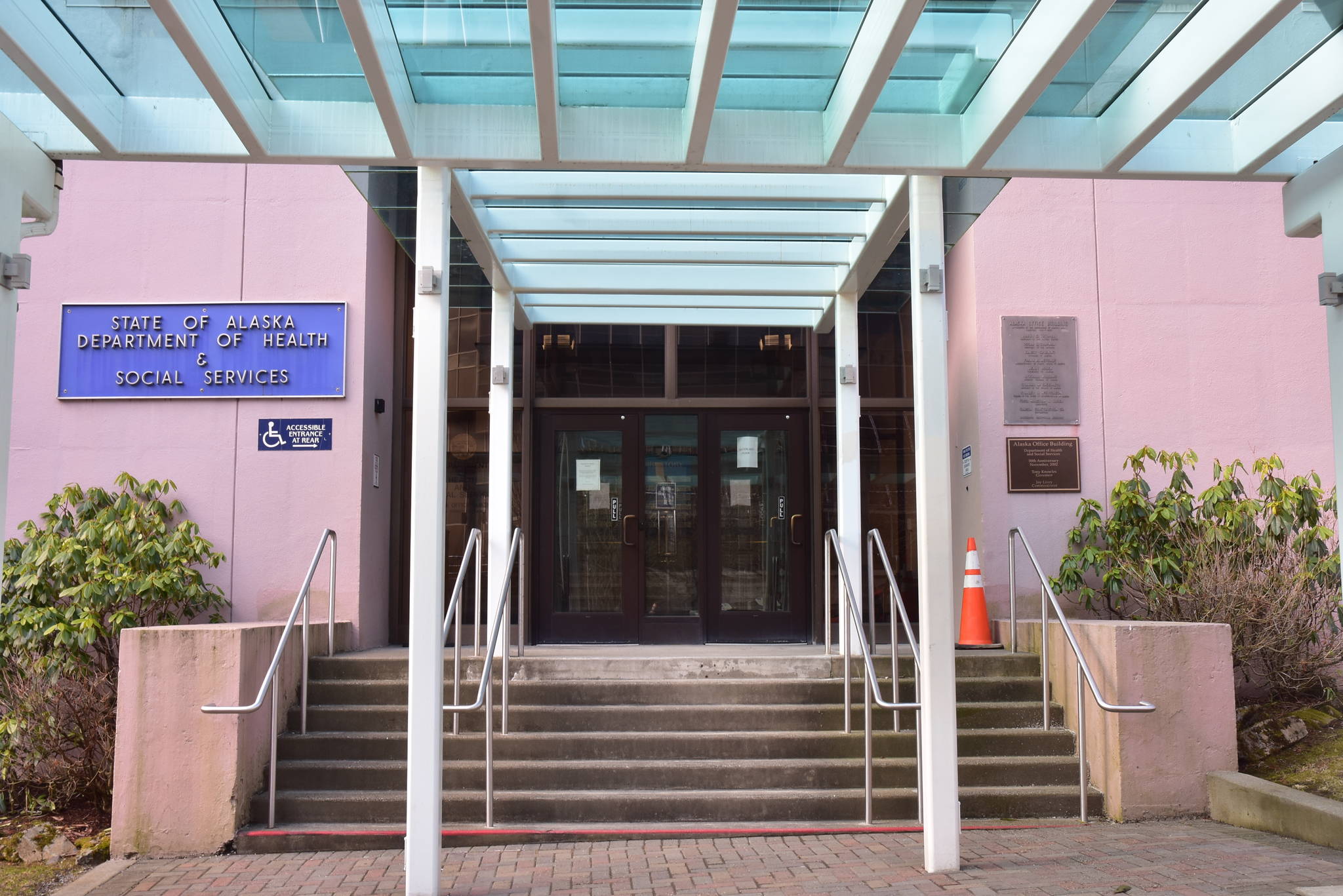
The Department of Health and Social Services, its headquarters seen here in Juneau on Monday, March 8, 2021, could be split into two departments by an executive order from the governor. However, some lawmakers have raised concern about the legality of the order, saying it could lead to costly litigation. (Peter Segall / Juneau Empire)

The Department of Health and Social Services, its headquarters seen here in Juneau on Monday, March 8, 2021, could be split into two departments by an executive order from the governor. However, some lawmakers have raised concern about the legality of the order, saying it could lead to costly litigation. (Peter Segall / Juneau Empire)

Lawmakers question whether proposed department split is legal

Governor maintains executive order is within his powers, others are less sure.

Lawmakers are questioning the legality of Gov. Mike Dunleavy’s use of an executive order to split the Department of Health and Social Services, saying the move would open the state to costly litigation.

At a House Health and Social Services Committee meeting Saturday, lawmakers reviewed a letter from the Legislative Legal Division outlining dozens of instances in which the executive order made substantive changes to existing law, something not allowed by executive order.

Many groups — notably tribal health care groups — have voiced opposition to the split, but in an interview Monday, Sen. Bill Wielechowski, D-Anchorage, said regardless of the intended effects of the split, the executive order being used to accomplish it is a violation of the state constitution.

“The constitution gives the governor the right to reorganize departments; however, that does not give the governor carte blanche to enact substantive law and that is what he’s doing,” Wielechowski said. “It’s written like a piece of legislation. There are at least 36 different substantive changes that our legislative attorneys have identified.”

Big changes

Wielechowski said his argument was not necessarily against splitting the state’s largest department, but against the way the governor was choosing to do it. He pointed to the legal memo which says proposed changes such as preventing registered nurses from pronouncing the death of a patient at an Alaska pioneers’ home or Alaska veterans home and adding board members to several commissions constitute substantive changes to existing law.

[Health department split would hurt Alaska Natives, leaders say]

“It appears that this executive order would impermissibly create substantive changes to existing law. However, this is a lengthy, complex, and dense executive order and it is possible that additional legal questions and issues may exist,” states the memo, written by Andrew Dunmire, legislative counsel for the Legislative Legal Division.

The governor’s office counters the proposed changes fall well within the purview of a governor’s executive order, and provide examples of other orders that included substantive changes. A Feb. 24 memo from the acting Attorney General Treg Taylor to the Senate Finance Committee notes a 2003 order under former Gov. Frank Murkowski that reorganized DHSS, including moving the Division of Senior Services and the Alaska Pioneer Homes from the Department of Administration to DHSS.

“Gov. Dunleavy is simply exercising his authority to improve the level of services provided by the department through a reorganization,” Dunleavy spokesperson Jeff Turner said in an email.

Litigation lurking

As to the line between substantive changes and lesser ones, Dunmire told lawmakers there was a lot of gray area and his memo tried to detail that. Dunmire cited the issue with nurses at the pioneers’ homes as a substantial change, saying the proposal would substantively alter their duties.

Those are the kinds of changes that could lead to litigation, Weleichowski said. Changes to the duties of public employees could lead to legal challenge from unions, he said, who were just one of many groups who might bring litigation.

The governor introduced his proposal late last year, and the suggestion was met with immediate opposition from health care and tribal groups. The executive order was introduced into the Legislature on Jan. 25, and lawmakers have 60 days to disapprove. If they fail to act by March 24, the order automatically goes into effect.

The changes in the order, including splitting DHSS into the Department of Health and the Department of Family and Community Services, would be implemented July 1, 2021, according to the governor’s office.

A special concurrent resolution has already been drafted to disapprove of the order, and needs only a simple majority of a joint session of the Legislature to pass. However, with current health mitigation rules in place, lawmakers have yet to find a way to hold a joint session.

But Weleichowski said he was optimistic the memo would raise a few eyebrows and motivate lawmakers to act.

“The Legislature is able to move very quickly when it wants to,” he said.

Contact reporter Peter Segall at psegall@juneauempire.com.

Follow him on Twitter at @SegallJnuEmpire.

More in News

David Ross is sworn in as Kenai Police Chief on Tuesday, May 31, 2016 at Kenai City Hall. The Alaska Association of Chiefs of Police named Ross the 2025 Police Chief of the Year, recognizing over two decades of service. Photo by Megan Pacer/Peninsula Clarion
Kenai police chief named 2025 Police Chief of the Year

The Alaska Association of Chiefs of Police recognized David Ross for his more than two decades of leadership.

The cast of Nikiski Middle School’s upcoming performance of “Alice in Wonderland” is pictured on Dec. 2, 2025. The upperclassmen-directed play opens on Friday, with additional showtimes Saturday and next weekend. Photo courtesy of Carla Jenness
Nikiski Middle School debuts student-led “Alice in Wonderland”

The show opens on Friday, with additional showtimes this weekend and next.

On Tuesday, the Kenaitze Indian Tribe unveiled Kahtnu Area Transit, a public transportation service open to the entire Peninsula Borough community. Photo courtesy of Kahtnu Area Transit
Kenaitze Indian Tribe unveils Kahtnu Area Transit

The fixed bus route offers 13 stops between Nikiski and Sterling.

The Kenai Chamber of Commerce and Visitor Center hosts the annual Christmas Comes to Kenai on Nov. 28<ins>, 2025</ins>. The beloved event began over 40 years ago, and this year over 1,000 attendees enjoyed hot chocolate, fireworks, pictures with Santa and shopping. Photo courtesy of the Kenai Chamber of Commerce
 Photo courtesy of the Kenai Chamber of Commerce
The Kenai Chamber of Commerce and Visitor Center hosted the annual Christmas Comes to Kenai on Nov. 28. The beloved event began over 40 years ago, and this year over 1,000 attendees enjoyed hot chocolate, fireworks, pictures with Santa and shopping.
Kicking off a month of holiday festivities

Last weekend’s holiday events, including the annual Christmas Comes to Kenai and the Soldotna Turkey Trot, drew folks from all over the Kenai Peninsula.

Starting Dec. 2, Aleutian Airways will offer roundtrip flights between Anchorage and Unalakleet every Tuesday, Friday and Sunday.
Aleutian Airways to offer roundtrip flights between Anchorage and Unalakleet

Starting Dec. 2, Aleutian Airways will offer three roundtrip flights per week.

The Trump administration’s “Big Beautiful Bill” act requires the Bureau of Ocean Energy management to hold at least six offshore oil and gas lease sales in Alaska between 2026-2028 and 2030-2032. The first of these sales — known as “Big Beautiful Cook Inlet 1,” or BBC1— is scheduled for March 2026. Photo courtesy of the Bureau of Ocean Energy Management
Cook Inletkeeper launches petition against federal government

The organization is calling for transparency in Cook Inlet offshore oil and gas sales.

Winter dining has always carried more weight than the menu might suggest. In the off-season, eating out isn’t just about comfort food or convenience; it’s a way of supporting local businesses as they hold steady through the slower months. Photo credit: Canva.
The ripple effect: How local spending builds stronger communities on the Kenai Peninsula

From cozy cafés to fine-dining bistros, purchases made close to home sustain local jobs and services

Courtesy Harvest
On the Kenai Peninsula, a dormant liquefied natural gas export plant could be repurposed to receive cargoes of imported LNG under a plan being studied by Harvest, an affiliate of oil and gas company Hilcorp. The fuel would be transferred from ships to the tanks on the left, still in liquid form, before being converted back into gas and sent into a pipeline.
Utilities say Alaska needs an LNG import terminal. Consumers could end up paying for two.

Planning for two separate projects is currently moving ahead.

A map shows the locations of the 21 Alaska federal offshore oil and gas lease sales proposed by the Trump administration. (Map provided by the U.S. Bureau of Ocean Energy Management)
Trump administration proposes offshore leasing in almost all Alaska waters

A new five-year offshore oil and gas leasing plan proposes 21 sales in Alaska, from the Gulf of Alaska to the High Arctic, and 13 more off the U.S. West Coast and in the Gulf of Mexico.

Most Read