
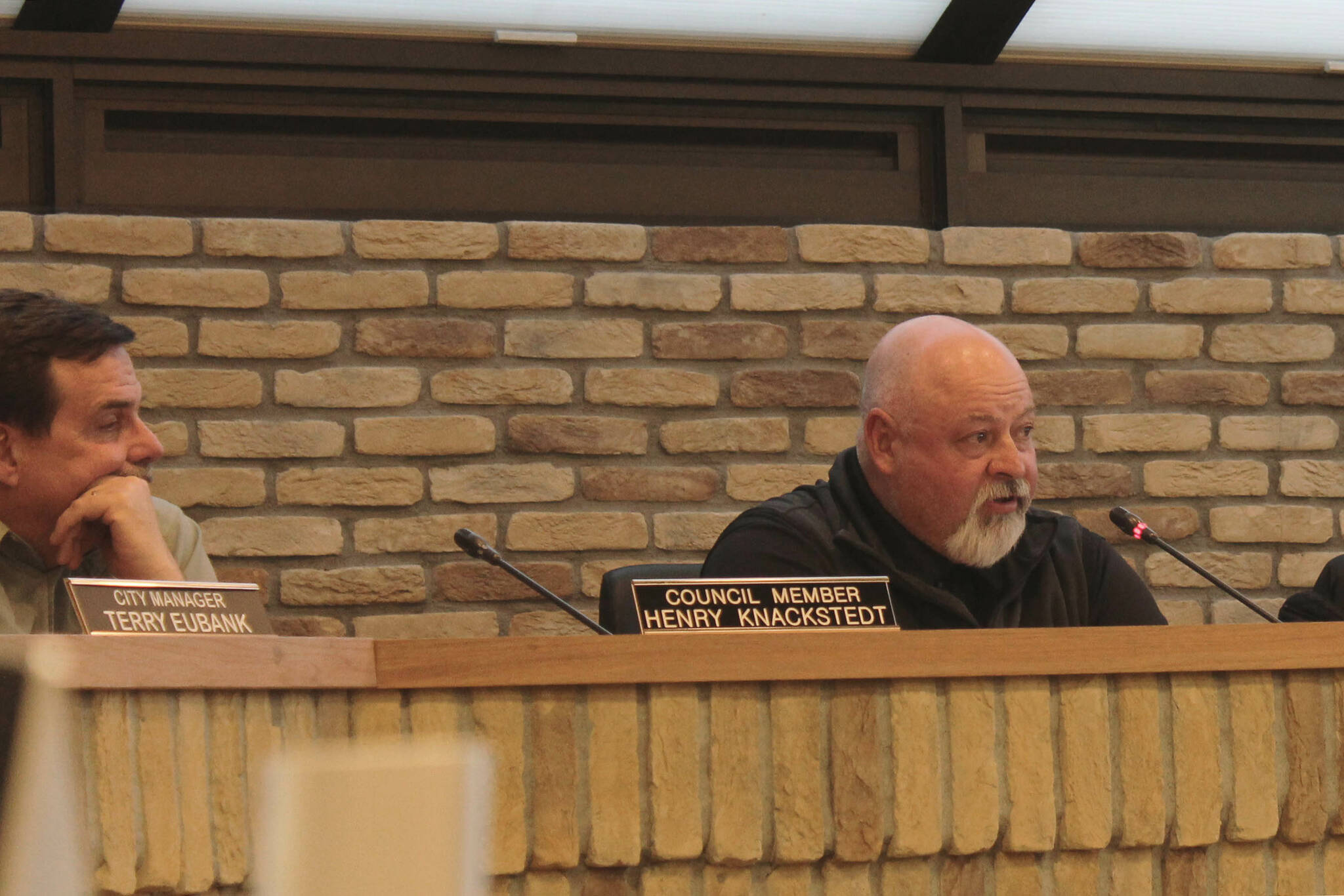
Kenai City Council members on Wednesday formally stated their support for the Kenai Peninsula Borough Assembly’s request to the Alaska State Legislature that the amount of money school districts receive from the State of Alaska per student be increased.
That amount, called the base student allocation, is a hot topic in Juneau this year, as state lawmakers work to reconcile calls from school districts for more financial support with others demanding more accountability in education. The Kenai Peninsula Borough School District is facing a $13 million deficit for the upcoming fiscal year and is one of many Alaska school districts lobbying the state for more money.
Alaska’s base student allocation — other than a $30 increase approved by lawmakers in 2022 — has not changed since fiscal year 2017. Those calling for the figure to be increased say its failure to grow with inflation has amounted to a financial decrease for Alaska’s K-12 school.
As originally introduced, the resolution considered by Kenai City Council members on Wednesday would have stated the body’s request for the state to “make a meaningful increase to the base student allocation for public schools.” The language was similar to a resolution passed by members of the Kenai Peninsula Borough Assembly earlier this month.
After debating the language of the resolution for more than an hour, Kenai City Council members amended its language to say that the council supports the assembly’s request for increased funding. That was as opposed to the city council making their own request. Council members considered a similar resolution last year, but ultimately failed to adopt it.
Council members engaged in a brief back-and-forth with Duane Bannock, who asked them during the public comment period not to pass the resolution. Bannock, a talk show host on KSRM 920 AM, said he wants to see higher test scores before increasing money for education, suggested that school districts are sitting on large piles of unspent money in savings and said that the state formula used to calculate state spending per student is too complicated.
“If there is a plan that shows an outcome — a measurable, verifiable outcome — that gets me more than 28% in proficiency in math, I will cheerfully, cheerfully pay more money,” Bannock said.
Council member James Baisden said he didn’t support the council resolution considered last year and that he wouldn’t support it this year, suggesting that any increase would go to bolstering teachers’ unions.
“I don’t see any way how this funding helps the education of my child in the school district here,” he said. “If we want to talk about what the funding will actually do, I mean you could see all the red shirts up in Anchorage, with our senator at the podium and what took place up there, and it’s not about the education of our children at all. It’s about those individuals and the funding they need to continue getting their pay.”
Baisden’s comment was in reference to a rally organized by the National Education Association’s Alaska chapter in Anchorage on Jan. 13, as part of which demonstrators called for a permanent increase to state funding for education. State Sen. Jesse Bjorkman, R-Nikiski, who is also a teacher at Nikiski Middle/High School, spoke during the rally.
Baisden said further that state funding for education is a conversation that needs to happen on the state level, not the local one, and suggested that KPBSD was being misleading when it says it doesn’t have funds.
“They’re going to threaten us this year, again, with closing pools and those types of things because they don’t have the funding — they do have the funding,” he said. “I’ve been around in the system to where I know how they move money into their budget. They will have funding for this year.”
KPBSD has on multiple occasions cautioned against using the amount of money in the district’s savings account as an accurate measure of how much money the district has on hand. In one installment of KPBSD’s “Budget 101” series, which aims to inform the general public about how the school district’s budget process works, KPBSD Finance Director Liz Hayes spoke exclusively about the district’s fund balance, or savings account.
The school district’s fund balance refers to the monetary value of what the school district has in savings and is divided into five categories. Only one of those categories — unassigned fund balance — refers to money that is not already designated for a specific purpose and that the school board can spend at its discretion to meeting district needs. The board opted last year, for example, to draw from that account to help offset a budget deficit.
Council member Deborah Sounart, a former KPBSD educator and band teacher of 26 years, didn’t support the resolution considered by council members last year, but voted in favor of the resolution on Wednesday. Better test scores, she said, require quality teachers, and funding is part of the reason KPBSD struggles to attract and retain quality teachers.
“Back to some of the concerns that, if we bump the BSA, that it will not physically affect your child’s education — maybe it won’t because of the silly funding formula and maybe it won’t because of all the decisions that other people make that are out of our control,” she said. “However, if we don’t do it, we don’t stand a fighting chance of getting teachers up here from the Lower 48. We have positions in this district that are empty, that are not being filled, because the teachers will not come.”
Council member Phillip Daniel, who sponsored the resolution alongside council member Alex Douthit, said that the resolution as presented acknowledges that an issue has been raised and seeks a resolution to that problem. Douthit agreed, further noting that KPBSD has previously said the $13 million deficit correlates to about 95 staff positions that could be cut.
“A BSA increase — what the goal is there would be to get away from having that one-time funding and then you could show your teachers you’re not giving them pink slips so you’re not having to hire first thing in the sprint or wait until the middle of the summer,” Douthit said.
Council members amended the resolution to say that the council supports the Kenai Peninsula Borough Assembly’s request for a BSA increase, rather than directly making that request from the city council. The council passed the amended resolution by a vote of 5-2, with Baisden and council member Victoria Askin voting in opposition.
Reach reporter Ashlyn O’Hara at ashlyn.ohara@peninsulaclarion.com.
