
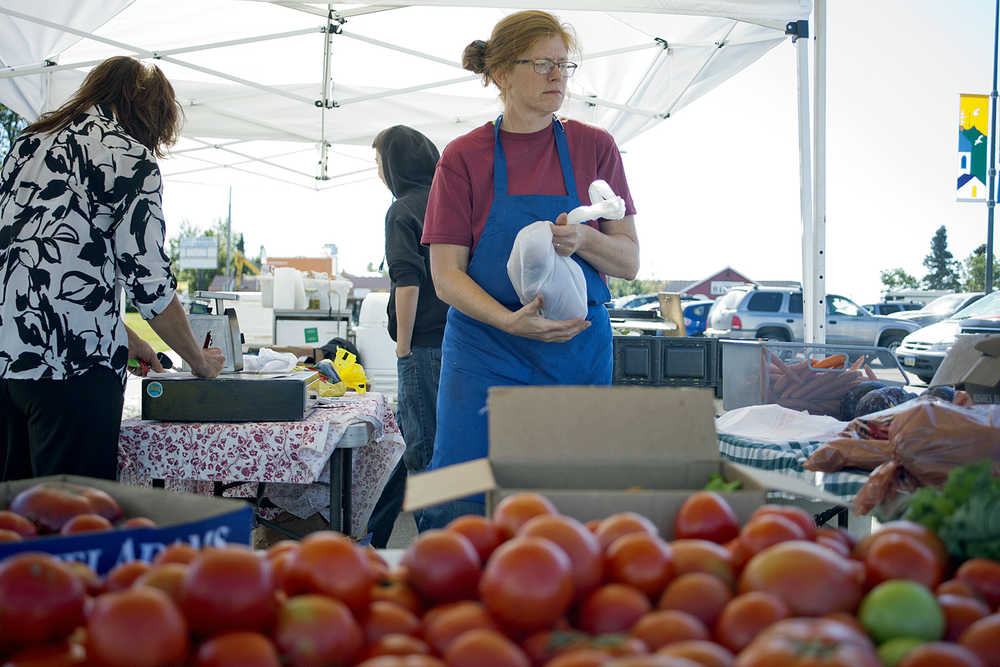
Alaska’s agriculture industry has one of the highest rates of Direct to Consumer sales in the nation.
Increasingly, producers are taking advantage of farmer’s markets and word-of-mouth marketing to move surplus produce off of small farms and onto local tables without any middlemen.
“We are really leading the country in direct sales, not in volume, but percentage,” said USDA Alaska Director Danny Consenstein. “I think we are seeing more and more of that for a number of reasons — one consumers love it. They (consumers) love to buy directly from the farmer and see exactly where their food is coming from, and actually enjoy that experience of meeting the farmer — the person who is actually growing the crop. There is some trust involved, there’s a learning experience by talking to that farmer. I think consumers also see the product that they get is a better product, it’s fresher, it’s closer to the farm, and it tastes better.”
According to Building Food Security in Alaska, a document co-commissioned by the Alaska Food Policy Council and the Alaska Department of Health and Social Services, the number of farmers participating in direct sales rose by 62 percent from 2007 to 2012. Direct sales totaled 3.8 percent of all farm sales, 13 times higher than the national average, according to the report.
One contributing factor was the increase in availability of farmer’s markets as accessible, visible venues to sell product. By 2013, 37 farmers markets had been established in Alaska, according to the report. In 2015, there are more than 40 farmers markets registered statewide through the Alaska Farmers Market Association.
In the central Kenai Peninsula area, there are four weekly markets where enthusiasts and commercial farmers can sell their fresh produce.
District manager for the Kenai Soil and Water Conservation District Heidi Chay refers to farmer’s markets as the “small business incubators of the agriculture economy.”
The weekly markets are places to grow clientele and interact with customers, Chay said. Markets provide a hub for buying and selling, and put more money into a local economy, Chay said.
“It’s important to distinguish between farmer’s markets that emphasize farmers and fresh produce, and the outdoor markets, or public markets where arts and crafts and ready-to-eat food are the main offerings, supplemented by a little produce,” Chay wrote in an email.
Each of the four local markets has regular vendors that sell produce but “shoppers looking for farmers and Kenai Peninsula farm produce will find the widest selection” at the Farmers Fresh Market and at the Central Kenai Peninsula Farmers Market, Chay wrote.
Chay has been surveying central Kenai Peninsula market customers who, on average, spend $20 on Alaska-grown products. She has also worked with the Alaska Farm Bureau to spur the $5/Week Challenge locally.
Most Alaskans spend $1 per week on products that are made in Alaska, Chay said. Increasing that weekly $1 to $5 is a huge boost to the economy, and the farmers’ businesses, she said.
Velma Bittick and husband Tom Gotcher own a garden, complete with plots, greenhouses, high tunnels, located within five miles of the Farmers Fresh Market. The couple took up their old hobby after retirement, and two years ago improved production to the point of surplus, so they went to market.
“I would rather sell direct at the market so people know who I am, how I grow things and what kind of quality they are getting,” Bittick said. “Marketing the idea of locally grown food is a twofold thing for me. I am sure it is for some of the other growers too. It’s a new niche down here.”
One trip to the market, sewing, growing and picking her produce equates to roughly 13 man hours of labor, Bittick said. But the work is always worth it, to be a part of an industry, she believes, that will only continue to increase.
Consenstein said in the future, the number of regional food hubs, community supported agriculture programs and potentially wholesalers or restaurants willing to buy local will ensure many options for producers looking to sell directly to their customers.
“Alaska is going to have to start moving in that direction,” Consenstein said. “Direct sales might be one of the only options for the small farmers.”
Reach Kelly Sullivan at kelly.sullivan@peninsulaclarion.com.
