
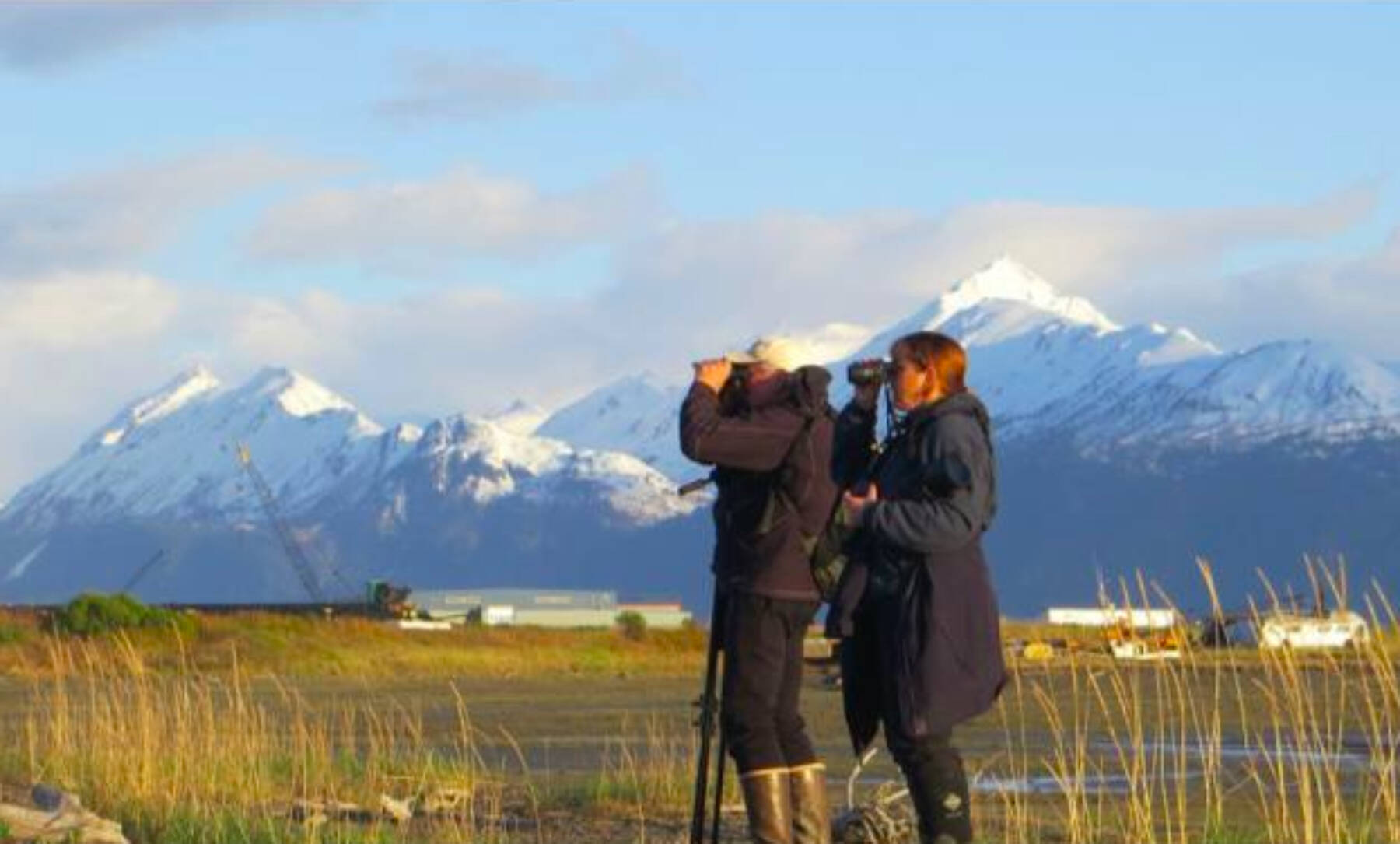
Homer’s annual citizen scientist shorebird count will kick off its 17th year Saturday, April 12.
The project will cover 10 monitoring sites, in five day intervals, until May 22. Locations include: Mud Bay; Mariner Park Lagoon; Green Timbers; Louie’s Lagoon; the boat harbor area; the Beluga Slough area; “Islands & Islets”; the Anchor Point River area; the Kasilof River area; and Hoen’s Lagoon in Seldovia Bay.
The Kachemak Bay Shorebird Monitoring Project began in 2008 with the creation of Kachemak Bay Birders. The nonprofit is locally run, entirely by volunteers. According to a 2024 report to the Alaska Shorebird Group, 72 volunteers participated in the annual community project.
The long-term citizen science project aims to get a better understanding of the status of shorebird populations in Kachemak Bay as well as the intertidal areas of the Anchor and Kasilof Rivers, particularly during spring migration. It also provides volunteers with an opportunity to become engaged in local conservation work and learn from more experienced birders.
“Participating in this project will teach you a lot about local birding, birders, and shorebirds,” wrote organizer George Matz in a March 28 email. “We operate in teams of 3-5, and each team has an experienced leader who helps with identification.”
Matz pointed out that because the monitoring sessions follow a rigorous protocol, they are not like field trips, but a more dedicated effort to collect data that will help provide the community and scientists with valuable information about shorebird migrations.
Kachemak Bay Birders hopes the data may also be useful to others assessing shorebird populations across the entire Pacific Flyway and help protect shorebird populations and habitat on the western side of the Kenai Peninsula, according to a 2024 report published by the Alaska Shorebird Group.
In a September 2021 newsletter, the International Shorebird Survey called Kachemak Bay “one of the most important staging sites in Alaska” and said the cumulative years of data provided by Kachemak Bay Birders make it one of the most well-covered sites in the hemisphere.
In addition to the 16 years of data collected by the monitoring project, Kachemak Bay Birders analyzes data from 1984-1996 shorebird monitoring work done by the late University of Alaska Fairbanks professor emeritus George West, who retired in Homer. West authored many books on birding, including “A Birder’s Guide to Alaska” and “North American Hummingbirds: An Identification Guide.”
When selecting the protocol for the monitoring project, U.S. Fish and Wildlife Service shorebird biologists advised using International Shorebird Survey protocol. After reviewing the protocol for their specific monitoring areas, Kachemak Bay Birders decided changes were needed.
“The ISS protocol states that monitoring frequency should be every 10 days,” Matz wrote in a January 2021 article for the Western Hemisphere Shorebird Reserve Network newsletter. “Because some shorebird stopovers in Alaska are just a day or two, that frequency would miss observing many migrants.”
Because of this, the group monitors every five days from mid-April to late May, bracketing the spring migration. Kachemak Bay Birders acknowledges that they miss flocks of shorebirds coming and going between monitoring dates, but their analysts review eBird reports from the area to estimate when and how many shorebirds they might have missed, filling the reporting gaps. eBird is an online database where birders can document their observations. According to Matz, the platform is widely used in the birding community.
Rather than a protocol based on individual trips, as the International Shorebird Survey recommends, Kachemak Bay Birders wanted to use a team approach, with teams assigned to specific sites. The sites are monitored for two hours at the same time. Matz argues that this provides a more complete snapshot of the area and a better opportunity for less experienced birders to participate. To minimize duplicate counting, observers note when a flock of shorebirds moves to another site.
Given the extreme tidal range for Kachemak Bay — where the highest tides exceed 22.5 feet and the lowest tides are around minus 6 feet — shorebird observations can vary significantly based on what part of the tide cycle is being monitored, according to Matz. Kachemak Bay Birders determined that the optimal time to start monitoring is when the outgoing tide approaches 15 feet, to minimize this variable and add consistency.
According to a 2024 report to the Alaska Shorebird Group, Kachemak Bay Birders observers at five Kachemak Bay monitoring sites saw 25 different species of shorebirds and counted 15,191 individual shorebirds. At the mouth of the Anchor River, they saw 18 species of shorebirds and counted 1,340 individual shorebirds. At the mouth of the Kasilof River, they saw 25 species of shorebirds and counted 16,435 individual shorebirds.
All observations and bird species counted during the Kachemak Bay Shorebird Monitoring Project are entered into eBird. To review shorebird monitoring data from prior years, you can visit kachemakbaybirders.org. The group’s annual report to the Alaska Shorebird Group can be viewed at alaskashorebirdgroup.com/annual-project-summaries/.
If you’re interested in participating in the 2025 Kachemak Bay Shorebird Monitoring Project or would like more information, contact organizer George Matz by emailing geomatz41@gmail.com.
Reach reporter Chloe Pleznac at chloe.pleznac@homernews.com.
Two volunteers monitoring shorebirds on the Homer Spit in May 2016. (Photo courtesy of Kachemak Bay Birders)
