
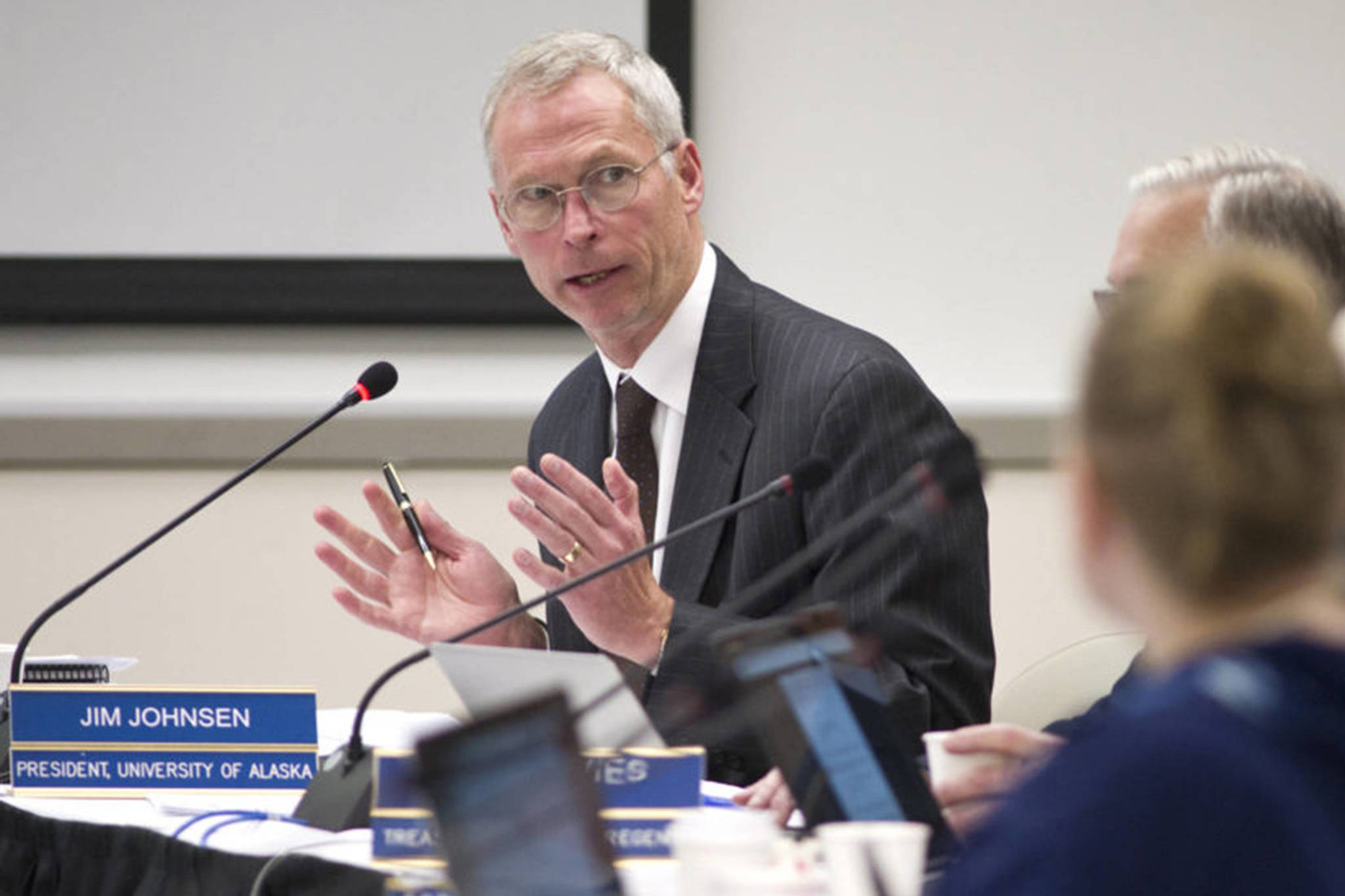
In his State of the University address on Friday, University of Alaska President Jim Johnsen said that if the UA system had a mascot it would be the phoenix: “the bird of fire, rising anew, strong, bright, and resilient from the ashes of a most challenging 2019.”
The budget was a focus of Johnsen’s address. In 2019, Gov. Mike Dunleavy proposed an unprecedented 41% cut to the state’s university system. However, Johnsen and Dunleavy negotiated a compact agreement in August 2019 that would lessen the blow to the university budget, which would be a 21% cut over the course of three years. Johnsen said that if that agreement hadn’t been made, and the governor’s cut pursued, the State of the University would be a “memorial service.”
“It wasn’t the best deal ever, but it was a lifesaver,” Johnsen said in his address.
Instead of a memorial service, Johnsen said his State of the University address was a time to recommit to serving the state’s need for a “strong, resilient university system.”
“But just as the phoenix rose from the ashes with life and hope and light, with resilience, so will the University of Alaska,” Johnsen said.
Johnsen said that amid academic and administrative reviews and program reductions and discontinuations, the university system will continue to serve its mission for the people of Alaska.
Johnsen said enrollment at the universities have been in decline since 2011. Part of that decline is a national trend and another is the state’s economy providing many high-paying jobs that do not require higher education, Johnsen said. He said other reasons are that the university is behind on what students expect in a “digitally enabled world” and also “budget woes.”
“I share these numbers with you not so you run to the doors in desperation, but to appreciate the huge challenge we face, and to thank all of you for your courage and your commitment to this worthy cause for Alaska’s future,” Johnsen said.
Moving forward, the university system’s plan must address budget cuts, Johnsen said. To do that, he said the universities are going to need to drive revenue through increased enrollment and the tuition that follows. This means stepping up recruitment and marketing and “getting the word out there about just how well the university helps our students realize their dreams.”
He said the university system is working in Washington, D.C., to increase funding for research in a range of areas, like environment, behavioral health and national security.
“One of the areas under attack last year was university research,” Johnsen said. “Research that addresses real problems and creates practical opportunities here in Alaska and across the Arctic. UAF not only leads the world in Arctic research, our research enterprise is an economic engine for Alaska. With the state’s investment of $25 million, our researchers generate $150 million, for a return of 600 percent.”
Johnsen said those dollars flow through the state’s economy and that the research solves problems for communities across Alaska.
Strengthening ties and partnerships with businesses and industry is also a goal the system is working toward, he said.
At the Board of Regents’ direction, Johnsen said academic and administrative services are being examined for cost savings at each university across the state. Those reports are due March 23, and a full recommendation will be made to the board in early June.
University programs will be reviewed and prioritized according to the Board of Regents criteria: cost, demand, availability of alternatives and alignment with the board’s five strategic goals of economic development, research, workforce development, educational attainment and equity and cost effectiveness.
“Yes, we will need to make tough decisions, programs will be reduced and discontinued, but as we take our destiny in our own hands, as those decisions are made, the interests of our students come first,” Johnsen said. “We have a commitment to our students enrolled in a program that they will be able to complete that program and, rest assured, we will meet that commitment.”
Johnsen touted the university system’s affordability, despite recent tuition hikes. The Alaska Commission on Postsecondary Education reports that the University of Alaska’s average tuition is the third-lowest of any state in the nation. The percentage of student debt is second-lowest in the nation and the share of the total cost paid by UA students is the fifth-lowest in the nation, Johnsen said.
Johnsen said each of the universities are examining their tuition rates and looking at the possibility of different rates across the system, with some increasing and maybe some decreasing. He says that will hopefully include “a sizable tuition reduction at the community campuses.”
Since 2017, the university system has also received $105 million in private contributions from 13,811 people, 6,388 of those were first time donors, he said. Much of these donations are dedicated to a specific purpose and many are endowed for the long term.
“This strong outpouring of support for the university is a sign of how many people see the university as a way to realize their dreams for a better world,” Johnsen said.
Johnsen closed his State of the University address with a quote from Theodore Seuss Geisel: “You have brains in your head. You have feet in your shoes. You can steer yourself any direction you choose. You’re on your own. And you know what you know. And you are the one who’ll decide where to go …”
“Thank you all for believing that Alaska can,” Johnsen said. “With the brains in your heads and the feet in your shoes, and I humbly would add the hearts in your chests, I am confident that Alaska can and Alaska will.”
