
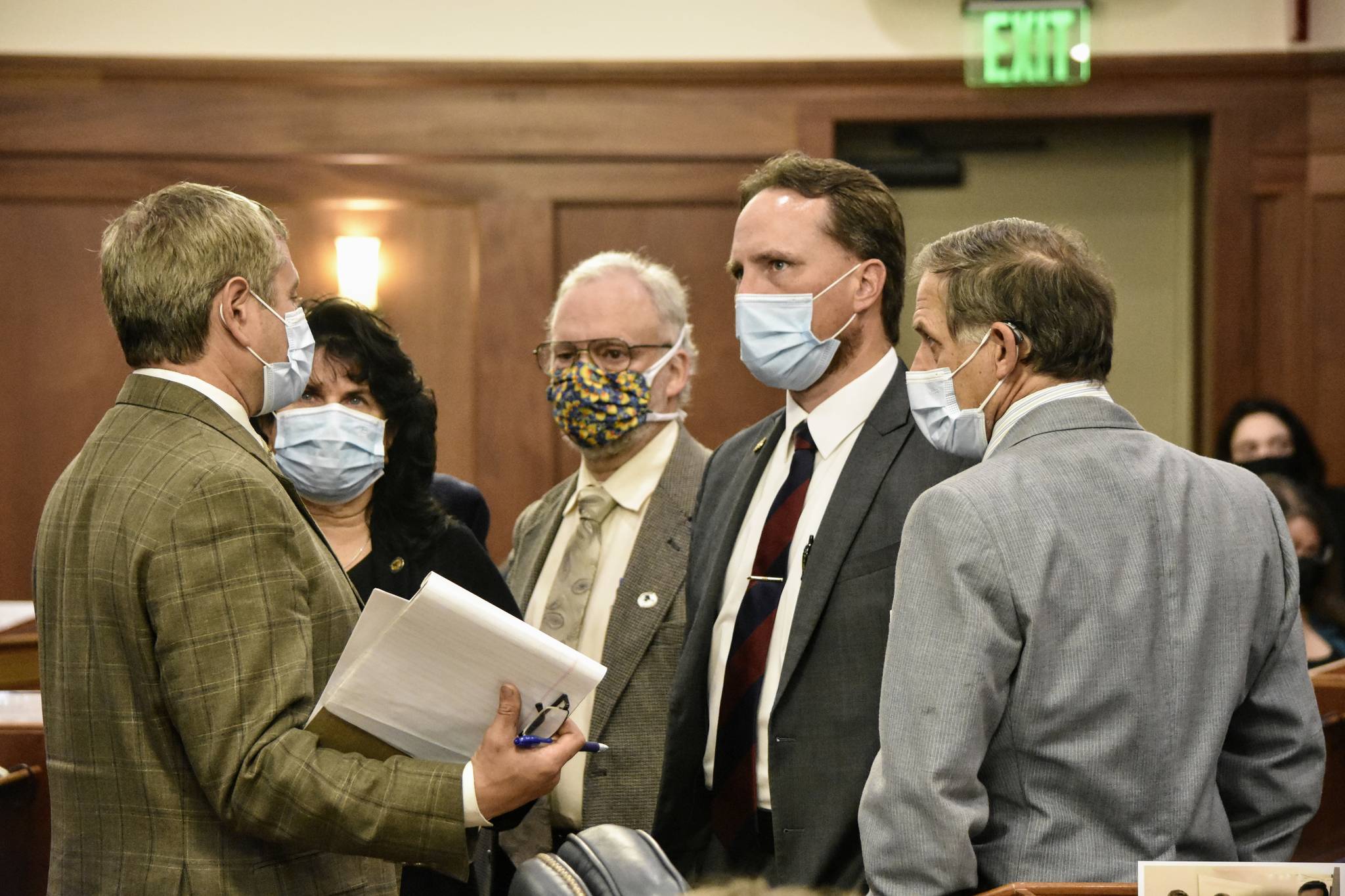
From left to right, House Majority Leader Chris Tuck, D-Anchorage; House Minority Leader Cathy Tilton, R-Wasilla and Reps. Mike Prax, R-North Pole; Ben Carpenter, R-Nikiski and George Rauscher, R-Sutton, speak on the floor of the Alaska House of Representatives following a floor session on Monday, Aug. 30, 2021. Lawmakers found themselves debating familiar topics as they worked through amendments to a budget bill. (Peter Segall / Juneau Empire)

From left to right, House Majority Leader Chris Tuck, D-Anchorage; House Minority Leader Cathy Tilton, R-Wasilla and Reps. Mike Prax, R-North Pole; Ben Carpenter, R-Nikiski and George Rauscher, R-Sutton, speak on the floor of the Alaska House of Representatives following a floor session on Monday, Aug. 30, 2021. Lawmakers found themselves debating familiar topics as they worked through amendments to a budget bill. (Peter Segall / Juneau Empire)

House budget debate stretches into evening

Amendments touched on familiar issues

The Alaska House of Representatives worked into the evening Monday, amending an appropriations bill introduced by Gov. Mike Dunleavy and modified by the House Finance Committee.

Members of the House minority caucus object strongly to the committee’s version, saying they hadn’t been given enough time to properly vet the bill nor were they given sufficient time to scrutinize proposed amendments to the bill.

All 40 members of the House were present for floor sessions Monday, where members of the House majority tried to advance a version of House Bill 3003 to complete the state’s budget. Minority members have complained not enough attention has been paid to resolving the state’s long-term fiscal deficit as House leadership has made the budget a priority.

Committee meetings have been scheduled for every day this week to hear proposals on deficit issues but lawmakers have yet to allocate an Alaska Permanent Fund dividend and some state programs and obligations remain unfunded. The House voted to adopt the committee’s version of the bill, which allocated a $1,100 PFD and added back funding vetoed by the Dunleavy administration.

But before House members could vote on the bill and send it to the Senate, lawmakers found themselves debating familiar topics.

[Divisions delay work as lawmakers trade blame]

“I feel like I’ve done this before,” said Rep. DeLena Johnson, R-Palmer, of an amendment to pay PFDs based on a 1982 formula.

An amendment from Rep. David Eastman, R-Wasilla, to use $2.5 billion to pay dividends based on that formula, which he and other minority members said the state must either follow or change.

“We have statutes on the books. If the majority wants to change the payout, change the law. It worked for 35 years,” Johnson said during floor debate. “If we don’t like the law, change the law. It’s the law and as long as it’s the law I will be a yes vote.”

Members of the mostly Democratic majority pointed out the Alaska Supreme Court had ruled the state was not bound by that statute and that there are other obligations to pay — many of which are outlined in the state constitution and pre-date the PFD.

Rep. Ivy Sponholz, D-Anchorage, said to pay such a large dividend would require lawmakers to break the 5% of market value law passed in 2018 and Rep. Zack Fields, D-Anchorage, read from the state constitution regarding the creation of the permanent fund.

The makers of the fund, according to Fields, “explicitly did this with the intention of funding services, many of them are in the constitution, school bond debt reimbursement and the universities.”

But minority members maintained the Legislature was taking money from Alaskans and spending it on government.

“Is it the people’s money or is it the government’s money,” asked Rep. Chris Kurka, R-Wasilla. “Does the permanent fund belong to the people or is it a sovereign wealth fund to fund government spending?”

In September 2019, the International Forum of Sovereign Wealth Funds held its annual conference in Juneau because of the Alaska Permanent Fund.

The amendment for a statutory PFD failed, as did a separate amendment from Eastman to pay a supplemental dividend based on interest earned on the difference between the statutory formula and the PFD amounts paid beginning in 2017.

Eastman also forwarded several amendments expressing legislative intent to have state money not go to entities with certain policies regarding COVID-19 vaccines. Amendments to block funding to entities that required vaccines in adults or minors failed, but an amendment intending to block funding to entities which “solicit, collect or maintain” COVID-19 vaccine status information passed.

That vote passed narrowly, with Rep. Chris Tuck, D-Anchorage, crossing party lines to vote with the minority.

Eastman and several minority members said they had heard significant concern from constituents about the perceived erosion of civil liberties, even as members of the majority pointed out that vaccine requirements have been upheld by the U.S. Supreme Court for decades.

Another of Eastman’s amendments would have liquidated the Power Cost Equalization fund and transferred the money to the Constitutional Budget Reserve. That amendment failed 38-2 with only Eastman and Kurka voting to approve.

“We all want a strong PCE program,” said Rep. Mike Cronk, R-Tok, speaking against the amendment. “It not only pays for the subsidy but it pays for the infrastructure we all want.”

Once passed, the bill will go to the Senate before coming back to the House of Representatives. The current special session ends Sept. 15.

House members were still debating amendments as of 5:30 p.m.

Contact reporter Peter Segall at psegall@juneauempire.com. Follow him on Twitter at @SegallJnuEmpire.

More in News

The cast of Nikiski Middle School’s upcoming performance of “Alice in Wonderland” is pictured on Dec. 2, 2025. The upperclassmen-directed play opens on Friday, with additional showtimes Saturday and next weekend. Photo courtesy of Carla Jenness
Nikiski Middle School debuts student-led “Alice in Wonderland”

The show opens on Friday, with additional showtimes this weekend and next.

On Tuesday, the Kenaitze Indian Tribe unveiled Kahtnu Area Transit, a public transportation service open to the entire Peninsula Borough community. Photo courtesy of Kahtnu Area Transit
Kenaitze Indian Tribe unveils Kahtnu Area Transit

The fixed bus route offers 13 stops between Nikiski and Sterling.

The Kenai Chamber of Commerce and Visitor Center hosts the annual Christmas Comes to Kenai on Nov. 28<ins>, 2025</ins>. The beloved event began over 40 years ago, and this year over 1,000 attendees enjoyed hot chocolate, fireworks, pictures with Santa and shopping. Photo courtesy of the Kenai Chamber of Commerce
 Photo courtesy of the Kenai Chamber of Commerce
The Kenai Chamber of Commerce and Visitor Center hosted the annual Christmas Comes to Kenai on Nov. 28. The beloved event began over 40 years ago, and this year over 1,000 attendees enjoyed hot chocolate, fireworks, pictures with Santa and shopping.
Kicking off a month of holiday festivities

Last weekend’s holiday events, including the annual Christmas Comes to Kenai and the Soldotna Turkey Trot, drew folks from all over the Kenai Peninsula.

Starting Dec. 2, Aleutian Airways will offer roundtrip flights between Anchorage and Unalakleet every Tuesday, Friday and Sunday.
Aleutian Airways to offer roundtrip flights between Anchorage and Unalakleet

Starting Dec. 2, Aleutian Airways will offer three roundtrip flights per week.

The Trump administration’s “Big Beautiful Bill” act requires the Bureau of Ocean Energy management to hold at least six offshore oil and gas lease sales in Alaska between 2026-2028 and 2030-2032. The first of these sales — known as “Big Beautiful Cook Inlet 1,” or BBC1— is scheduled for March 2026. Photo courtesy of the Bureau of Ocean Energy Management
Cook Inletkeeper launches petition against federal government

The organization is calling for transparency in Cook Inlet offshore oil and gas sales.

Winter dining has always carried more weight than the menu might suggest. In the off-season, eating out isn’t just about comfort food or convenience; it’s a way of supporting local businesses as they hold steady through the slower months. Photo credit: Canva.
The ripple effect: How local spending builds stronger communities on the Kenai Peninsula

From cozy cafés to fine-dining bistros, purchases made close to home sustain local jobs and services

Courtesy Harvest
On the Kenai Peninsula, a dormant liquefied natural gas export plant could be repurposed to receive cargoes of imported LNG under a plan being studied by Harvest, an affiliate of oil and gas company Hilcorp. The fuel would be transferred from ships to the tanks on the left, still in liquid form, before being converted back into gas and sent into a pipeline.
Utilities say Alaska needs an LNG import terminal. Consumers could end up paying for two.

Planning for two separate projects is currently moving ahead.

A map shows the locations of the 21 Alaska federal offshore oil and gas lease sales proposed by the Trump administration. (Map provided by the U.S. Bureau of Ocean Energy Management)
Trump administration proposes offshore leasing in almost all Alaska waters

A new five-year offshore oil and gas leasing plan proposes 21 sales in Alaska, from the Gulf of Alaska to the High Arctic, and 13 more off the U.S. West Coast and in the Gulf of Mexico.

A decorated gingerbread house awaits judgment in the Kenai Chamber of Commerce on Monday<ins>, Nov. 24, 2025</ins>. This year marks the 13th annual gingerbread house contest, and submissions are open until Dec. 8.
Kenai chamber extends gingerbread house contest deadline

Submissions to the Kenai Chamber of Commerce gingerbread house contest are now due by Dec. 8.

Most Read