
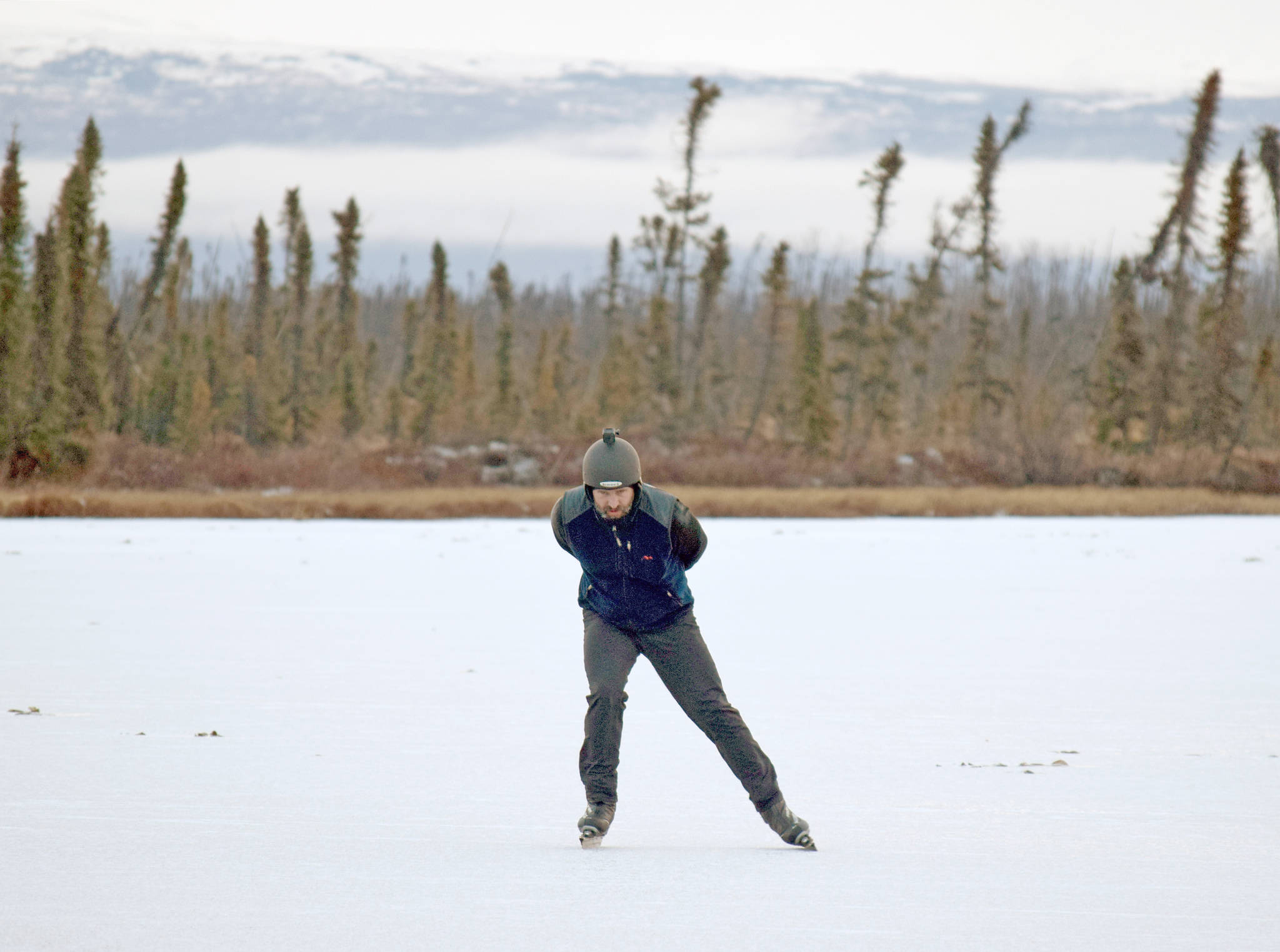
Some central Kenai Peninsula outdoors enthusiasts have found a silver lining to the slow snow start to winter. And it looks a lot like a skate blade.
Laura Pillifant is as avid a skier as anyone. She skied for the University of Alaska Fairbanks back in 1978 and has been a familiar figure on the area’s ski trails since moving here in 1989.
Yet, as she talked about a Dec. 9 outing to Griebe and Camp Island lakes on the Swanson River canoe trails with a group of friends, there was no trace of disappointment that the skis that day were left in the car.
“The lake was beautiful, with the mountains and sun out,” Pillifant said. “It was so nice.”
In March, Pillifant will ski from border to border in Finland over the course of seven days, averaging 40 to 80 kilometers a day. But she has found a path to winter enjoyment that includes more than skis, although all the snow late in the week will definitely have her on skis, not skates, for the immediate future.
In the past five or six years, Pillifant’s early winter has increasingly included skating the lakes with Nordic blades, which snap onto ski boots to make something similar to a speed skate. The big difference is the front of the blade is at a very low angle, allowing the blade to take on rougher ice.
Pillifant said the blades are another tool to making sure there is a way to get outside no matter the weather. A common strategy is to leave the house with skis, blades and ice cleats and do whatever nature dictates.
“I love Alaska and plan to live here the rest of my life and I do what I can to get outside,” said Pillifant, who moved to Anchorage in 1966 when she was 5. “I don’t complain when we don’t have snow for skiing.
“I have a fat bike with studded tires, Nordic blades, and I’ll walk the trails with cleats. I don’t complain too much. I just try to get out every day.”
Trevor Davis and Clark Whitney find themselves in a camp similar to Pillifant’s.
Davis moved to the area with his family in 2007. He skated and cross-country skied growing up in central Maine, but it wasn’t until about three years ago that he got back into skating in earnest.
Davis has done a bunch of classic cross-country skiing since coming to the peninsula. Many winters the snow would come too soon to get in good skating. About three years ago, though, he said a slow start to winter got him hooked on skating.
“My friends would use the arena for skating, but after I got out on Nordic skates on wild ice it was kind of like, ‘Game over,’” he said. “I didn’t want to go to the arena with nice, smooth ice. I’d rather be in the backcountry. The further, the better.”
Davis also has been getting more and more into using the skate technique for cross-country skiing and he’s hoping the balance required for ice skating helps him now that the trails are coated with snow.
The aerobic workout — Davis flew through 13 miles in an hour during a Monday skate — certainly won’t hurt the skiing. Pillifant, an expert skier, confirms that skating helps, especially with the all-important ability to balance and glide with all of one’s weight on a single leg.
“I always skate with skate-length poles,” she said. “It’s super fun and great practice.”
Whitney is another winter veteran who has been turning increasingly to ice skating, though he has yet to trade his hockey skates for Nordic blades. He moved to the peninsula in 1973, graduating from Kenai Central in 1976, and learned to ice skate as a child in Nondalton, which is across Cook Inlet.
“We had Sixmile Lake right out in front of the village there, and two of the three winters we had good ice early,” he said. “We could skate the length of the lake.
“One time I skated up Newhalen River and I was probably lucky I didn’t die, but it sure was fun.”
Whitney is the ski coach at Skyview Middle School and pines for snow as much as anyone. At the same time, he said some skating experiences are tough to top, like a skate under a Thanksgiving full moon at Bottenintnin Lake, which is a half mile from the west junction of Skilak Lake Road.
“When the ice is shifting sometimes it makes kind of the beautiful sound of a whale,” Whitney said. “I love the wilderness and I love being on the water, whether it’s frozen or open. It’s almost a spiritual thing for me.”
As per usual, wilderness can be dangerous and Pillifant, Davis and Whitney urged safety and caution. The first step is making sure the ice is thick enough to skate.
That means 3 to 4 inches. Whitney suggested bringing an auger, chisel or ax to check, but many times cracks in the ice are an easy way to gauge thickness. A ski pole without a basket is also a good option for continually probing the ice.
Whitney also recommended social media fitness apps like Strava for monitoring what lakes others are skating safely. A “NordicSkate-SouthCentral Alaska” Facebook page is another option.
But being safe is about more than ice thickness, as Whitney learned from an elder in Nondalton.
“His advice would be to take your time,” Whitney said. “He would say to anybody that every lake is different.
“Ice is plastic and variable. The first time you go out, don’t take off at full speed. Walk on it and check it first. Don’t listen to music until you go around once. The ice will talk to you and let you know.”
When investigating a lake, look for things like outlets and springs that can rapidly eat away at ice thickness. Take note of surfacing air bubbles or other irregularities, like cracks from an earthquake, that could suddenly stop skate blades.
Pillifant said that if she is by herself or the ice is making noises she doesn’t like, she skates close to the shore.
Even popular area lakes for skating like ARC, Headquarters and Bottenintnin lakes can have surface changes each day that can trip up a skater.
“It’s important to realize how unforgiving that surface is,” Davis said. “It’s not like skiing where if you fall, there’s a relatively soft landing. You don’t need to be going that fast to hurt yourself. It’s very unforgiving.”
Whitney recently had a friend split his head open on the ice. That’s why veteran skaters have no trouble recommending helmets and pads for the elbows and knees.
As unpleasant as falling on the ice is, falling through the ice is another matter entirely. Davis said factors like familiarity with the lake, whether he is alone, how far the lake is in the backcountry and ice thickness influence how much safety gear he brings.
Ice claws, a throw rope, an ice screw for fastening a rope, a life jacket and a backpack with clothes in a dry bag are all items that should be considered. For backcountry adventures, things like a means to start a fire and first-aid kit become musts.
But Pillifant, Davis and Whitney all said that taking the proper precautions is worth all the fun gained.
“It’s pure pleasure flying atop the ice on a full-moon night or under the northern lights,” Whitney said. “It’s definitely a high point of the season. I almost find myself hoping we don’t get snow early.”
