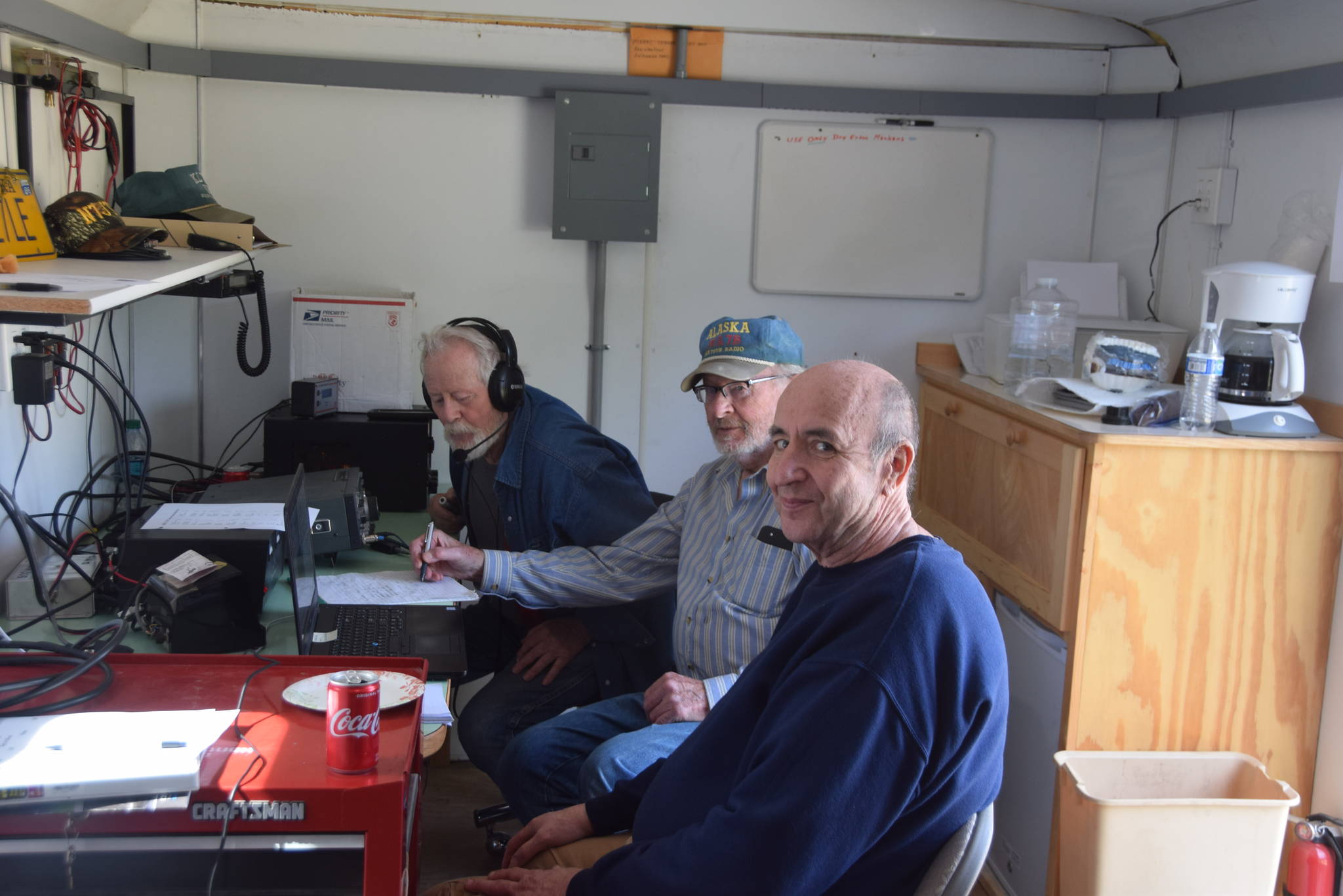
From left, George Van Lone, Max Carpenter and Ed Seaward monitor the airwaves inside the Moose Horn Amateur Radio Club’s mobile operation center in Kenai, Alaska during the Amateur Radio Relay League’s annual Field Day on June 22, 2019. (Photo by Brian Mazurek/Peninsula Clarion)

From left, George Van Lone, Max Carpenter and Ed Seaward monitor the airwaves inside the Moose Horn Amateur Radio Club’s mobile operation center in Kenai, Alaska during the Amateur Radio Relay League’s annual Field Day on June 22, 2019. (Photo by Brian Mazurek/Peninsula Clarion)

Hamming it up

Amateur radio operators gather for annual field day

The airwaves were abuzz on Saturday as amateur radio operators from the Kenai Peninsula gathered to participate in the Amateur Radio Relay League’s Annual Field Day. The 24-hour event gives radio operators from all over North America a chance to practice their skills and connect with fellow ham radio enthusiasts from hundreds or thousands of miles away. The local Moose Horn Amateur Radio Club set up their portable headquarters at the field across from the Vintage Pointe Senior Apartments and spent the day exchanging call signs with people from Alberta, Canada, San Francisco and even Honolulu, while catching up with old friends and enjoying good food and great weather.

For those interested in becoming an amateur radio operator, the folks at Moose Horn also provided the opportunity to take the 35-question certification exam right there on the spot. Anyone who passes the exam with at least a 75% is issued a unique and universally recognized call sign by the Federal Communications Commission. In many cases, operators know each other’s call signs better than they know their real names, and several of the people participating in the Field Day proudly displayed their call signs on their hats and license plates.

While it’s not a requirement for certification, many ham radio operators take on the role of first responders in the event of an emergency where traditional lines of communication break down. That’s exactly what happened in the wake of the 1964 earthquake, when ham radio operators came together to be the voice of remote communities that had no other way to communicate with each other. The Alaska-Pacific Emergency Preparedness Net, which was set up in the wake of the earthquake, still operates to this day on the 14.292 MHz frequency band and has amateur operators checking in five days a week.

George Van Lone — better known by his call sign, KL7AN — is a member of the Moose Horn club and still has the radio that his wife’s aunt used during the earthquake. Van Lone said the radio is currently in storage in California, but he’s hoping to get it up to Alaska soon and is considering donating it to a museum to preserve it as a part of history.

“Radios were a lot bigger in those days, so we’re still trying to figure out how to get it up here,” Van Lone said.

While scanning the different frequencies to find anyone broadcasting for the Field Day — also known as a “search and pounce” — Van Lone picked up on someone transmitting out of San Francisco and after a few attempts managed to get their attention and add them to the list. By mid-afternoon, the Moose Horn station had only been in contact with a handful of other operators. Van Lone attributed this to the fact that most stations outside of Alaska don’t point their receivers in this direction and Alaska transmissions sometimes get lost in translation.

“The problem is that we’ve got our antennae pointed at them, but they’ve got their antennae pointed at each other,” Van Lone said. “So a lot of times we hear them but they don’t hear us.”

Ron Hovarth, call sign W8PVZ, never had an interest in amateur radio until his dad passed away in 2006. Hovarth’s dad was an operator for 75 years, and Hovarth knew that his dad’s call sign would go back to the FCC to eventually be recycled. So while living in Bethel he and a friend earned their certifications, and Hovarth was able to acquire his dad’s old call sign after a little bit of haggling with the FCC. Now he uses it to keep his dad’s spirit alive on the airwaves, and has since used his ham radio to communicate with people all over the world.

“I remember flipping burgers on my back porch in Bethel while talking to someone in South America,” Hovarth said.

Hovarth also recalled a time when he connected with two World War II veterans, one living in the United Kingdom and one living in Australia. After talking with them for a while, the two veterans had the realization that they were stationed at the same military base in Australia during the war — they even played a game of baseball against each other.

“They kept narrowing down the details of when and where they were stationed, and all of a sudden it was like, ‘Oh so you’re the guy I tagged out at second base!’” Hovarth said.

Anyone interested in taking the amateur radio certification exam or joining the Moose Horn Amateur Radio Club can contact Max Carpenter at wa7b@aol.com. Carpenter, call sign WA7B, has been an amateur radio operator for over 30 years — going all the way back to when he broadcasted on the “funny channels” of CB radio that were not exactly legally sanctioned at the time. Carpenter is the president of the Moose Horn Club and administers the certification exams to would-be operators. The club gets together for lunch on Thursdays and has a meeting every month.

More in News

Snow covers a branch hanging over Watergate Way in Kenai, Alaska, on Thursday, Nov. 9, 2023. (Jake Dye/Peninsula Clarion)
District-wide school closure in effect Friday, Jan. 16

All Kenai Peninsula Borough School District schools and Kenai Peninsula College campuses are closed due to rain and freezing temperatures expected overnight.

Kenai Peninsula Borough Mayor Peter Micciche speaks during a meeting of the Borough Assembly in Soldotna, Alaska, on Tuesday, May 21, 2024. (Jake Dye/Peninsula Clarion)
Borough updates public noticing requirements

The Kenai Peninsula Borough Assembly approved an ordinance last week effectively ending requirements to publish notices in a newspaper of general circulation.

A map presented by the Alaska Department of Natural Resources during a virtual meeting on Dec. 11, 2025, shows the location of a potential Kenai Peninsula State Forest. Screenshot.
Community discusses state forest proposal at Homer meeting

The public comment period on the proposed Kenai Peninsula State Forest closes Jan. 16 at 5 p.m.

The Alaska Department of Environmental Conservation helped a Nikiski resident dispose of over 43 tons of contaminated soil after a home heating oil spill in November<ins> 2025</ins>. DEC on Friday launched a program to help eligible homeowners cover cleanup costs relating to home heating oil spills. Photo courtesy of the Department of Environmental Conservation
State launches home heating oil spill cleanup program

The Department of Environmental Conservation formally announced the program statewide on Friday.

Sterling resident Jonny Reidy walks 11 miles from his dry cabin to his part-time job at Fred Meyer on Dec. 15, 2025. Reidy aims to walk 1,000 miles by midsummer, and he’s asking people to pledge donations to food banks for every mile he travels. Photo courtesy of Jonny Reidy
Sterling man is walking 1,000 miles for hunger awareness

Jonathan Reidy asks people to pledge donations to local food banks for every mile he walks.

Soldotna High School students learn how to prepare moose meat through the school’s annual Moose Permit Project, an educational partnership between SoHi and the Alaska Department of Fish and Game. Photo courtesy of Tabitha Blades/Soldotna High School
Soldotna students get hands-on moose harvest experience

SoHi’s annual Moose Permit Project is an educational collaboration between the school and the Alaska Department of Fish and Game.

A snowmachine rider takes advantage of 2 feet of fresh snow on a field down Murwood Avenue in Soldotna, Alaska, on Monday, Dec. 12, 2022. (Jake Dye/Peninsula Clarion)
Kenai refuge announces snowmachine opening

All areas traditionally allowing snowmachine use in the Kenai National Wildlife Refuge are now open.

Kate Rich’s play, “The Most Comfortable Couch in Town,” is performed during “Stranded: A Ten-Minute Play Festival” in August 2025 in Homer, Alaska. Photo provided by Jennifer Norton
Homer playwright receives fellowship award

Kate Rich is revising a new play, which she hopes to take to the Valdez Theatre Conference Play Lab.

A BUMPS bus waits for passengers in the Walmart parking lot in Kenai, Alaska, on Oct. 15, 2018. (File photo)
Ninilchik Traditional Council expands public bus service

The Homer-Kenai BUMPS bus will now run five days a week.

Balloons fall on dozens of children armed with confetti poppers during the Ninth Annual Noon-Year’s Eve Party at the Soldotna Public Library in Soldotna, Alaska, on New Year’s Eve, Tuesday, Dec. 31, 2024. (Jake Dye/Peninsula Clarion)
Out with the old, in with the new

The Peninsula Clarion looks back on 2025 in this “year in review.”

The sign in front of the Homer Electric Association building in Kenai, Alaska as seen on April 1, 2020. (Photo by Brian Mazurek/Peninsula Clarion)
State regulatory commission approves electric utility rate increase

The Homer Electric Association ratified a 4% base rate increase in November.

A map presented by the Alaska Department of Natural Resources during a virtual meeting on Dec. 11, 2025, shows the location of a potential Kenai Peninsula State Forest. Screenshot.
Community meeting in Homer to focus on proposed state forest

The Department of Natural Resources will continue to gather community input on the potential establishment of a Kenai Peninsula State Forest during a meeting on Tuesday at Kachemak Bay Campus.