
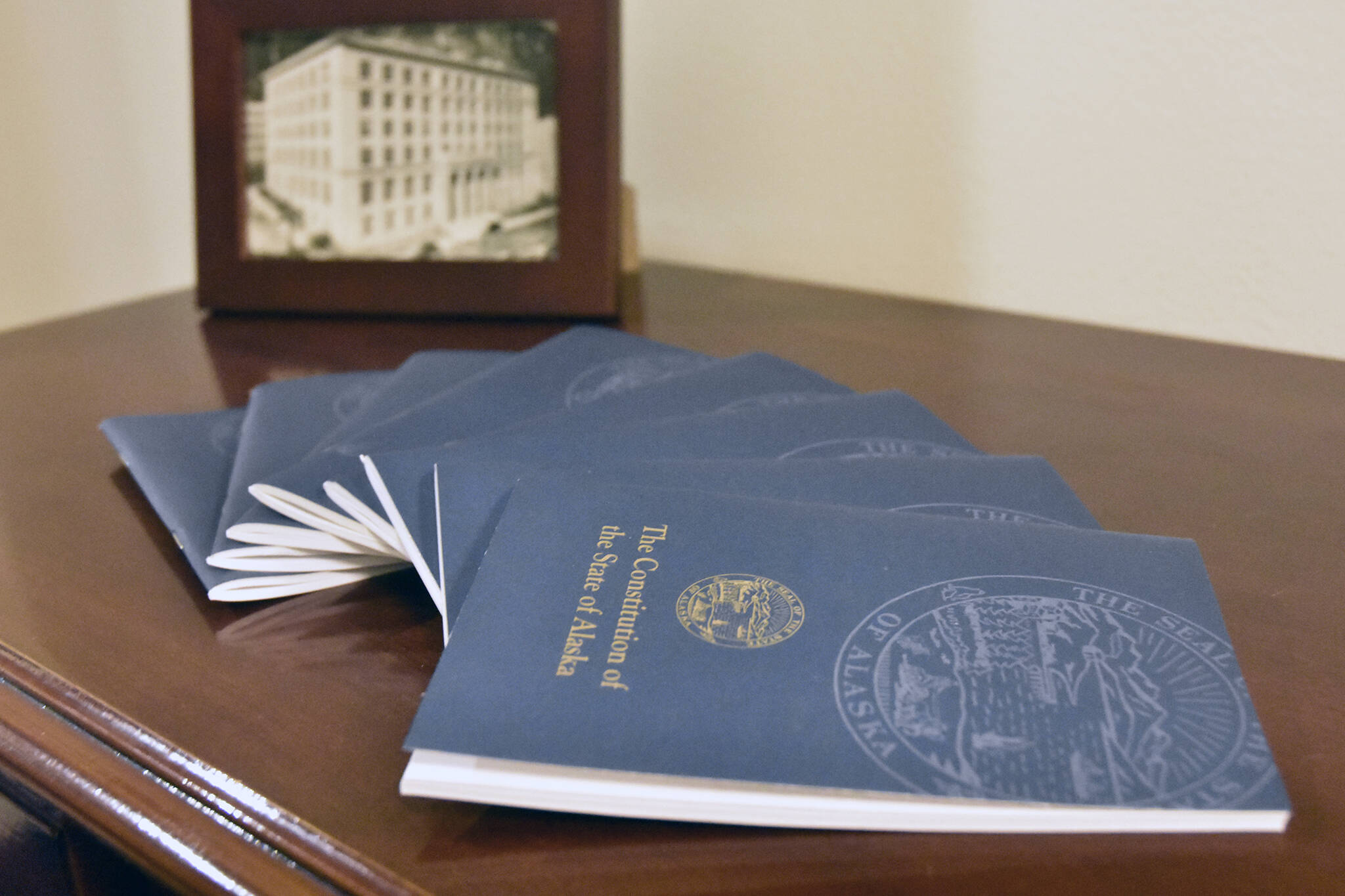
Alaskans will be asked in the next statewide election if they want to hold a constitutional convention. Ahead of that, a group of state and local leaders said they want to help inform people about the full impacts. In a Dec. 12, news release, the group — Defend Our Constitution — said a constitutional convention would be chaotic and expensive.
Alaska’s constitution requires that voters be asked every 10 years to hold a convention to change the state’s foundational document. But a convention would subject the entire document to change, which opponents to a convention say is too risky. The group’s members — which include current and former state lawmakers, mayors and others wary of a convention — said a convention would create the opportunity for special interest groups to try to rewrite state laws in their favor.
Speaking on the floor of the Alaska Senate on Sept. 19, Sens. Shelly Hughes, R-Palmer, and Mike Shower, R-Wasilla, suggested that voters may choose to hold a constitutional convention over lack of action on the Alaska Permanent Fund dividend.
“I’m not taking a position for or against having a constitutional convention, my goal is to make sure that folks understand what we’re getting into,” said Sen. Gary Stevens, R-Kodiak, one of Defend Our Constitution’s eight co-chairs. “If we choose to do the (constitutional convention), it’s a big thing. It takes a tremendous amount of effort; it takes a long time.”
If the state does hold a constitutional convention the state’s entire founding document will be subject to change, and that’s something DOC’s co-chairs said would be dangerous to the state.
[Cities hope to see full state budget, bolstered by federal funds]
In an interview with the Empire Monday, Stevens said he’d written a research paper on what the actual process would be for holding a convention, and how much it would cost. It would likely be several years before the convention would actually be held, Stevens said, as the process for electing delegates and convening a meeting would be time-consuming and expensive. In addition to his own research, Stevens has asked legislative leaders to convene a special committee to examine the process.
“The process begins with the Legislature,” Stevens said. “How to do it, how to fund it, who are the delegates, how do we elect them, who do we elect.”
A convention would have to be fully staffed, Stevens said, and would have first call on the state’s budget, meaning funds for the convention would be prioritized over all others, including public security and education.
Defend Our Constitution’s co-chairs said they didn’t necessarily oppose changing the constitution, or even holding a convention, but said they wanted the public to understand what that will mean for the state. The group is co-chaired by Stevens, former Senate President Cathy Giessel, R-Anchorage; former Sen. John Coghill Jr., R-Fairbanks; Rep. Bryce Edgmon, I-Dillingham; former Juneau Mayor Bruce Botelho; former Fairbanks North Star Borough Mayor Luke Hopkins; Gail Schubert, president and CEO of the Bering Straits Native Corporation; Joelle Hall, president of the Alaska AFL-CIO; and former revenue commissioner Bill Corbus.
“Obviously everything is subject to a vote of the people,” Botelho said. “But the risk of fundamental changes to the structure of government is too great to take that chance.”
Botelho and other co-chairs said Alaska’s constitution was considered by legal scholars to be a well-written document and argued there was already a process in place to amend the state’s constitution rather than rewrite it entirely. Botelho told the Empire that frustration with the state government might entice people to vote for a convention, but that would open the opportunity for special interest groups of all kinds to try and influence state laws.
“It’s not just the delegates but the pressure that will come from outside, truly outside, that will try to refashion state government,” Botelho said.
Speaking to the Empire, Giessel said there were several specific issues with the constitution that might motivate voters such as the PFD, abortion and other divisive issues, but cited the risk of subjecting the entire document to change to achieve targeted goals.
“Emotions are running high; that’s one of the significant risks to holding a convention,” Giessel said. “These are not good times to objectively debate.”
It’s possible voters could simply vote down any proposed constitutional changes, but the process would be contentious and costly, Stevens said. If voters did want to have a convention, Stevens said, they should have an “eyes-wide-open” approach to the full process.
“We can change things by the Legislature making amendments; it doesn’t have to be a full-scale rewriting of the constitution,” Stevens said.
Contact reporter Peter Segall at psegall@juneauempire.com. Follow him on Twitter at @SegallJnuEmpire.
