
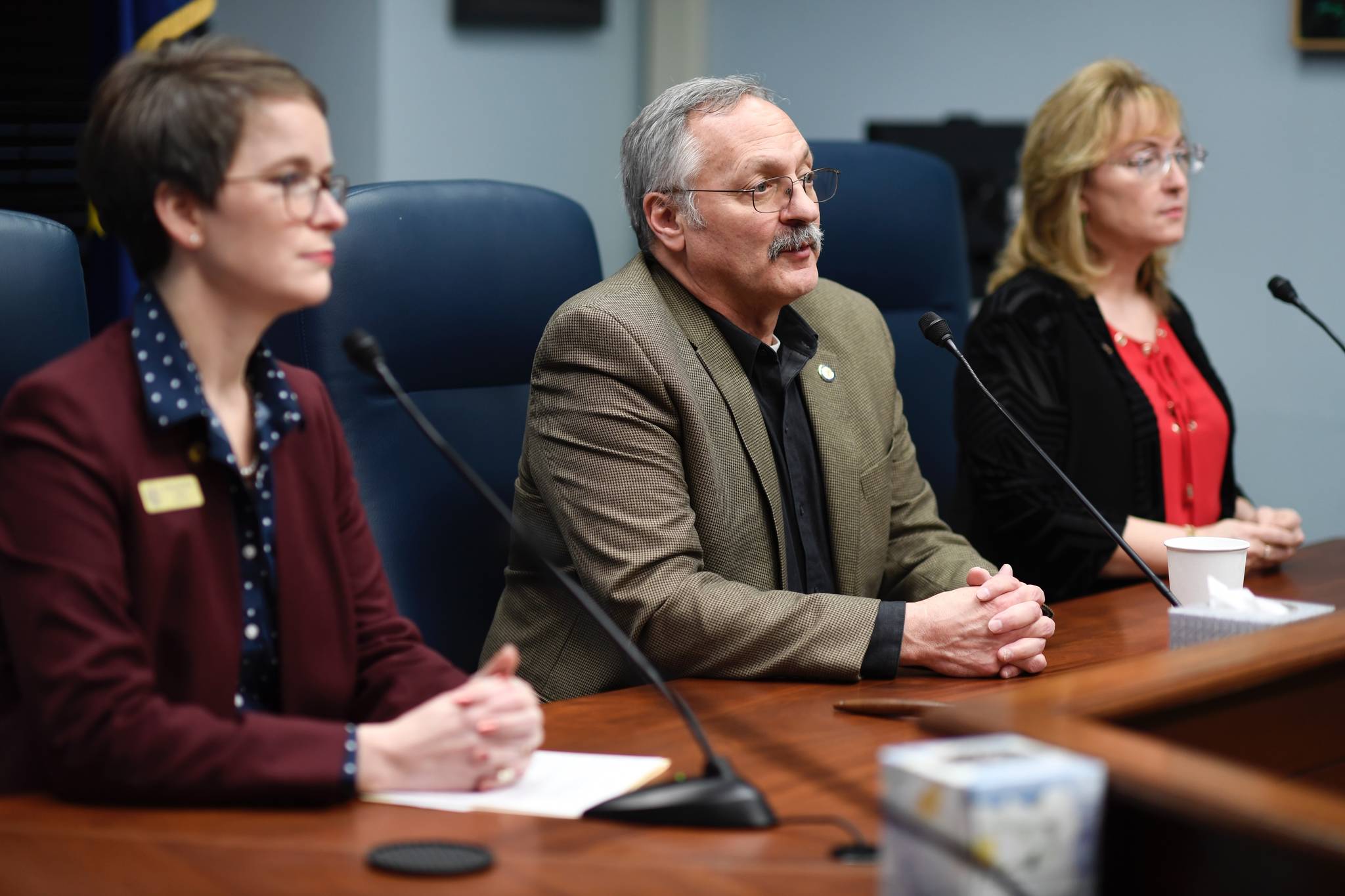
A proposed state budget from Gov. Mike Dunleavy brought both concern and praise from two lower Kenai Peninsula legislators.
“It’s pretty shocking,” said Sen. Gary Stevens, R-Kodiak, in a phone interview on Monday. “… It’s pretty depressing now. We’ll go through it line by line.”
Stevens said Dunleavy’s budget drew criticism throughout the Senate.
“There isn’t anybody at this point who says ‘We approve that total budget,’” he said.
In a statement released through the House Republicans, Rep. Sarah Vance, R-Homer, said that while Dunleavy’s budget requires “great attention and a thorough review,” she agrees with it on principle.
“I am committed to stay true to my word and support balancing the budget, repealing SB91 and restoring the Permanent Fund Dividend,” she wrote. “These are the topics upon which I was elected, and I plan to stay committed to these things while working open-mindedly with my colleagues to achieve a budget that will benefit the State of Alaska.”
Vance said Dunleavy’s budget broke new ground.
“Last week, Alaska Governor Michael J. Dunleavy proposed (a) FY20 budget that, for the first time in memory, balances state expenses with revenue,” she wrote.
That’s not quite accurate. During periods of high oil prices in the mid 2000s, former Gov. Sarah Palin proposed and the Legislature passed budgets fully paid for with oil and gas revenues and that put money into earnings reserves.
In an initial analysis of the budget, Steven’s chief of staff, Doug Letch, noted these impacts locally:
• Kindergarten through 12th grade funding would fall by $320 million, from $1.66 billion to $1.34 billion, with the biggest cut in the foundation formula, from $1.2 billion to $942 million.
• The state contribution to the University of Alaska budget would drop 44 percent, with potential effects to branch campuses in Homer, Kodiak and Soldotna.
• The Alaska Marine Highway System budget would drop from $144 million to $44 million, with a cut to ferry fuel from $20.6 million to $4 million. Stevens said that would mean the M/V Tustumena would end winter service in November.
• Medicaid spending would drop from $2.27 billion to $1.55 billion.
• The Alaska Department of Fish and Game would see a $5 million cut, and the department would not manage special areas such as wildlife refuges, sanctuaries and habitat areas, including the Kachemak Bay Critical Habitat Area.
• The Alaska Department of Natural Resources would see a $4 million cut, mostly for the Division of Agriculture.
• Alaska State Parks would see minor cuts, with only a reduction from $15.8 million to $15.4 million.
Dunleavy’s budget does not add new sources of revenue such as a state income or sales tax, and also proposes paying a Permanent Fund Dividend using the traditional formula. Dividend check amounts had been cut by former Gov. Bill Walker and the Legislature in order to help pay for state services and reduce the state’s massive deficit.
Stevens said on Monday he had attended Senate Finance Committee meetings.
“What I heard that resounded with me, from Sen. (Natasha) von Imhof, was ‘This is the budget you get when you give a full Permanent Fund Dividend,” he said.
Chair of the Senate Education Committee and a retired college professor, Stevens said the cut to the K-12 foundation formula would be hard.
“I’ve been talking to the districts,” he said. “It’s really an unfair position to put them in. We can’t tell them what’s going to happen until we get to the end of each May.”
Delaying information on how much money schools will receive until the summer impacts teacher retention. Many teachers decide to leave and apply for jobs elsewhere when districts aren’t able to offer positions until just a few months before the school year starts.
In addition to department cuts, Stevens noted another impact to local government: a transfer to state coffers of local municipal taxes like the petroleum property tax and the fisheries business and landing taxes. Dunleavy proposes using that money to balance his budget. For petroleum taxes, that’s about $400 million that cities and boroughs would lose. Kenai Borough Assembly Member Willy Dunne, Homer, said the Anchor Point Emergency Service Area would lose $400,000 in such funds.
For fisheries taxes, Kodiak would lose $1.7 million, the borough would lose $177,000 and Homer would lose $59,000.
“These are reductions the communities are going to have to make up one way or another,” Stevens said.
The cuts to the Marine Highway System would be hard on communities with no road service, like Kodiak, Cordova or Prince William Sound villages.
When asked how the ferry cuts would affect plans to build a new Tustumena ferry, homeported in Homer, Stevens said, “There might very well not be a new ship.”
While the governor proposes, the Legislature disposes, and no money can go into the budget that the Legislature does not pass. That means if Dunleavy wants to fund a full PFD, he needs cooperation from them — a potential bargaining tool.
“We’re not at that point yet, but we need to have some really good meetings with the governor and present our case to him,” Stevens said. “He may come off his position. … We’ve got quite a process … we have to deal with. It requires some close negotiations between the House and the Senate and then the governor.””
Raising new revenues is off the table, Stevens said. Dunleavy has said he would repeal an income tax. Dunleavy can veto line items, and it takes 45 votes out of 60 — the House and Senate combined — to override a veto.
“It’s a high barrier, but at this point the governor’s budget has pretty much aggravated everyone I know,” Stevens said. “The North Slope, educators, the university. Who’s left?”
Of Dunleavy’s budget, Vance wrote, “This controversial proposal has made it’s (sic) fair share of waves since it’s (sic) release on February 13th — my office alone receiving more than 60 emails and phone calls from you, the people, wanting to share your support, concern, and altogether powerful voice.”
Reach Michael Armstrong at marmstrong@homernews.com.
