
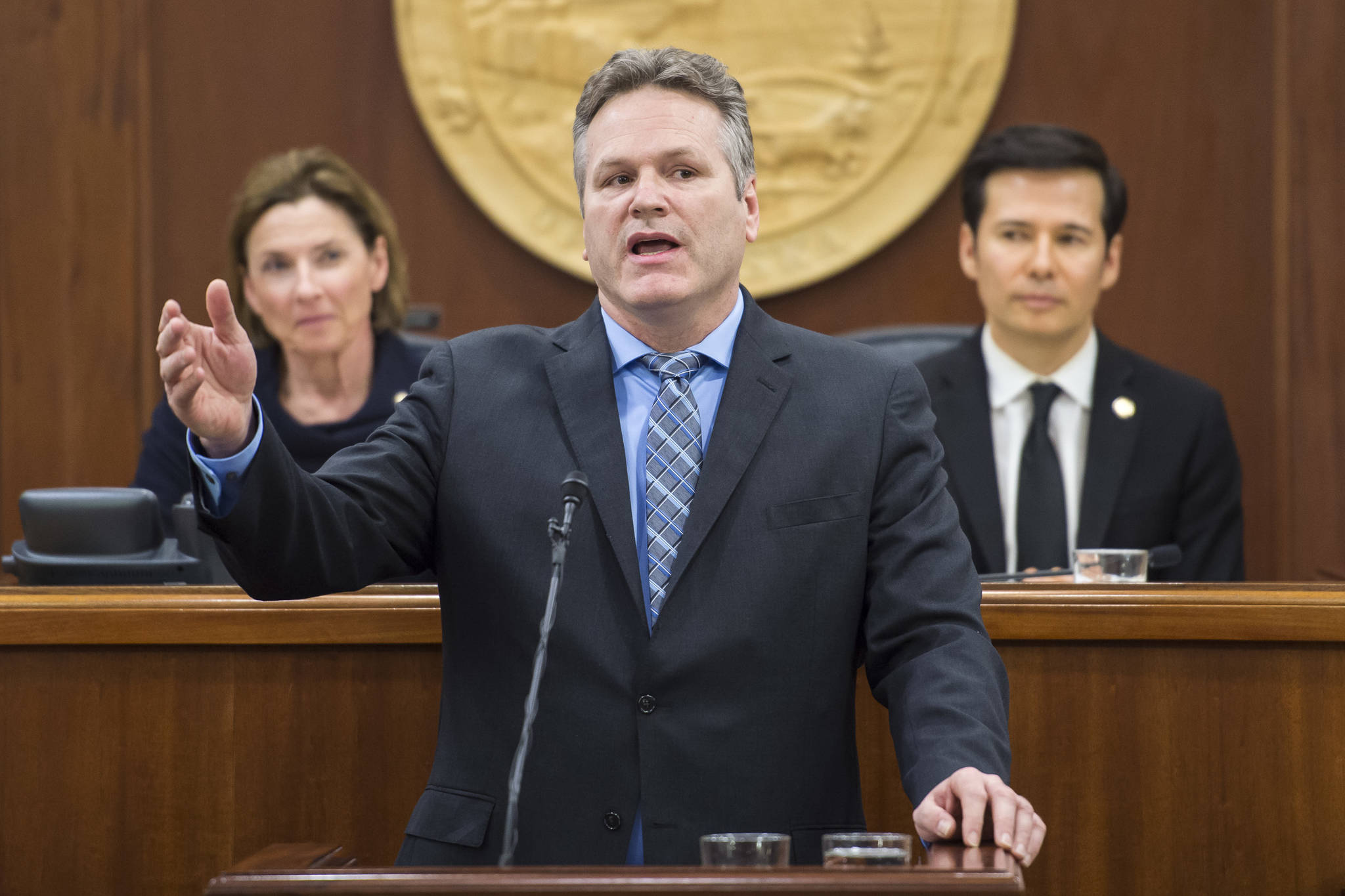
Gov. Mike Dunleavy proposed two supplemental budget bills Monday, one of which includes a $20 million cut to education.
Senate Bill 39 provides an increase for other areas of state government including Department of Corrections, the Alaska State Troopers and the Office of Information Technology. Both bills were referred to the Senate Finance Committee on Monday morning.
The second bill, Senate Bill 38, would appropriate $37.7 million toward disaster relief and mitigation.
Supplemental budget bills amend the current budget, which ends June 30, by moving unused funds from one department to another department.
In May 2018, legislators passed a $20 million appropriation to be distributed among Alaska’s school districts during the current fiscal year. Dunleavy’s proposal essentially nixes the $20 million appropriation approved by legislators when the budget passed.
The $20 million was the first budget increase in years. It was divided among Alaska’s 53 school districts and Mt. Edgecumbe school in Sitka.
According to a document from the Office of Budget and Management, the reason for the proposed education cut is, “The additional funding created a situation in which education was funded beyond the statutorily required amount while other programs were underfunded. This reduction is required to meet other obligations of the state.”
Rep. Andi Story, a freshman from Juneau who spent 15 years on the Board of Education, said she has never seen a move like this.
“That would be unprecedented to make a cut mid-year when school boards have already planned and made budgets, and worked with parents, and made contracts on those allocations,” Story said. “I want teachers, and parents and staff to focus on outcomes. Not the budget. They should be focused on kids right now and I don’t want them to have to worry about budget. It’s not the appropriate time to do it.”
Lisa Parady, executive director of the Alaska Council of School Administrators, said this proposed cut from the Dunleavy Administration was “not unexpected” but also “disappointing.” The Council of School Administrators represents superintendents, principals and other administrators but not teachers.
“The school districts have had this budgeted since July first,” Parady said in a phone interview. “In many cases districts in Alaska have relied on this revenue.”
Parady said going back on a deal that was reached the previous legislative session, would be a “double whammy” because of a Alaska’s teacher shortage, and would only exacerbate the situation.
“I think many educators are wondering whether to stay or to go,” Parady said.
Parady does not believe Alaskans want this education cut, nor does she believe there is a will in the legislature. She referenced a recently released survey from the Republican-led Senate Majority, that says 51 percent of those surveyed think education spending is too low.
“To take it back at this point is very difficult for school districts,” she added.
Before Dunleavy can sign a bill, it must be passed by the Senate and House. The House remains without a majority caucus, and it cannot conduct legislative business until it does.
Rep. Sara Hannon, D-Juneau, said she was perplexed by this supplemental bill.
“Instead of being an addition, you’re taking away money,” Hannan said. “If this bill if went through as the governor proposed it, (School districts) may be three-fifths of through the fiscal year before you ask for this money. That’s the part that really throws me.”
Senate Bill 38
This is a disaster relief bill to help make repairs in Southcentral Alaska following the magnitude 7.0 earthquake that rocked Anchorage in November. This disaster relief bill would provide a $6.5 million to match a federal grant of $46 million. This would be a forward payment for fiscal 2020.
The bill would add another $21.9 million to the state’s disaster relief fund. As the governor pointed out in a memo attached to the bill, “The full damage to highways may not be known until spring.” The state may have to spend more money repairing earthquake damage.
Another $1 million would go to the Department of Transportation and Public Facilities to make repairs that were not covered by insurance.
This bill would also appropriate $7.9 million to the Department of Natural Resources for the purpose of wildland firefighting and related activities.
• Contact reporter Kevin Baird at 523-2258 or kbaird@juneauempire.com.
