
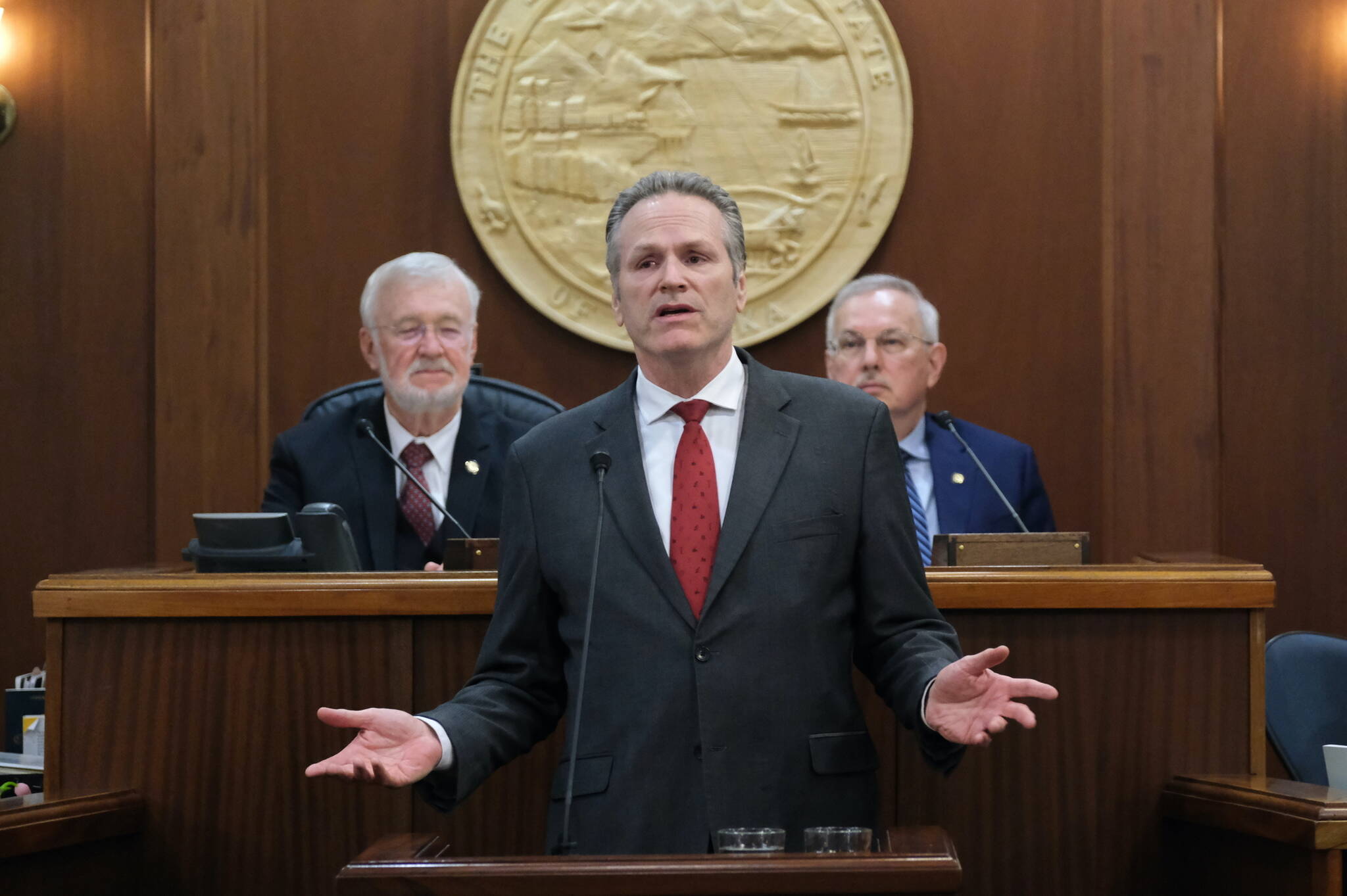
Gov. Mike Dunleavy, in his second-to-last State of the State address on Tuesday night, took a victory lap with a selective recitation of actions and statistics from the past six years of his administration, along with boisterous predictions for the state’s economic future due to the return of Donald Trump to the White House.
The Republican governor’s 45-minute speech to a joint session of the Legislature on Tuesday night at the Alaska State Capitol also made numerous questionable claims, along with remarks contradicting statements he’s made recently. House Speaker Bryce Edgmon, a Dillingham independent, said afterward the governor’s speech was filled with “mixed messages.”
In discussing spending, for instance, Dunleavy said he ran for office “to ensure the state lives within its means.” Yet his proposed budget for next year has a $1.5 billion deficit and a 10-year plan that leaves the state $12 billion in debt (aside from the constitutionally protected Alaska Permanent Fund).
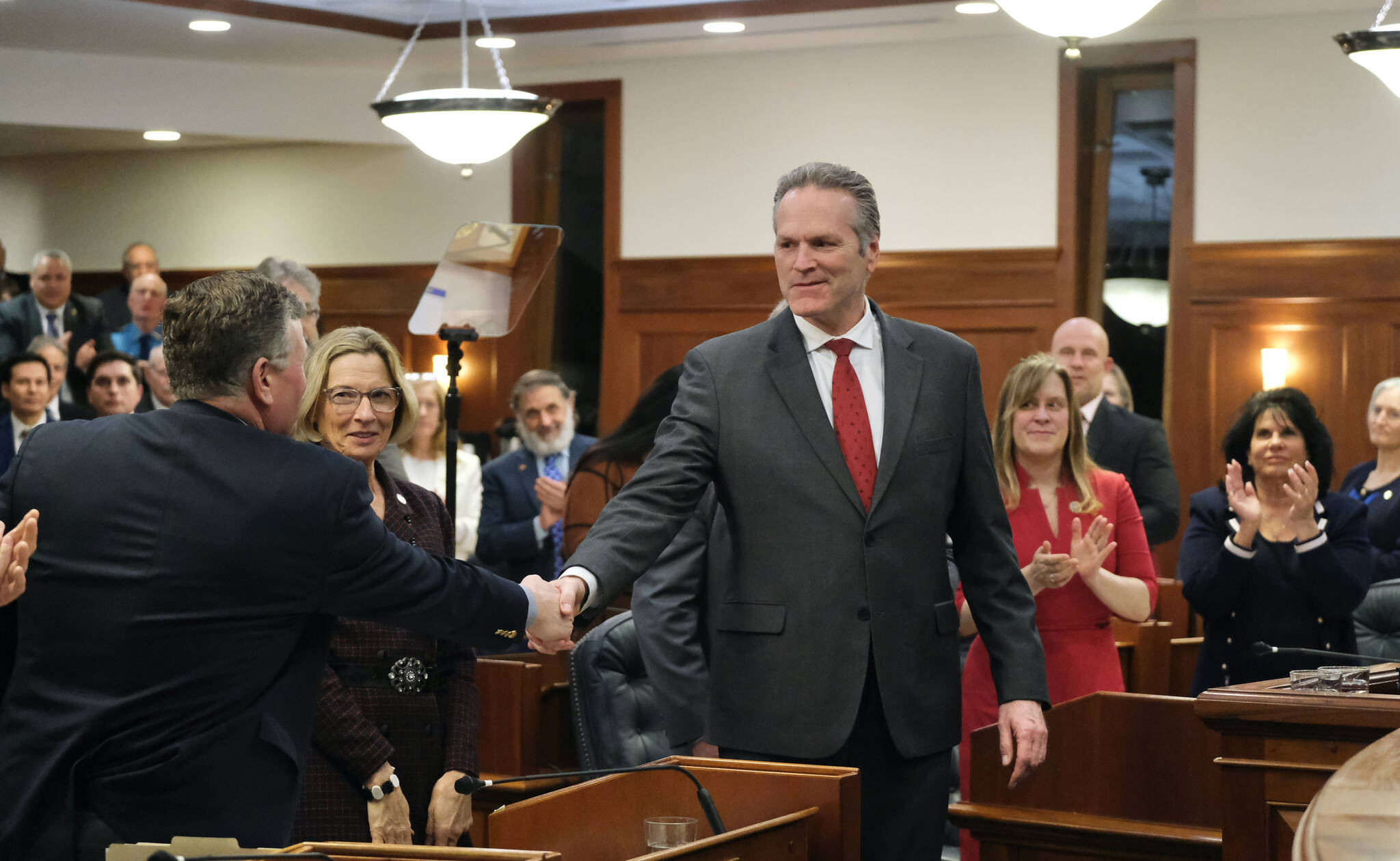
Republican Gov. Mike Dunleavy, right, shakes hands with House Majority Leader Chuck Kopp, an Anchorage Republican, before delivering his State of the State speech at the Alaska State Capitol on Tuesday, Jan. 28, 2025. (Klas Stolpe/Juneau Empire)
Such figures are why the governor has been among the biggest champions of Trump’s efforts to open Alaska to oil and other resource extraction.
“The (U.S.) Department of Interior estimates the state could see as much as an additional $2 billion per year in revenue if (the Alaska National Wildlife Refuge) is fully developed,” Dunleavy said. “We can develop our way to prosperity if we’re given the opportunity and we take advantage of it.”
In a similar mixed message, the governor asserted “our population has not only stabilized, but has grown,” with more than 741,000 residents in 2024 being the highest total since 2017. Yet the state has experienced more than a decade of outmigration and a state study released in December forecasts a 2% population drop (led by a 17% decline in Southeast Alaska) by 2050.
Dunleavy portrayed Alaska as a place where oil, gas and other industry activity has thrived under his leadership, yet during a press conference last week repeated accused former President Joe Biden of a “war on Alaska” that was locking up its natural resources.
The governor also omitted discussion of some areas where the state is struggling — there was no mention of fish or the state’s beleaguered fisheries industry.
“The only real disappointment (in the speech) was the commercial fishing industry in Alaska is in real crisis and over 40-some-odd minutes it would have been good to hear mention about their plight and what he sees as a good way to help.” Sen. Jesse Kiehl, a Juneau Democrat, said after the speech.
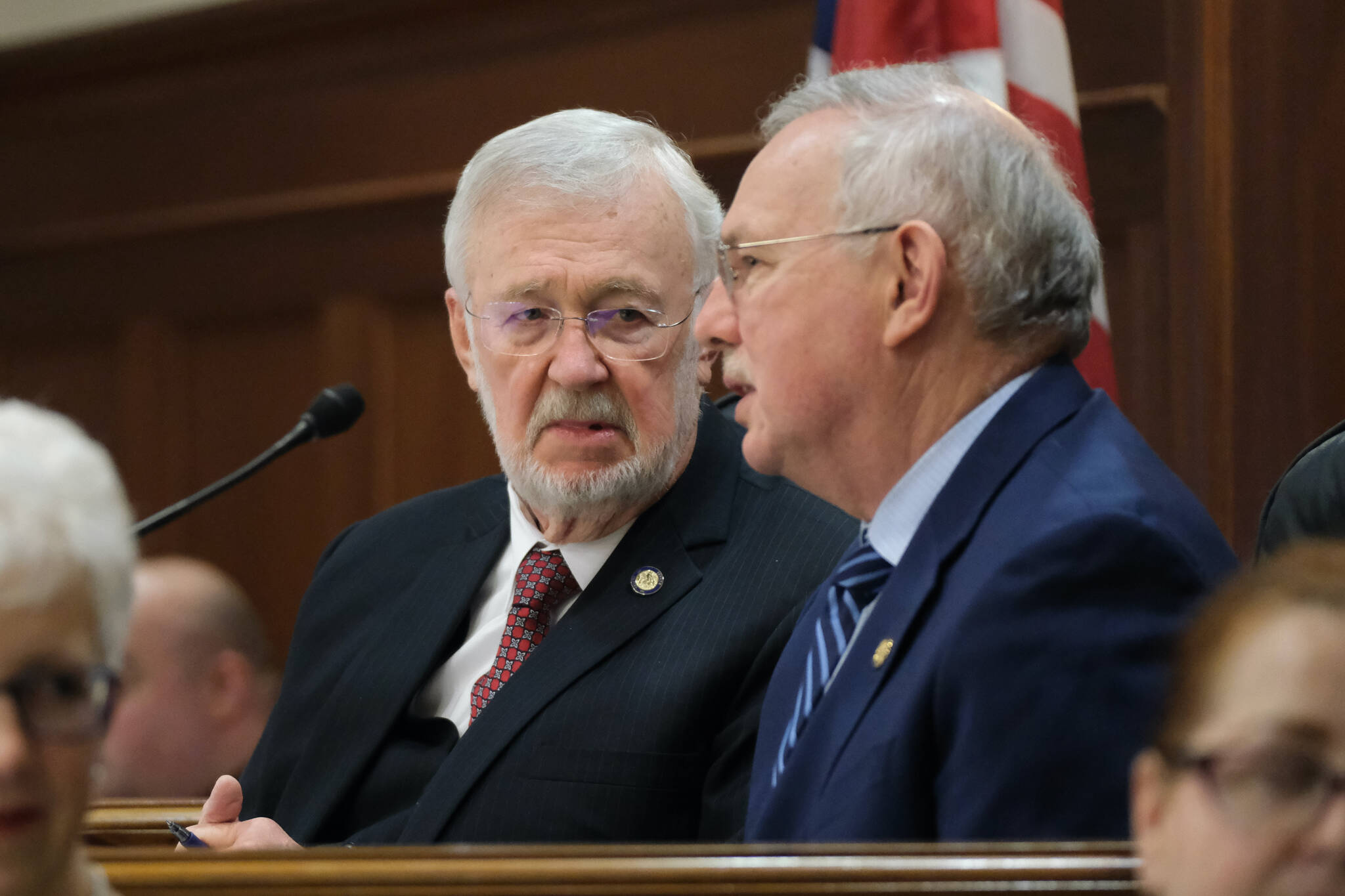
Alaska Senate President Gary Stevens, a Kodiak Republican, left, talks with House Speaker Bryce Edgmon, a Dillingham independent, before Republican Gov. Mike Dunleavy’s State of the State speech on Tuesday, Jan. 28, 2025, at the Alaska State Capitol. (Klas Stolpe/Juneau Empire)
The governor, after the customary thanks and acknowledgements, opened his speech with sports metaphors beginning with “for my time in this office it’s the fourth quarter.”
“And I have no intention of running out the clock and taking a knee with the time I have left,” he said.
Many of Dunleavy’s declared goals for the coming legislative session and beyond are carried over from previous years, including suggesting he is willing to support an education funding increase the Democratic-led bipartisan majority caucuses in the Legislature want if they will support policy changes such as more support for charter schools. But he took a confrontational approach toward legislators and others who oppose those changes.
“Despite the evidence that parents want choice in public education, despite the evidence that students can succeed in more than one type of environment, there are some very loud voices that show up down here like the swallows returning to Capistrano with megaphones and t-shirts telling you that the only thing that matters is money,” he said. “We even have people that will take the state to the Supreme Court to try to limit student options and force them into a one-size-fits-all model.”
That combative approach was exhibited by Dunleavy before his speech in a social media message encouraging people to testify Wednesday against a House majority bill that permanently raises the state’s per-student education funding formula, including a 22% raise during the coming year and a total of more than 40% after three years. Edgmon called it one of the contradictions in the governor’s speech that also called for people at the Capital seeking to find common ground.
“I can tell you that education, our schools are crippled right now by surging fixed costs — whether it be energy, whether it be healthcare, whether it’s for some schools teetering on declining enrollments — that are really making a material impact on their overall bottom line,” Edgmon said. “Those are real-world problems that I would have loved to have heard him address.”
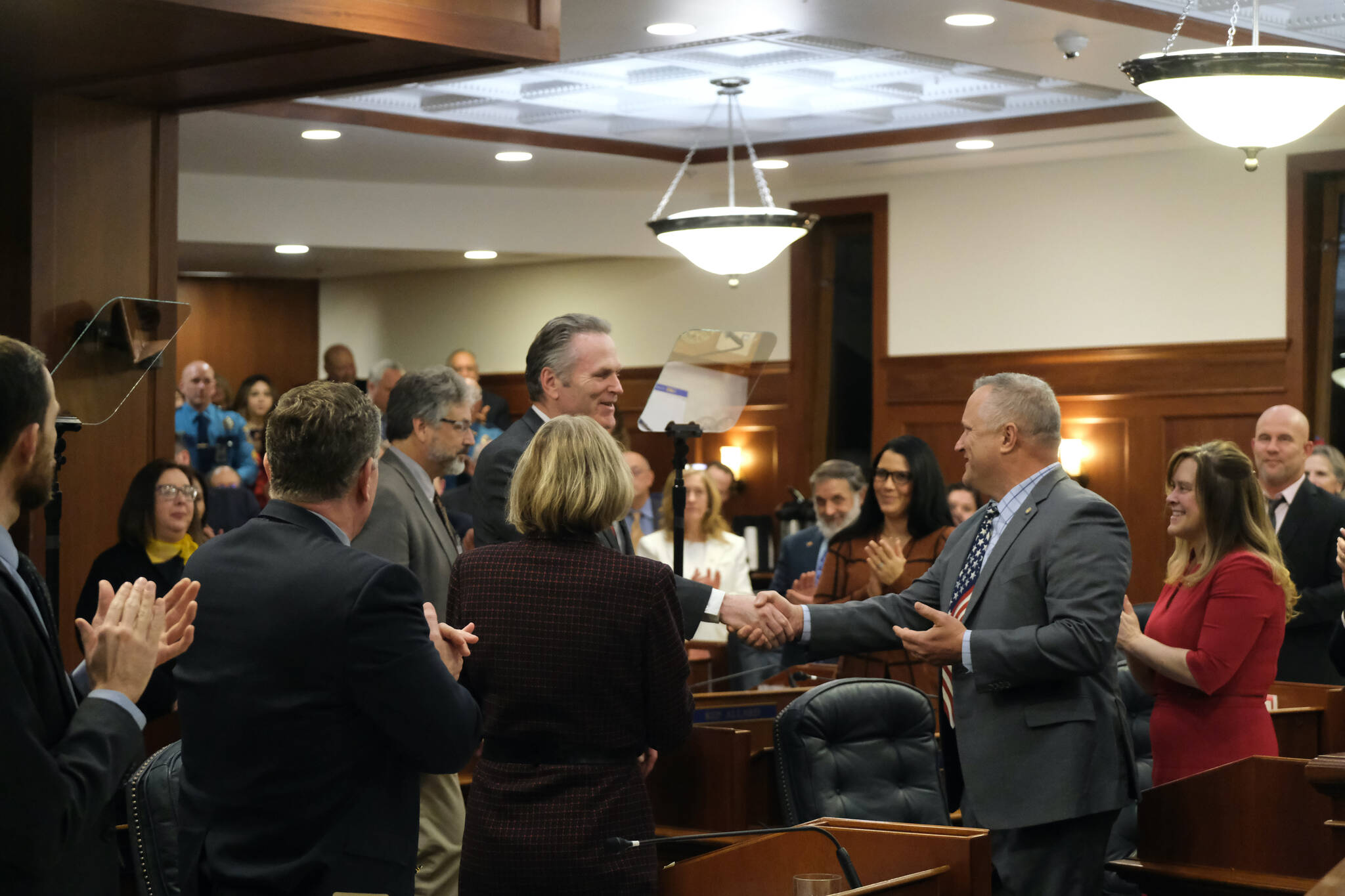
Republican Gov. Mike Dunleavy, center, shakes hands with Senate Minority Leader Mike Shower, a Wasilla Republican, right, before delivering his State of the State speech Tuesday, Jan. 28, 2025, at the Alaska State Capitol. (Klas Stolpe/Juneau Empire)
At the same time, he said most of the Legislature agrees with Dunleavy’s assertion that Alaska “is a resource development state,” and “he’s going to have the support of the Legislature” for many of his policy goals in that area.
Dunleavy highlighted Trump’s Alaska-specific executive order that seeks to do away with federal regulations that inhibit resource development, with the governor vowing “my administration will be introducing legislation to ensure we have the most competitive licensing process that attracts professional talent and allows them to get to work quickly.”
“All we have to do is embrace these opportunities and make sure we have policies in place that let the world know we are open for business — not just on federal lands, but state lands as well,” Dunleavy said.
The governor didn’t mention some other actions by Trump that have found far less favor with many lawmakers and Alaskans, including reviving the name of Mount McKinley instead of Denali and a federal funding freeze that set off widespread turmoil until a federal judge suspended the order until at least Monday.
Crime was another major topic of the speech for Dunleavy, who again was selective in the data he presented. The governor stated the overall crime rate is down 37% since 2018 — a year that saw an upward spike in crime — but the state continues to be among the nation’s leaders in per-capita violent crimes such as rape and murder. The state is also experiencing a worsening problem with illegal drugs — including a rapid rise in overdose deaths at a time they are declining nationally — which Dunleavy acknowledged largely in terms of actions by law enforcement.
“In 2018, our Troopers seized about 78 pounds of illegal drugs,” he said. “Last year, their efforts led to the seizure of more than 572 pounds of drugs.”
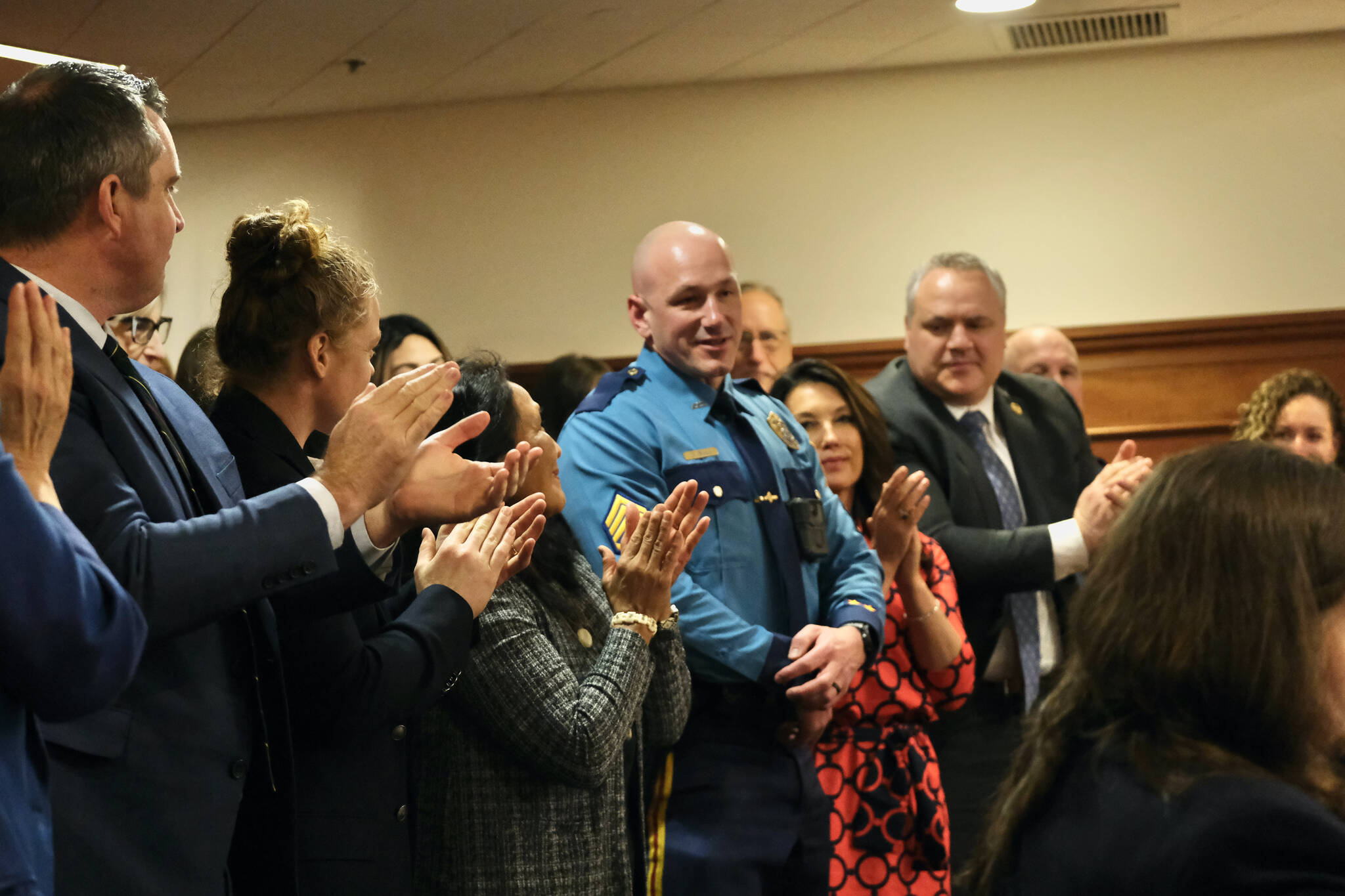
Alaska State Trooper Sgt. Jared Noll, center, is honored during Gov. Mike Dunleavy’s State of the State speech on Tuesday, Jan. 28, 2025, at the Alaska State Capitol. He is surrounded by members of Dunleavy’s Cabinet and other guests, including Dunleavy’s wife, Rose Dunleavy, third from left. (Klas Stolpe/Juneau Empire)
But Dunleavy’s talk of expanding law enforcement activities in Alaska overlooks another harsh reality neglected in his speech — a widespread and ongoing workforce shortage, said Senate Majority Leader Cathy Giessel, an Anchorage Republican, in comments to reporters after the speech.
“We have unfilled positions right now,” said Giessel, who among other things is leading an effort to boost public employee retirement benefits to make those jobs more attractive. “The Anchorage Police Department has 71 openings that they can’t fill. The Troopers have a similar number. So recruitment is a problem. It’s great to throw more money at something, but if you can’t recruit and retain employees after they’ve been trained and brought up to speed you’re really not ahead. You’ve actually wasted some time and money. We need to turn that around.”
Dunleavy used the references to drug busts to single out one of two residents recognized during the governor’s speech. Alaska State Troopers Sgt. Jared Noll, a member of the Statewide Drug Enforcement Unit in the Matanuska-Susitna Valley, was credited by Dunleavy for leading “a multi-agency effort last year over several months tracking dealers selling drugs and fentanyl poison in our Mat-Su and Kenai Peninsula communities.”
“Not only did it lead to the indictments of four individuals involved in a multistate trafficking operation, but they also seized over 75 pounds of drugs including heroin, meth, cocaine and more than 35 pounds of fentanyl,” Dunleavy said.
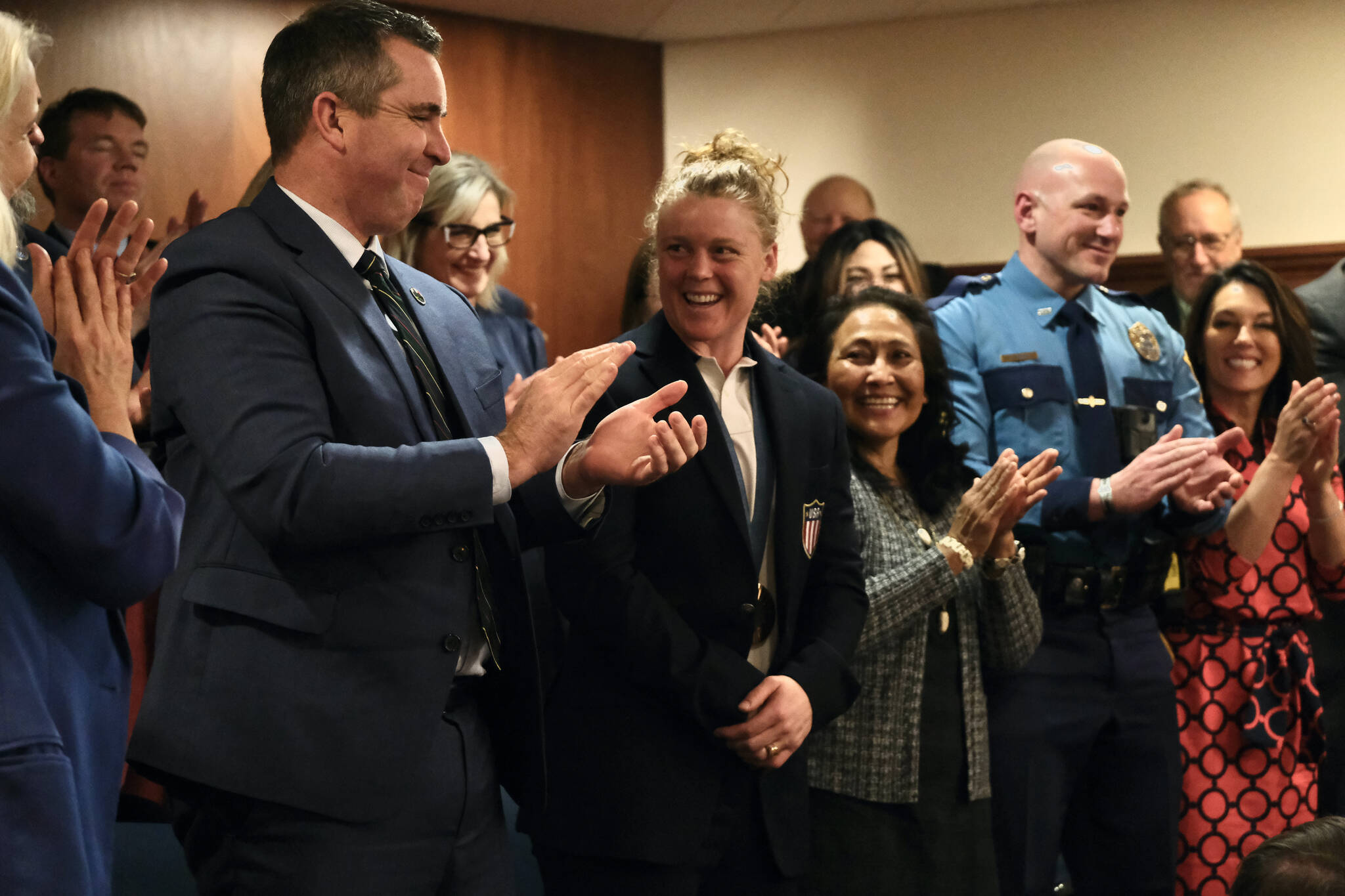
Olympic athlete Alev Kelter, center, smiles as she’s recognized during Gov. Mike Dunleavy’s State of the State speech on Tuesday, Jan. 28, 2025, at the Alaska State Capitol. Next to Kelter is Dunleavy’s wife, Rose Dunleavy, and Alaska State Trooper Sgt. Jared Noll, who were also recognized during the speech. (Klas Stolpe/Juneau Empire)
The other person recognized by the governor was rugby star Alev Kelter, a Chugiak High School graduate who was a member of Team USA’s bronze-winning Rugby Sevens team at the 2024 Summer Olympic Games in Paris. She was inducted into the Alaska Sports Hall of Fame last year.
“Kelter isn’t just a three-time Olympian, she’s also the national team’s all-time leading scorer and we’re proud she still calls Alaska home,” Dunleavy said.
• Contact Mark Sabbatini at mark.sabbatini@juneauempire.com or (907) 957-2306.
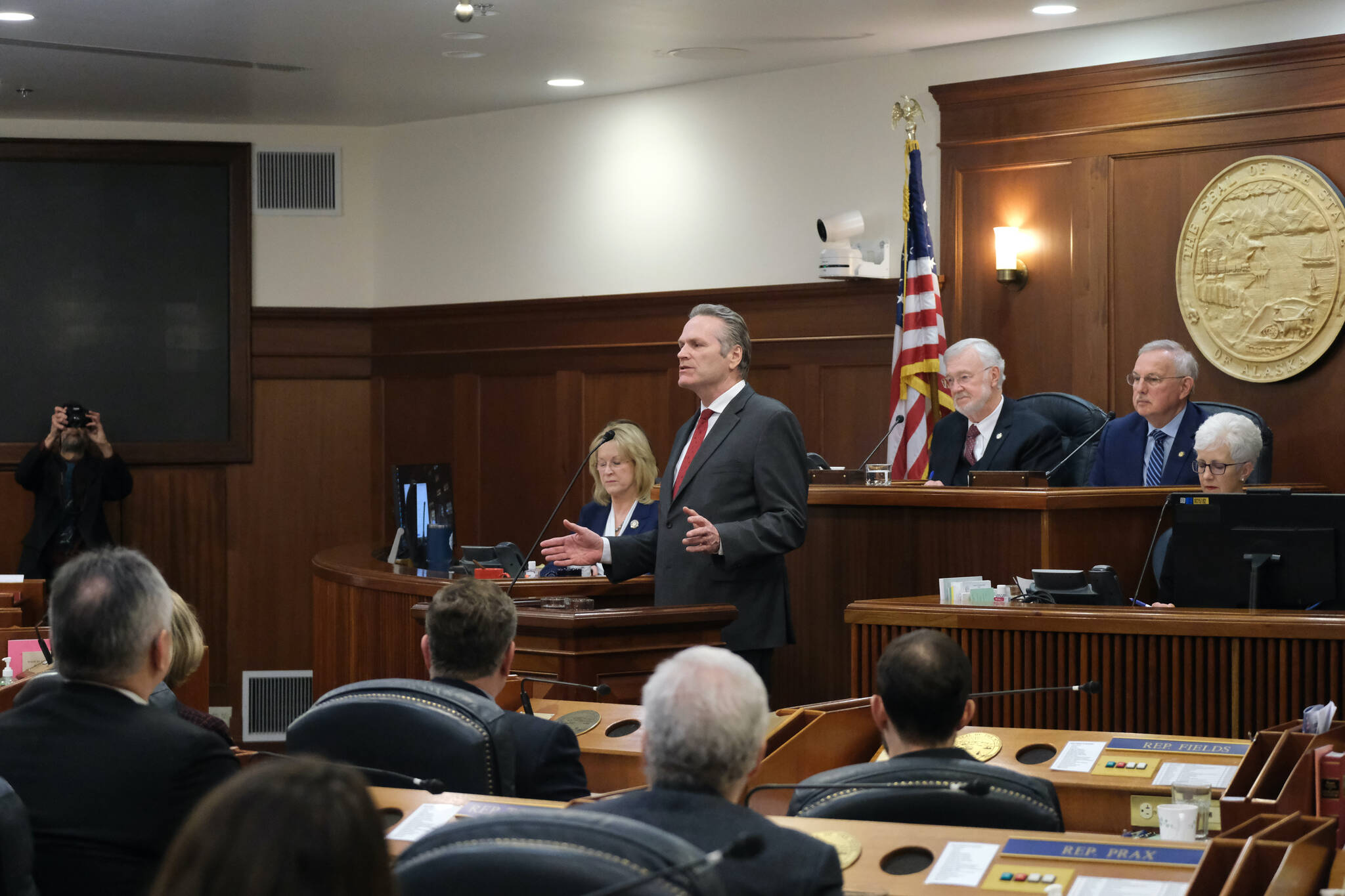
Gov. Mike Dunleavy delivers his State of the State speech Tuesday, Jan. 28, 2025, at the Alaska State Capitol. (Klas Stolpe/Juneau Empire)
