
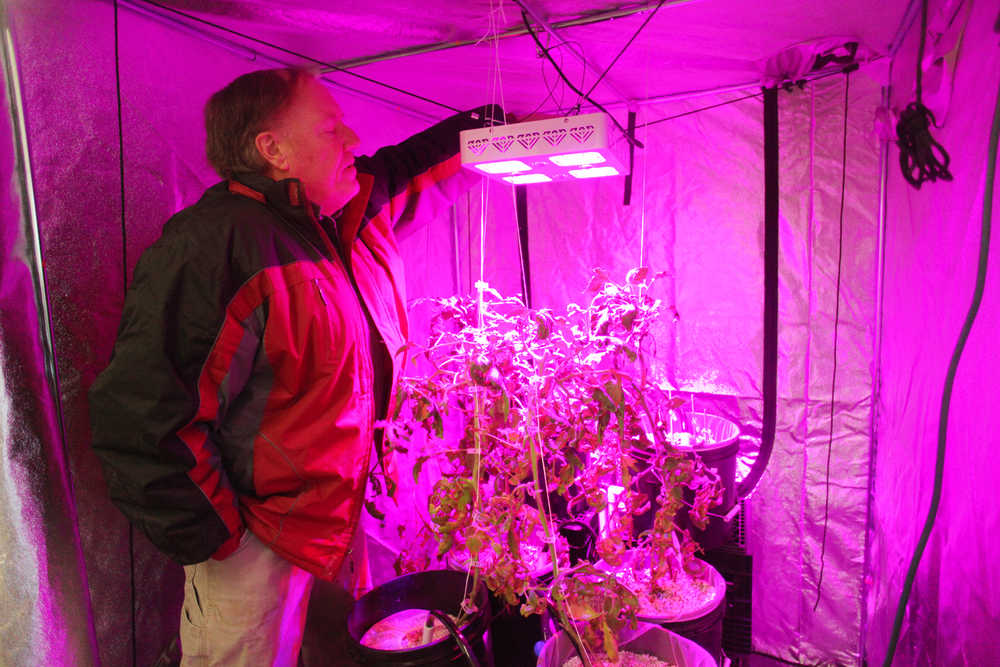
Photo by Kelly Sullivan/ Peninsula Clarion Patrick White adjusts the LED lights over the four tomato plants he is growing in hopes of breaking the world record for biggest tomato grown indoors, Wendesday, Jan. 6, 2016, in Soldotna, Alaska.

Photo by Kelly Sullivan/ Peninsula Clarion Patrick White adjusts the LED lights over the four tomato plants he is growing in hopes of breaking the world record for biggest tomato grown indoors, Wendesday, Jan. 6, 2016, in Soldotna, Alaska.

Going big: Soldotna gardener shoots for tomato record

  • By Kelly Sullivan
  • Wednesday, January 6, 2016 10:09pm
  • News

The gardener who broke the record for largest tomato at the Alaska State Fair this summer is braving an attempt at producing another phenomenal fruit this winter.

Patrick White is up against more than two dozen contestants worldwide who are trying to grow giant tomatoes indoors. Forgoing shoes, White scuffled around his unusually warm garage Wednesday, explaining the hand-rigged system that is feeding four genetic clones of the plants that won him the award this summer.

“There is no soil at all, just Perlite,” White said with a laugh. “That’s all it is.”

Under a large black tent, six containers are kept off the cold ground with retired milk crates. The two in back have the thin onion greens peeking out. White is also, of course, trying to break the world record with the seeds he purchased from the United Kingdom’s Peter Glazebrook, who produced the current champion, a nearly 19-pound onion. He has to cultivate the sour vegetables inside for five months before transplanting them into the ground.

White said he hasn’t heard of another tomato grower in Alaska that has taken up the challenge this season.

He picked up a small handful of the tiny white pebbles that the roots trail through to present the foundation that is insusceptible to disease and rot. He also pointed out the series of tubes that supply water to the sprouting systems for two hours every six hours and then is drained with a large pipe.

Heating and lighting are also set to timers, which are replicating similar, if not exact, conditions that their mother plants received in the largest of three high tunnels White has in his Soldotna backyard this summer. The plants get 12 hours of sunlight and sit in temperatures of 80 degrees Fahrenheit for that time, and then at 60 degrees Fahrenheit “overnight,” he said.

The LED lights White uses cost more than the high-intensity discharge HID lamps used for indoor growing, but they use about one-fourth of the power.

He also notes that construction was accomplished on the cheap. Building the hydroponic operation from scratch also saved considerable money and, he added, the timers were only $11 each.

White feeds his fruit with a formulated mixture of calcium nitrate, magnesium sulfate, sodium bicarbonate “to increase alkalinity” and pH down to lower the acidity.

There are some limitations to the system, White said. People run into trouble when they expect too much from the LED bulbs, he said. The two tallest tomato plants are the only ones with green fruits two months after germination, he said. But he plans to keep them on the vine for another 60 days, which should be enough to get close to the goal.

White said he is aiming for much larger than the one-pound bodies that have been reported as the benchmark by his competitors. He is consistently tending to his tiny patch and when he is gone from the state for any period of time, his son Stephen, who helped with the nearly five-pound record breaker, steps in.

The challenge finishes on the first day of spring, and all entries will be verified and honored by the Great Pumpkin Commonwealth, which officiates the Alaska state fair’s crops department entries.

White’s entries for the 2015 contest took the fourteenth, sixteenth, twenty-fourth and forty-eighth spots out of nearly 300 entries for the world’s largest tomatoes. The plants he is nourishing now will be replanted in his high tunnel in on May 1, along with other clones to go for the record again this year.


Reach Kelly Sullivan at kelly.sullivan@peninsulaclarion.com.

More in News

Kenai Peninsula Borough Mayor Peter Micciche speaks during a meeting of the Borough Assembly in Soldotna, Alaska, on Tuesday, May 21, 2024. (Jake Dye/Peninsula Clarion)
Borough updates public noticing requirements

The Kenai Peninsula Borough Assembly approved an ordinance last week effectively ending requirements to publish notices in a newspaper of general circulation.

A map presented by the Alaska Department of Natural Resources during a virtual meeting on Dec. 11, 2025, shows the location of a potential Kenai Peninsula State Forest. Screenshot.
Community discusses state forest proposal at Homer meeting

The public comment period on the proposed Kenai Peninsula State Forest closes Jan. 16 at 5 p.m.

The Alaska Department of Environmental Conservation helped a Nikiski resident dispose of over 43 tons of contaminated soil after a home heating oil spill in November<ins> 2025</ins>. DEC on Friday launched a program to help eligible homeowners cover cleanup costs relating to home heating oil spills. Photo courtesy of the Department of Environmental Conservation
State launches home heating oil spill cleanup program

The Department of Environmental Conservation formally announced the program statewide on Friday.

Sterling resident Jonny Reidy walks 11 miles from his dry cabin to his part-time job at Fred Meyer on Dec. 15, 2025. Reidy aims to walk 1,000 miles by midsummer, and he’s asking people to pledge donations to food banks for every mile he travels. Photo courtesy of Jonny Reidy
Sterling man is walking 1,000 miles for hunger awareness

Jonathan Reidy asks people to pledge donations to local food banks for every mile he walks.

Soldotna High School students learn how to prepare moose meat through the school’s annual Moose Permit Project, an educational partnership between SoHi and the Alaska Department of Fish and Game. Photo courtesy of Tabitha Blades/Soldotna High School
Soldotna students get hands-on moose harvest experience

SoHi’s annual Moose Permit Project is an educational collaboration between the school and the Alaska Department of Fish and Game.

A snowmachine rider takes advantage of 2 feet of fresh snow on a field down Murwood Avenue in Soldotna, Alaska, on Monday, Dec. 12, 2022. (Jake Dye/Peninsula Clarion)
Kenai refuge announces snowmachine opening

All areas traditionally allowing snowmachine use in the Kenai National Wildlife Refuge are now open.

Kate Rich’s play, “The Most Comfortable Couch in Town,” is performed during “Stranded: A Ten-Minute Play Festival” in August 2025 in Homer, Alaska. Photo provided by Jennifer Norton
Homer playwright receives fellowship award

Kate Rich is revising a new play, which she hopes to take to the Valdez Theatre Conference Play Lab.

A BUMPS bus waits for passengers in the Walmart parking lot in Kenai, Alaska, on Oct. 15, 2018. (File photo)
Ninilchik Traditional Council expands public bus service

The Homer-Kenai BUMPS bus will now run five days a week.

Balloons fall on dozens of children armed with confetti poppers during the Ninth Annual Noon-Year’s Eve Party at the Soldotna Public Library in Soldotna, Alaska, on New Year’s Eve, Tuesday, Dec. 31, 2024. (Jake Dye/Peninsula Clarion)
Out with the old, in with the new

The Peninsula Clarion looks back on 2025 in this “year in review.”

Most Read