
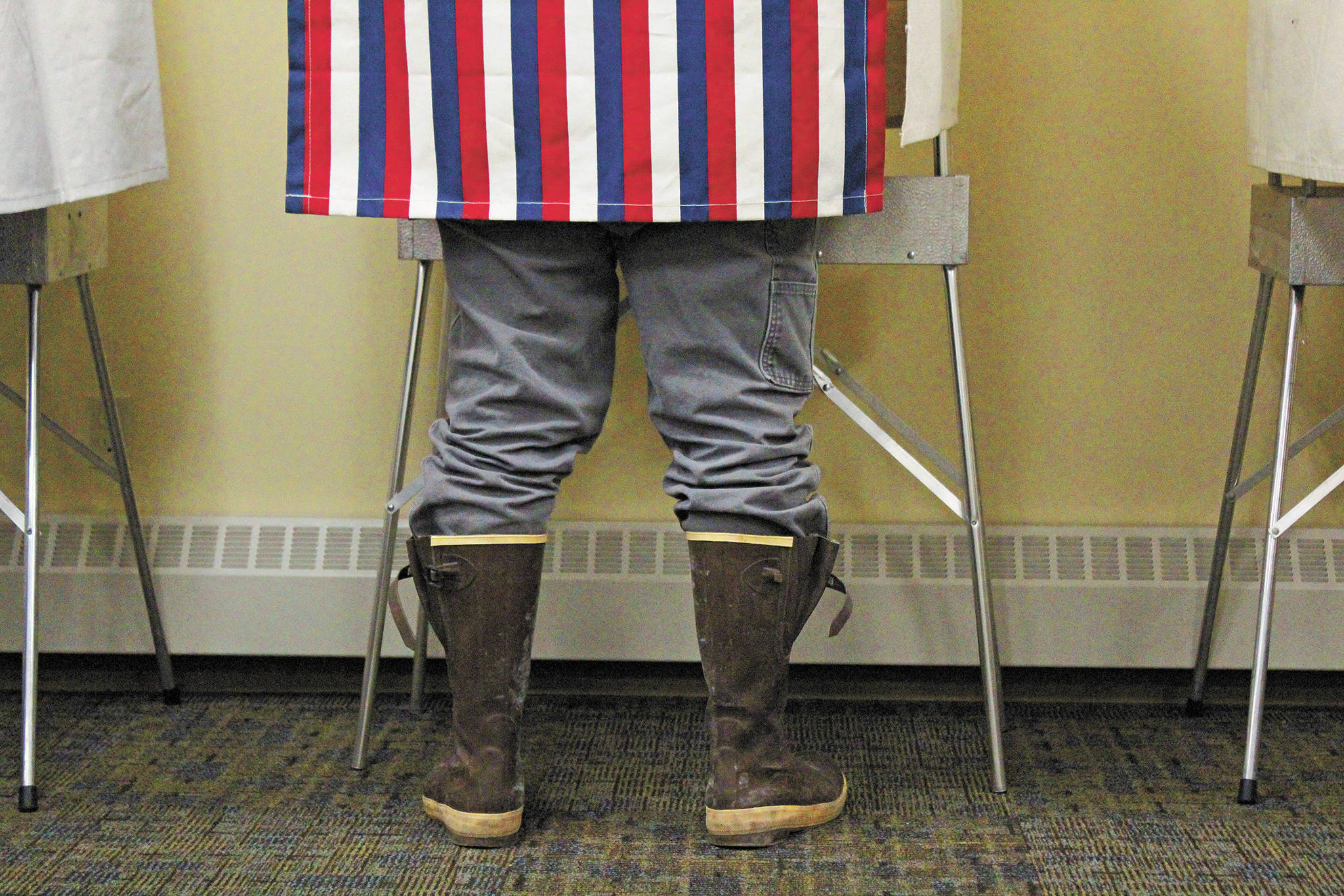
After months of advertising, mailers, social media blitzes and debates, citizens have the final say on the election next Tuesday, Nov. 3, when they go to the polls and vote. For those navigating the general election, here’s a last-minute guide on how to cast their ballots.
Polls are open from 7 a.m. to 8 p.m. at precincts around the Kenai Peninsula. Everyone in line before polling places close at 8 p.m. will get to vote — even if that means poll workers have to stay until midnight, said Tiffany Montemayor, public relations manager for the Alaska Division of Elections.
The ballot for District 30 — which includes Kenai and Soldotna, includes elections for U.S. president and vice president, U.S. senator, U.S. representative and state representative – District 30. The ballot also includes a question asking if judges should be retained. On the ballot are retention questions for Alaska Supreme Court Justice Susan M. Carney, Court of Appeals Judge Tracey Wollenberg, and judges from the Third Judicial District Superior Court and District Court.
The ballot for District 29, which includes Nikiski, Seward, Hope and Sterling, includes the same races as the ballot for District 30, however, voters will be selecting their choice for state representative – District 29 instead of 30.
Voters also will decide on two ballot measures. Measure No. 1 is “an act changing the oil and gas production tax for certain fields, units, and nonunitized reservoirs of the North Slope” and Measure No. 2 is “an act replacing the Political Party Primary with an Open Primary System and Ranked-Choice General Election, and Requiring Additional Campaign Finance Disclosures.”
You can view the election pamphlet with candidate descriptions here: https://www.elections.alaska.gov/election/2020/General/OEPBooks/2020%20AK%20Region%20I%20pamphlet_FINAL-web.pdf
A sample ballot for District 30 is here:
https://www.elections.alaska.gov/election/2020/General/SampleBallots/HD30%20JD3.pdf.
A sample ballot for District 29 is here:
https://www.elections.alaska.gov/election/2020/General/SampleBallots/HD29%20JD3.pdf
Alaskans should bring some sort of identification with them, such as their voter registration cards. Polling places will follow COVID-19 safety practices. Poll workers will wear face masks and have plastic barriers between them and the public. Voters are strongly encouraged, but not required, to wear masks unless local regulations require masks. Social distancing marks will be placed on floors at polling locations. Hand sanitizer also will be available.
“We will be constantly cleaning and sanitizing all the things that are constantly touched, like voting equipment, secrecy screens, pens — all of that,” Montemayor said.
Alaska law prohibits campaigning within 200 feet of any entrance into the voting area. That includes discussing candidates or issues in that prohibited zone or wearing buttons, clothing, hats or even face masks with candidate names, logos or slogans that can be associated with a candidate. Voters also cannot display candidate flags or bumper stickers from their trucks or cars if parked near polling places.
People driving by in groups with flags or signs near a polling place would be prohibited, she said. People also cannot intimidate voters. Poll watchers — that is, anyone who is not a poll worker or voting — must wear identifying badges. Poll watchers can be sent by a political party, candidate or ballot measure when authorized by the Division of Elections. Poll watchers are not acting as security, Montemayor said.
Several people have asked about carrying firearms at polling places, Montemayor said. She referenced a link to an Alaska Department of Public Safety website that reads “Alaska’s laws do not prohibit anyone 21 or older who may legally possess a firearm from carrying it concealed or open.” That same website notes that owners of private property can prohibit firearms. Some polling places are on private property, such as churches. For more information, visit https://dps.alaska.gov/statewide/r-i/permitslicensing/concealedhandguns.
Poll workers are authorized to call local police or Alaska State Troopers for security issues and also have been told to call regional and state offices if there are issues, Montemayor said.
This year, thousands of Alaskans already have started the voting process. Statewide as of Monday, 119,519 voters requested absentee ballots, Montemayor said. Of those, 63,345 have already been returned, either through the mail or dropped off in secure ballot boxes or at absentee in-person voting locations.
Mailed in, dropped off and in-person absentee votes get counted starting Nov. 10. Statewide, 21,452 people have participated in early voting, Montemayor said. This is not the same as absentee in-person voting. Early votes get counted on Election Day if done before Oct. 29. The nearest early voting locations are in Anchorage.
Mailed ballots must be postmarked Nov. 3 and received by Nov. 13 from the United States and Nov. 18 if mailed from foreign countries. The target date for certifying the election is Nov. 25. However, absentee ballots are logged in as they are received, and the absentee review board began verifying received absentee ballots on Oct. 27 to check that they have the proper signatures, identifiers and other information. To see if your absentee ballot has been received, visit https://myvoterinformation.alaska.gov.
Montemayor said early or absentee votes will probably be about 25% of the total votes that could be cast by registered voters.
“Which means results aren’t going to be decided on election night,” she said. “There’s almost no way that could happen.”
Montemayor urged people to come up with a voting plan. Decide how you’re going to vote. If you’re voting in person, find your polling place and know when it’s open. If you’re going to need a ride, arrange a ride now, she said.
No matter how or when people vote, Montemayor said people should know one thing.
“It doesn’t matter when or how they voted, absentee or whatever,” she said. “Every eligible vote is going to counted.”
For more information on elections, visit https://www.elections.alaska.gov.
Reach Michael Armstrong at marmstrong@homernews.com.
