
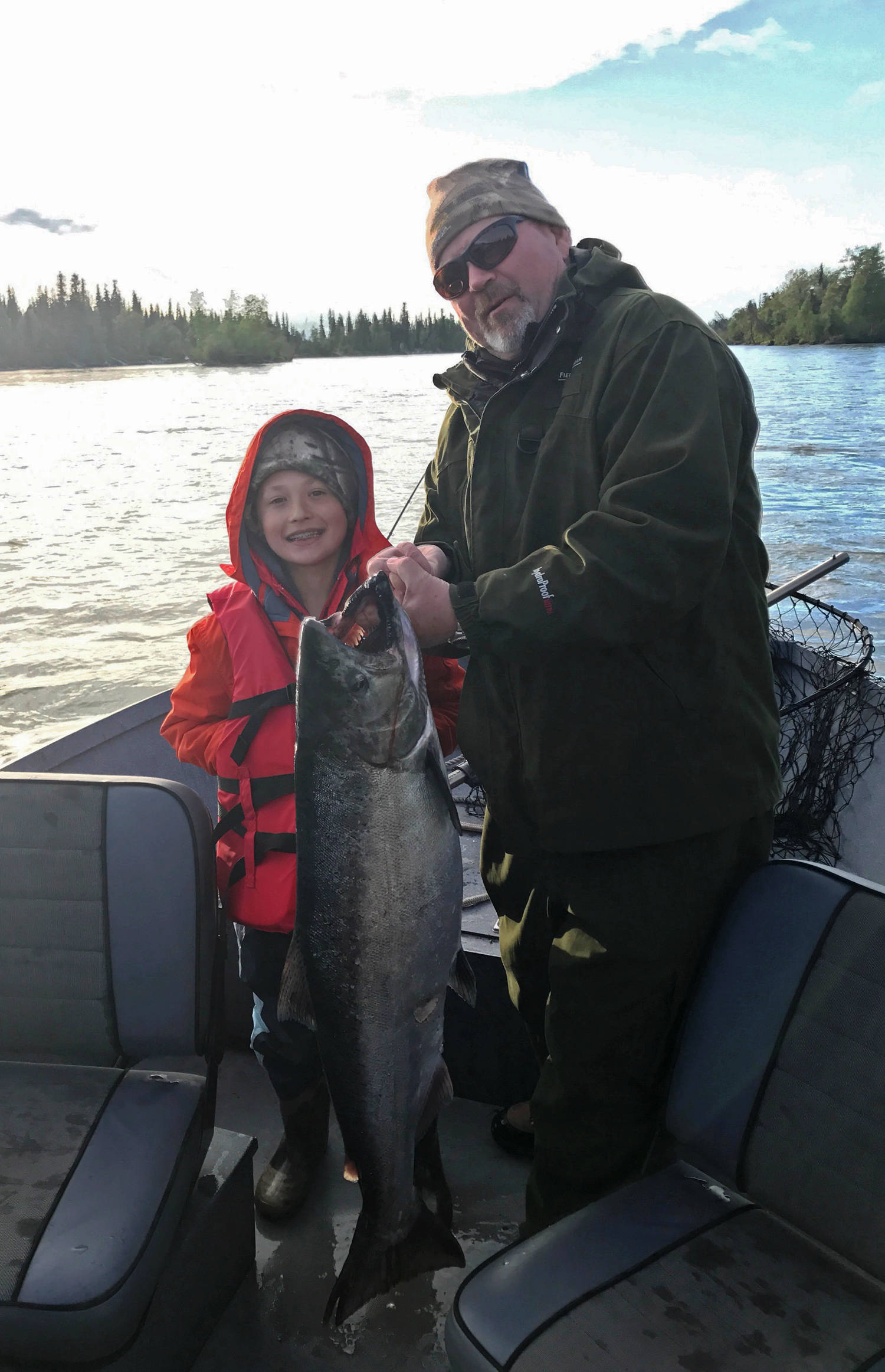
Randy McPherson and his grandson Ethan, 9, both of Wisconsin, show off their Kenai River king salmon caught Tuesday, June 13, 2017. Kenai River early-run kings have been returning in larger numbers this year as compared to the last several years, leading the Alaska Department of Fish and Game to liberalize the maximum size limit for retention from 36 inches to 46 inches on Monday. (Photo courtesy Jason Foster)

Randy McPherson and his grandson Ethan, 9, both of Wisconsin, show off their Kenai River king salmon caught Tuesday, June 13, 2017. Kenai River early-run kings have been returning in larger numbers this year as compared to the last several years, leading the Alaska Department of Fish and Game to liberalize the maximum size limit for retention from 36 inches to 46 inches on Monday. (Photo courtesy Jason Foster)

Fishing report: Russian flush with reds

Sunday morning’s opener at the confluence of the Russian River and Kenai River saw a lot of happy anglers.

By midmorning, fishermen of all ages were hooking into some of the famous sockeye salmon bound for the Russian River, a snow-fed tributary of the Kenai River. The daily bag limit for the confluence area and on the Russian River is three fish per day with six in possession, and many anglers were already packing out their fish before noon.

Sockeye hit the Russian River hard this year. As of Tuesday, 4,417 sockeye had passed the Alaska Department of Fish and Game’s weir on Lower Russian Lake, more than twice as many as by the same date in 2016.

The Russian River is separated into two distinct runs, demarcated on July 15. The early run is managed for an escapement goal of 22,000–42,000 fish, and the late run is managed for a run of 30,000 – 110,000 fish. The runs vary from year to year, both in size and timing. This year, it looks like the early run may have a high few days and then peter out, based on what’s coming up at Fish and Game’s king salmon sonar at river mile 14, said Jason Pawluk, the assistant area management biologist for the Division of Sportfish in Soldotna.

There are still fish congregating in the sanctuary of the Russian River confluence area, and the sonar registered some major pulses of fish headed up the river, with the peak still set to hit the area, he said.

“They’re there, and I really think any day now it’s going to be good,” he said. “I think people should still hold out hope that that fishery is going to be good.”

For anglers willing to hike, fishing could be better up in the clear waters of the Russian River itself, where there’s less water for the fish to disperse and less sediment clouding it, he said. As the weather warms, anglers may have the most luck going early in the morning as the overnight fish make their run or in the cooler parts of the day, or shadier parts of the stream with cooler water, he said.

“I think that’s the key to the Russian — whether you’re in the clear water or right below the confluence in the Kenai,” he said. “Early morning and late evening are your best bets … in sunny conditions (the fish) are probably not going to make a run up the Russian in the heat of the day.”

Down on the lower Kenai, the early run of king salmon is in full swing, with more fish returning than in many recent years. As of Tuesday, 4,589 large fish had passed Fish and Game’s sonar, still ahead of the count of all fish on the same date in 2016. Managers shoot for an escapement goal of between 3,900 and 6,600 large fish, which are defined as fish longer than 75 cm from mid-eye to tail fork or 34 inches in total length.

With the run about halfway through, based on historical run timing estimates, the managers decided to increase the maximum size allowed for retention until June 30 for fish taken between the mouth of the river and Slikok Creek, according to an emergency order issued Monday. The 36-inch limit is still in place for fish taken between Slikok Creek and Skilak Lake.

Anglers are now allowed to retain fish less than 46 inches long, an increase of 10 inches from the previous 36-inch size limit. The increase bumps up the available harvest of the run from about 28 percent to about 83 percent, as reported by the Clarion.

However, fishing conditions on the Kenai have declined in the past several days, as the Killey River has begun its annual process of clouding the water with sediment. The upper Kenai River still has a relatively low water level with good clarity, but down below, the visibility has declined, worsening fishing conditions, Pawluk said. Effort has still been fairly low and success has dropped, he said.

On the other hand, king salmon anglers on the Kasilof River have been consistently bringing in fish. The Kasilof hosts a run of both wild and hatchery king salmon, with varying rules on retention based on the day of the week, but logbook data shows guided trips are averaging between one and four kings per trip, Pawluk said. Kings aren’t enumerated on the Kasilof, so Fish and Game doesn’t have absolute numbers on the run there.

“Kasilof fishing, I would classify it as excellent for kings,” he said.

For fishermen wanting to stay away from the busy salmon fishing spots, lake fishing is reportedly good for trout on the Kenai Peninsula’s many lakes. Hidden Lake on Skilak Loop Road is a popular spot for lake trout, and the Swanson River Road lakes have been reportedly productive, according to Fish and Game’s weekly sportfishing report for the central peninsula. The trout fishing closure on the upper Kenai River and its tributaries ended June 11, so anglers can also now retain rainbow trout and Dolly Varden less than 16 inches long.

Personal-use gillnetting also opens at the mouth of the Kasilof River on Thursday. Alaskans can use a single set gillnet to fish for sockeye and king salmon for a week from the beaches for a mile north and a mile south of the river mouth.

Reach Elizabeth Earl at elizabeth.earl@peninsulaclarion.com.
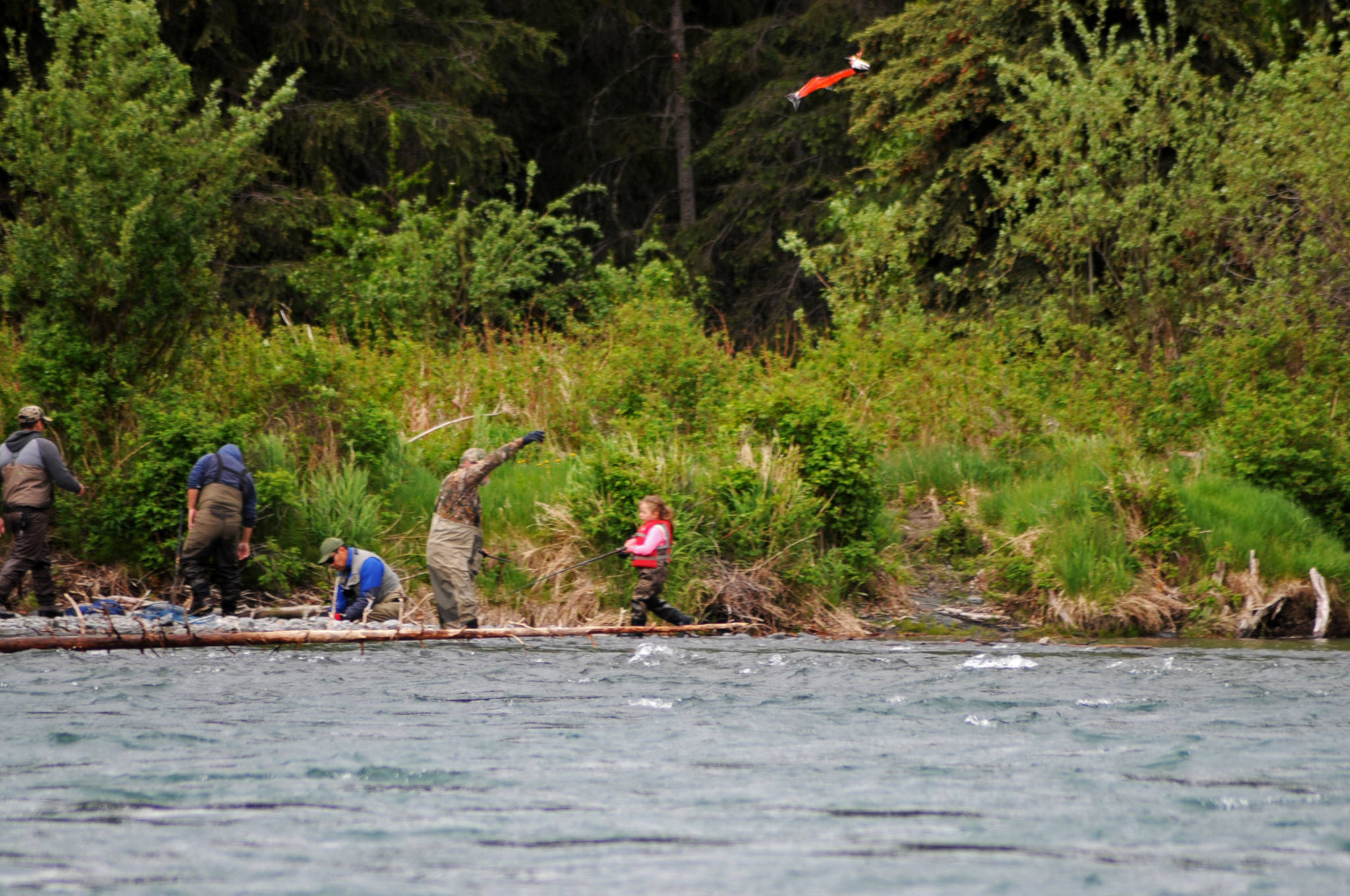
A successful angler pitches the remains of a filleted sockeye salmon out into the fast-flowing waters of the Kenai River downstream of the confluence with the Russian River on Sunday, June 11, 2017 near Cooper Landing, Alaska. Sunday was the first opening for the popular Russian River sockeye salmon sportfishery, and by midmorning, many anglers were already packing out their limits of salmon while others pulled in their catches. (Photo by Elizabeth Earl/Peninsula Clarion)
A successful angler pitches the remains of a filleted sockeye salmon out into the fast-flowing waters of the Kenai River downstream of the confluence with the Russian River on Sunday, June 11, 2017 near Cooper Landing, Alaska. Sunday was the first opening for the popular Russian River sockeye salmon sportfishery, and by midmorning, many anglers were already packing out their limits of salmon while others pulled in their catches. (Photo by Elizabeth Earl/Peninsula Clarion)
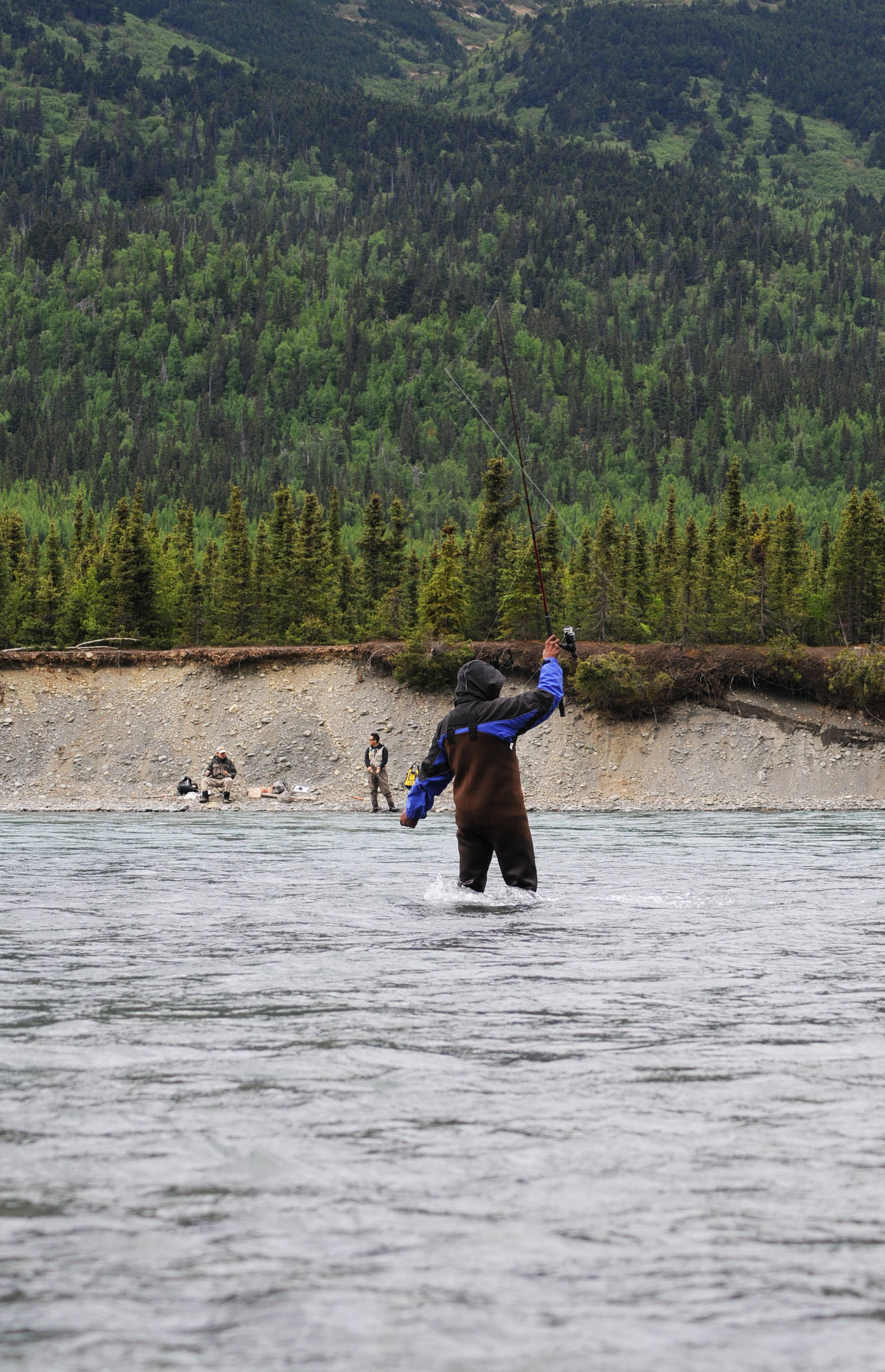
A flyfisherman casts for ockeye salmon on the bank of the Kenai River downstream of the confluence with the Russian River on Sunday, June 11, 2017 near Cooper Landing, Alaska. Sunday was the first opening for the popular Russian River sockeye salmon sportfishery, and by midmorning, many anglers were already packing out their limits of salmon while others pulled in their catches. (Photo by Elizabeth Earl/Peninsula Clarion)

A flyfisherman casts for ockeye salmon on the bank of the Kenai River downstream of the confluence with the Russian River on Sunday, June 11, 2017 near Cooper Landing, Alaska. Sunday was the first opening for the popular Russian River sockeye salmon sportfishery, and by midmorning, many anglers were already packing out their limits of salmon while others pulled in their catches. (Photo by Elizabeth Earl/Peninsula Clarion)

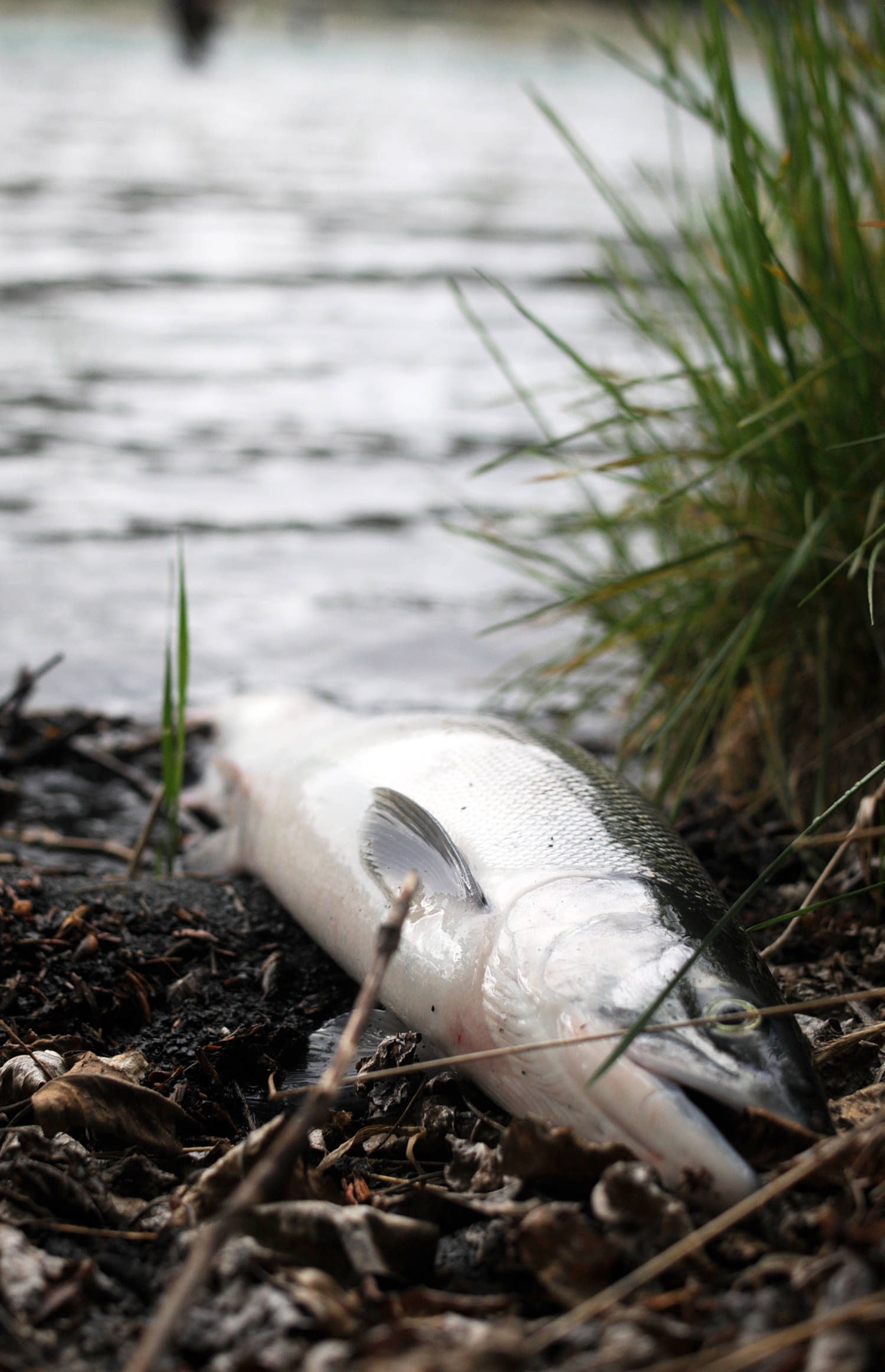
A sockeye salmon hooked by a lucky angler rests on the bank of the Kenai River downstream of the confluence with the Russian River on Sunday, June 11, 2017 near Cooper Landing, Alaska. Sunday was the first opening for the popular Russian River sockeye salmon sportfishery, and by midmorning, many anglers were already packing out their limits of salmon while others pulled in their catches. (Photo by Elizabeth Earl/Peninsula Clarion)

A sockeye salmon hooked by a lucky angler rests on the bank of the Kenai River downstream of the confluence with the Russian River on Sunday, June 11, 2017 near Cooper Landing, Alaska. Sunday was the first opening for the popular Russian River sockeye salmon sportfishery, and by midmorning, many anglers were already packing out their limits of salmon while others pulled in their catches. (Photo by Elizabeth Earl/Peninsula Clarion)

More in News

David Ross is sworn in as Kenai Police Chief on Tuesday, May 31, 2016 at Kenai City Hall. The Alaska Association of Chiefs of Police named Ross the 2025 Police Chief of the Year, recognizing over two decades of service. Photo by Megan Pacer/Peninsula Clarion
Kenai police chief named 2025 Police Chief of the Year

The Alaska Association of Chiefs of Police recognized David Ross for his more than two decades of leadership.

The cast of Nikiski Middle School’s upcoming performance of “Alice in Wonderland” is pictured on Dec. 2, 2025. The upperclassmen-directed play opens on Friday, with additional showtimes Saturday and next weekend. Photo courtesy of Carla Jenness
Nikiski Middle School debuts student-led “Alice in Wonderland”

The show opens on Friday, with additional showtimes this weekend and next.

On Tuesday, the Kenaitze Indian Tribe unveiled Kahtnu Area Transit, a public transportation service open to the entire Peninsula Borough community. Photo courtesy of Kahtnu Area Transit
Kenaitze Indian Tribe unveils Kahtnu Area Transit

The fixed bus route offers 13 stops between Nikiski and Sterling.

The Kenai Chamber of Commerce and Visitor Center hosts the annual Christmas Comes to Kenai on Nov. 28<ins>, 2025</ins>. The beloved event began over 40 years ago, and this year over 1,000 attendees enjoyed hot chocolate, fireworks, pictures with Santa and shopping. Photo courtesy of the Kenai Chamber of Commerce
 Photo courtesy of the Kenai Chamber of Commerce
The Kenai Chamber of Commerce and Visitor Center hosted the annual Christmas Comes to Kenai on Nov. 28. The beloved event began over 40 years ago, and this year over 1,000 attendees enjoyed hot chocolate, fireworks, pictures with Santa and shopping.
Kicking off a month of holiday festivities

Last weekend’s holiday events, including the annual Christmas Comes to Kenai and the Soldotna Turkey Trot, drew folks from all over the Kenai Peninsula.

Starting Dec. 2, Aleutian Airways will offer roundtrip flights between Anchorage and Unalakleet every Tuesday, Friday and Sunday.
Aleutian Airways to offer roundtrip flights between Anchorage and Unalakleet

Starting Dec. 2, Aleutian Airways will offer three roundtrip flights per week.

The Trump administration’s “Big Beautiful Bill” act requires the Bureau of Ocean Energy management to hold at least six offshore oil and gas lease sales in Alaska between 2026-2028 and 2030-2032. The first of these sales — known as “Big Beautiful Cook Inlet 1,” or BBC1— is scheduled for March 2026. Photo courtesy of the Bureau of Ocean Energy Management
Cook Inletkeeper launches petition against federal government

The organization is calling for transparency in Cook Inlet offshore oil and gas sales.

Winter dining has always carried more weight than the menu might suggest. In the off-season, eating out isn’t just about comfort food or convenience; it’s a way of supporting local businesses as they hold steady through the slower months. Photo credit: Canva.
The ripple effect: How local spending builds stronger communities on the Kenai Peninsula

From cozy cafés to fine-dining bistros, purchases made close to home sustain local jobs and services

Courtesy Harvest
On the Kenai Peninsula, a dormant liquefied natural gas export plant could be repurposed to receive cargoes of imported LNG under a plan being studied by Harvest, an affiliate of oil and gas company Hilcorp. The fuel would be transferred from ships to the tanks on the left, still in liquid form, before being converted back into gas and sent into a pipeline.
Utilities say Alaska needs an LNG import terminal. Consumers could end up paying for two.

Planning for two separate projects is currently moving ahead.

A map shows the locations of the 21 Alaska federal offshore oil and gas lease sales proposed by the Trump administration. (Map provided by the U.S. Bureau of Ocean Energy Management)
Trump administration proposes offshore leasing in almost all Alaska waters

A new five-year offshore oil and gas leasing plan proposes 21 sales in Alaska, from the Gulf of Alaska to the High Arctic, and 13 more off the U.S. West Coast and in the Gulf of Mexico.

Most Read