
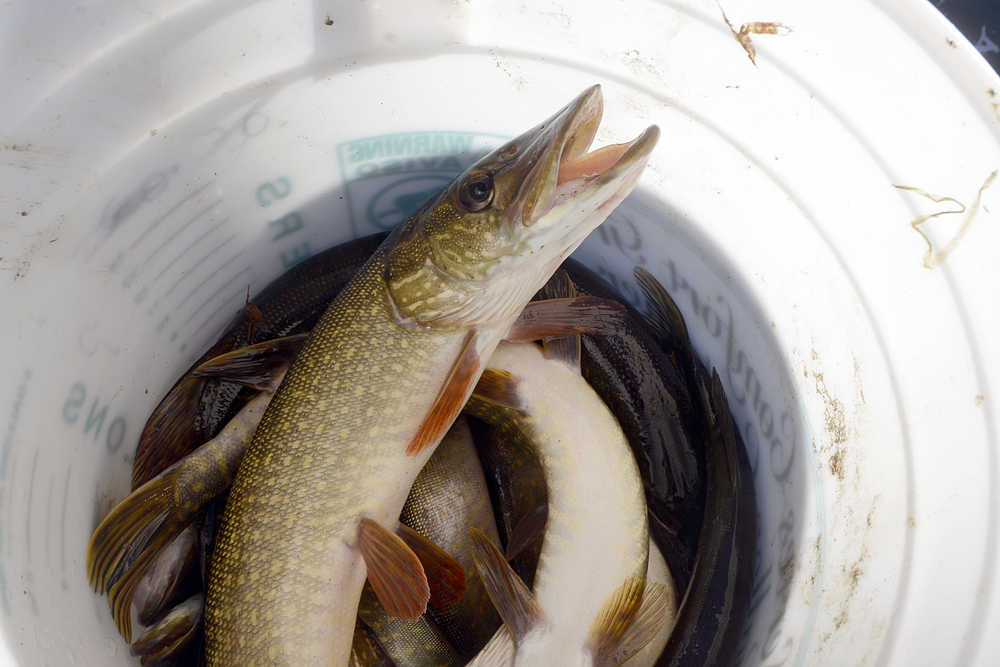
Soldotna Creek got a shock of chemicals this summer designed to kill off invasive northern pike, which appear to be almost gone from the stream system.
The creek, which runs from the lakes north of Soldotna down to join the Kenai River at Soldotna Creek Park, is home to native coho salmon, Dolly Varden and rainbow trout, stickleback, sculpin and other fish species, but northern pike were illegally introduce there and began to reduce the native fish populations. Pike, which are only native to the state north of the Alaska Range, are aggressive predators that can reproduce quickly and overtake lake and river systems where they are introduced.
The Alaska Department of Fish and Game began treating lakes on the Kenai Peninsula with a piscicide called rotenone in 2012, first treating Stormy Lake in Nikiski and then moving on to the Mackey Lake system in 2014 — a series of lakes connected to Soldotna Creek just west of the mainstem, including east and west Mackey lakes, and Derk and Union lakes. Last winter, Fish and Game determined that the lakes were pike-free and planned to continue with the eradication work on the Soldotna Creek mainstem this summer.
The treatment went well, said Rob Massengill, a fisheries biologist serving as the principal investigator on the pike eradication project. Fish and Game treated the Soldotna Creek mainstem and all its tributaries in June after moving more than 80,000 native fish into the Mackey Lake area, which Massengill calls “fish rescue.”
To prevent rotenone from running into the Kenai River, the biologists installed a station with the chemical potassium permanganate near the mouth of the creek and caged fish below it to test if any of the rotenone was still getting through. The caged fish all survived, he said.
“The rotenone naturally degraded and was no longer detected by a week or so,” Massengill said. “It was a pretty short period of time.”
Block nets in eight different places in the creek system caught the fish killed by the rotenone, which invades the fish’s cells and blocks their ability to process oxygen from the water. Not many pike turned up in the nets, though Fish and Game has video evidence of pike moving through the creek from 2009 and 2010, so they have moved through the system, Massengill said.
“I think part of the reason is we knocked out the core of the pike population in 2014, in the Mackey Lake chain,” he said.
The treatment process isn’t quite finished — next year biologists will treat Sevena Lake, the lake near the headwaters of the creek. Sevena Lake still has pike in it, though the netting data show the pike seem to have had trouble reproducing in the lake recently, Massengill said.
“They were mostly big fish,” he said. “We’re not sure why, but something was affecting their ability to reproduce.”
That’s happened before — when the biologists netted for pike on Hall Lake, a small lake near Sterling, they only caught adults. The department uses experimental gillnets that catch all sizes of fish, so it’s likely that there weren’t juveniles in the lake, meaning that the population had reproduction problems, he said.
The Sevena Lake treatment is scheduled to be finished by next June, but the department will continue to monitor the lakes and creek system, he said.
In 2008, 20 lakes on the Kenai Peninsula were found to have northern pike in them. Since then, the pike populations in two lakes have died out, potentially due to winterkill, Massengill said. Other lakes have been treated and only six pike populations remain.
The last set of lakes to treat are those on Tote Road, just south of Soldotna. The isolated lakes are not part of a river system, so there is no risk of the pike escaping the lakes on their own. Fish and Game is looking at grants to fund eradication of those pike populations, but the project would have to go through public scoping and permitting and so is likely still a few years away, Massengill said. If the department receives the funds, it will go to a public process to keep residents in the loop about potential pike eradication activities there, he said.
“We’re going to try to work with the community and try to do it right,” he said.
Invasive northern pike have also been found in lakes across the Matanuska and Susitna valleys. Pike prefer slow-moving, reedy water as habitat and will eventually consume all the juvenile salmon and trout in a lake system, moving on to cannibalizing one another. As the population grows and there is not enough food to sustain it, the pike grow generally smaller in size, which are more dangerous for juvenile fish because the smaller fish can only prey on salmon fry and smolt.
Pike have been detected in more than 150 lakes in the Kenai Peninsula, Anchorage and Mat-Su Valley drainages, according to Fish and Game.
Reach Elizabeth Earl at elizabeth.earl@peninsulaclarion.com.
