
Even as political relations between the United States and Russia devolve, scientists, activists, conservationists and fishermen between the two countries push for further protections of the two country’s shared resources — including Pacific salmon.
Six Russians spent a week in traveling between Anchorage and the Kenai Peninsula, learning about streamlined salmon management and sportfishing conservation practices through a cultural exchange program hosted by the Oregon-based non-governmental organization, or NGO, Wild Salmon Center.
During the few-days the group spent on the Kenai Peninsula, they were treated to an early-morning visit to Kenai’s Russian Orthodox Church, where Father Thomas Andrew met them to unlock the doors as the sun rose over the Cook Inlet and the mouth of the Kenai River; they drank Alaskan beer, Kassik’s blonde ale, during a dinner at Mykels restaurant in Soldotna; photographed a grizzly bear that interrupted their hike along the Russian River, and learned about local salmon management from biologists, activists and sportfishermen.
It was the second exchange hosted by the center in 2014 — the first group spent their time in Alaska on the Yukon River, learning about issues specific to the Pacific salmon that return each year to the behemoth, 1,980-mile river.
The program is important both as a cultural exchange and an opportunity to re-energize activists in Russia who face social, cultural and regulatory challenges to their conservation efforts, said Wild Salmon Center Western Pacific Program Manager Leila Loder.
“I think that these exchanges are very valuable, even as just cross-cultural bridges,” Loder said. “It gives the delegates a better understanding of their own situation, even if some of the things that they are learning here are not quite applicable to where they are working. The point is that they’re getting new experiences, new knowledge and a new perspective on things — so who they are is transforming.”
The Wild Salmon Center focuses its conservation efforts on wild salmon ecosystems in the Pacific Rim and has organized at least five trips between areas in the Russian Far East and the U.S., Loder said.
Loder, who grew up in Moscow, and the other program coordinator, Saule Richardson — a Kazakh from Uzbekistan — spent most of the trip translating conversations between the visiting Russians and scientists at the Alaska Department of Fish and Game, Alaska Wildlife Troopers, the Kenai River Sportfishing Association and Trout Unlimited members who met with the group to discuss salmon management in Alaska.
The visitors are active conservationists, politicians, sportfishing advocates and heads of non-governmental organizations from three regions in Russia — Sakhalin, Khabarovsk and the Kamchatka Peninsula.
Kamchatka
The Kamchatka Peninsula is a 1,000 mile long region that produces up to one-fourth of all wild Pacific salmon.
Like Alaska, many of the Kamchatka Peninsula’s rural and indigenous people rely heavily on salmon. For the approximately 400,000 residents of the peninsula one in five jobs are related to the salmon industry, according to data from the Wild Salmon Center.
The two visitors from Kamchatka, Viktor Zoloutkhin, deputy director of a sportfishing company, Credo Tour, and anchor of a sportfishing show in Kamchatka and Margarita Panchenko, head of the recreational and sportfishing department of the Federal Kamchatka Institution for Fisheries and Conservation of Aquatic Biological Resources — face numerous threats to their wild salmon.
The peninsula is one of the last large spawning grounds of wild Pacific salmon but some 55,000 tons of the are poached annually, according to Wild Salmon Center data.
Some estimates show that figure to be much higher, Valery Vorobiev, head of Akros — one of Kamchatka’s largest fishing companies — told National Public Radio reporter Gregory Feifer during a 2007 interview that more than 100,000 tons of salmon are poached each year. Much of it, he said, was for fish eggs, or caviar, the carcasses are discarded.
Loder said the group that spent their time on the Yukon earlier in 2014, came from the Kamchatka Conservation League — the two regions are similar in inaccessibility and abundance of natural resources.
“We took them to the Yukon because the two regions are having issues with declining chinook stocks and we led those two parties from two sides of the ocean to find out how they could address the issue,” she said. “They found out that the reasons for the decline are different but the issues are similar so they kind support each other and learn from each other.”
During the trip to the Kenai Peninsula, Loder said the focus was more on learning to grow and regulate sportfishing.
“Our delegates are conservationists at heart, it’s just a natural kind of development that sportfishing becomes one of the ways that you can conserve salmon,” Loder said. “So the people who are here on exchange are conservationists who want to develop sportfishing in their areas or sportfishermen who are, in their hearts, conservationists.”
While Zoloutkhin spent a lot of time shooting video during the group’s visit to the Kenai Peninsula, Panchenko quizzed Ricky Gease, of the Soldotna-based Kenai Sportfishing Association on his group’s outreach efforts and getting sportfishing anglers more involved with their salmon resources.
Gease also spoke about responsible development and ensuring safe fish-passage, cost-sharing programs to encourage habit-friendly residential development along salmon streams and cooperating with local, state and federal government officials to conserve the resource.
Gease said it was his first time speaking to a group from Russia and he enjoyed the experience but wishes he would have had more time to ask questions about their salmon management.
“It was interesting, you talk and it gets translated, they ask questions, it gets translated, it just takes twice as long as a normal conversation,” he said.
Despite the slow conversation, Gease said the dialogue was important — especially given the tense political situation between the two countries.
“On the international stage, there’s a chess game that gets played, but then there’s just that very real day-to-day functioning between local governments, industry and non-profits. People are so much more similar than they are different on that level.”
Sakhalin
At nearly 29,500 square miles, Sakhalin is the largest Russian island in the North Pacific Ocean. It is located north of Hokkaido, Japan and is home to 11 salmonid species. The island generates about 20 percent of the Pacific salmon catch, according to Wild Salmon Center data.
The two delegates, Maksim Ageev and Evgeny Demidov, like others in the group — did not know each other before meeting in Alaska.
Ageev is the head of the anti-poaching group “Aniva without Poachers,” and an active sportfisherman. Demidov is the vice-governor of the Smirnykh municipality, an urban settlement in the middle of the island, and focuses on sustainable development for indigenous people in the region and fisheries.
Ageev works with volunteers who patrol area rivers in early morning hours. They remove poacher’s nets and report illegal activity near Aniva, a city on the southern end of the island.
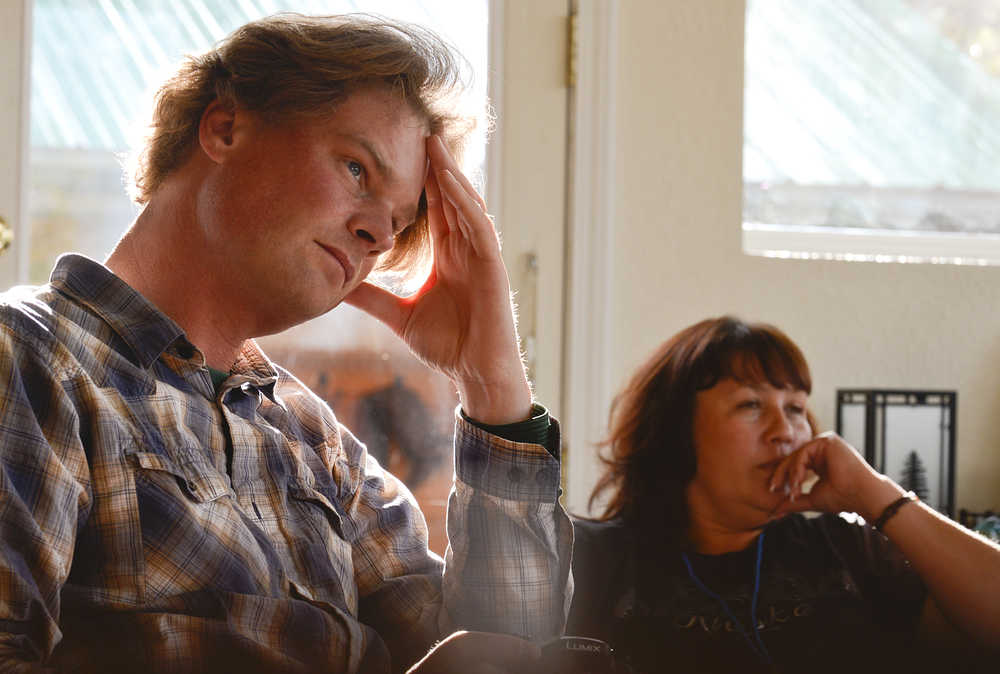
When the group met with Trout Unlimited spokesman Dave Atcheson, Ageev and Demidov asked questions about activism and being able to communicate about conservation efforts while working for the government.
Atcheson, and former Fish and Game management biologist David Evans, met the group at Kaladi Brothers on the Sterling Highway in Soldotna. They sat around a table in the orange-walled private room in the coffee shop, sipping tea and talking about volunteer efforts and non-governmental organizations working to change regulations in Alaska.
Evans spoke about habitat degradation on the Kenai River, which Panchenko said was not readily apparent.
“Fortunately, in Alaska, a lot of streams are still intact and it’s our job to keep them that way,” Atcheson said. “I think, in Alaska, the only reason they are still intact is because it was difficult to get here.”
On Sakhalin, one of the more populous islands in the Russian Far East, a large poaching industry and growing industrial development are a constant threat to wild salmon resources. Evans said as the population in Alaska grows it has become difficult to control damage to local rivers.
“I think one of the challenges here is that, in a state like Oregon, they know they’re degraded and the problems are apparent, everyone knows they’re there. But, here on the Kenai River there are so many people and such a high percentage of Alaska’s sportfishing effort takes place right here on the Kenai Peninsula – there’s so much effort here, I think one of the real challenges we have is that people don’t recognize the problems with high fishing pressure.”
Loder said Russia had a similar problem, fisheries along the road system are more accessible to poachers and have been depleted quickly.
Khabarovsk
The Khabarovsk Region is a relatively remote area located about 20 miles from Russia’s border with China, and 500 miles north of Vladivostok.
Ivan Voidilov and Aleksander Kulikov visited from the region which has seen significant ecological protection in recent years.
Voidilov is a senior inspector of the Regional Governmental Institution, or wildlife trooper, Koppi River region while Kulikov is the director of the non-governmental organization Khabarovsk Wildlife Fund. The fund has overseen the creation of nearly 7,000 square miles of protected areas within the region.
While Kulikov’s organization has created conservation areas for a species other than salmon, including the Amur, or Siberian, Tiger.
“Our mission, our philosophy, is conservation,” Kulikov said. “We focus our activity on creating new protected areas for conservation because if we conserve habitat, we conserve biodiversity.”
Among the recent projects spearheaded by the wildlife fund, a refuge on the Koppi, or Copper, River grants permanent legal protection status over 94,000 ares of wilderness land.
The designation will protect 20 species of fish including salmonids like cherry salmon and the endangered Sakhalin taimen — the largest of the Pacific salmonids.
Kulikov said he would like to see Alaskan and Russian conservations deepen ties between the two countries and suggested that the Koppi River wildlife preserve could be a good avenue for cooperation.
“We have a Copper River, Alaska has a Copper River. Let’s do a sister river project,” he said. “Let’s make it better for both rivers.”
Kulikov is no stranger to cross-cultural learning — he studied NGO management at California State University in 1994 and travelled to Portland in 2010. He said the experience is valuable each time.
“Every exchange program has two kinds of outcomes,” he said. “First, we receive new experiences, new knowledge and information and the second part is we kind of evaluate how, given what we see, how our region and country look and how our organization is doing. Sometimes, we get reassurances that we’re doing it the right way. And, of course we are processing how to integrate the knowledge that we get here and how we can apply it in our regions, to our work.”
An exchange that involved fisheries managers from the U.S. travelling to Russia would be beneficial, Kulikov said.
“The more we know, the better understanding we will have of each other and if we are speaking about this in philosophical terms … Lets take two countries, for example the U.S. and Russia — we have many differences. Differences in religion, politics, language etc., but there are points that do not have any contradictions, for example conserving shared resources. It unites, it doesn’t divide us. So lets go forward with this.”
Going forward
For Kulikov, several concrete concepts struck him as being applicable in the Khabarovsk region.
The Alaskan approach to angler education was one of them.
“Even if it’s not part of the rules and regulation, people are being educated on how to use hooks and not hurt the fish unnecessarily,” he said.
Loder said Russia is in the initial stages of reorganizing its fisheries — a massive undertaking for a country that has both Atlantic and Pacific salmon fisheries.
“The people who are invited (to Alaska) this time around will be actively participating in negotiating with government agencies back home in Russia,” he said.
While the regulations are set at the federal level in Russia, it will be people at the local level who figure out how best to implement them.
“We’re trying to get these people a chance to be as well informed as possible on how things are done in the U.S. and in Alaska before they come home and face this enormous task of coming up with their regional regulations,” Loder said. “(We’re showing them) this is how it’s done in Alaska, it’s not perfect — but in many cases we can provide shortcuts in their education about fisheries management.”
Reach Rashah McChesney at rashah.mcchesney@peninsulaclarion.com

Photo by Rashah McChesney/Peninsula Clarion Leila Loder, Western Pacific Program Manager for the Oregon-based Wild Salmon Center, Maksim Ageev, of Sakhalin and Aleksander Kulikov, of Khabarovsk, listen to Dave Atcheson, of Sterling, talk about Trout Unlimited and Alaska salmon conservation efforts Thursday September 11, 2014 in Soldotna, Alaska.

Photo by Rashah McChesney/Peninsula Clarion Several Russian visitors signed the guest book at the Holy Assumption of the Virgin Mary Russian Orthodox Church after Father Thomas Andrew arranged an early-morning visit for the group Thursday September 11, 2014 in Kenai, Alaska.

Photo by Rashah McChesney/Peninsula Clarion Several Russian delegates on an exchange trip to Alaska with the Oregon-based Wild Salmon Center, listen to Ricky Gease, executive director of the Kenai River Sportfishing Association, talk about issues of salmon management and habitat September 10, 2014 in Soldotna, Alaska.
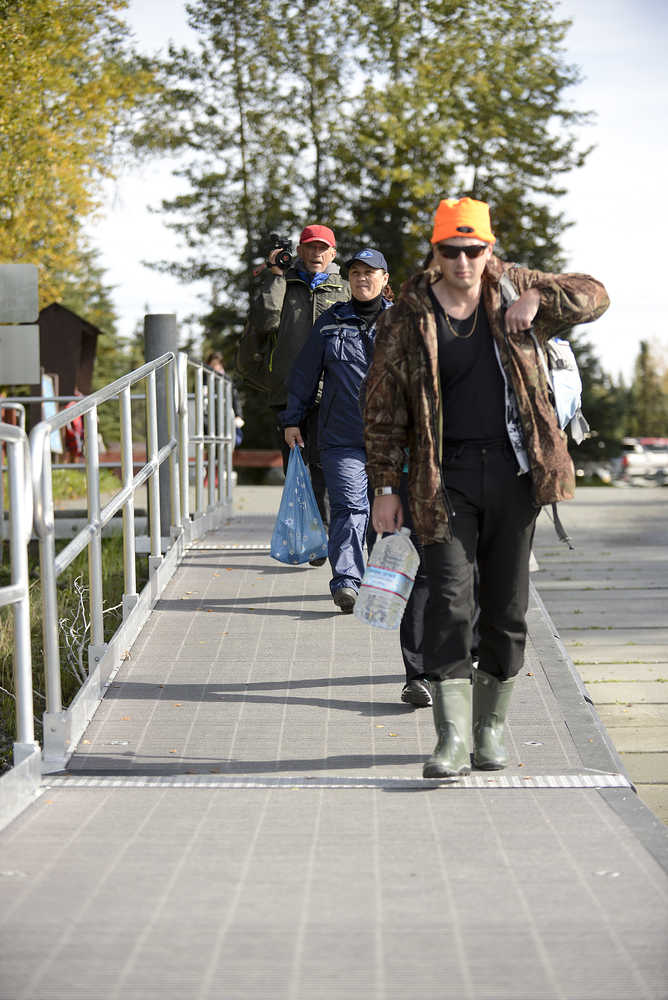
Photo by Rashah McChesney/Peninsula Clarion (left) Viktor Zoloutkhin, of Kamchatka, Margarita Panchenko, of Kamchatka, and Maksim Ageev, of Sakhalin, head down the dock at The Pillars boat launch September 11, 2014 in Soldotna, Alaska. The group was headed on a guided coho salmon fishing trip with Fishology Alaska.
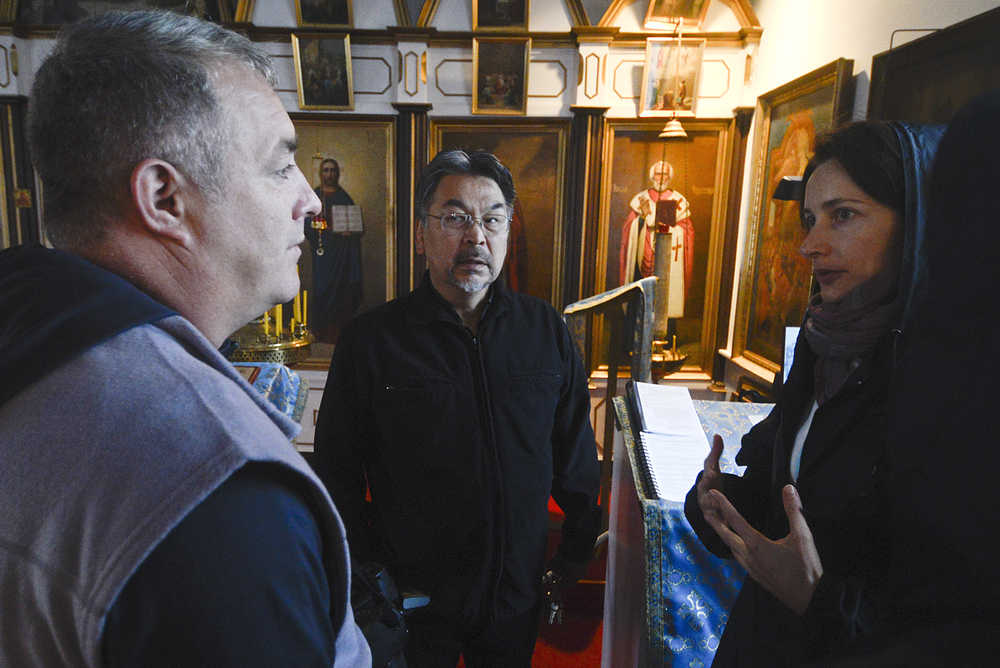
Photo by Rashah McChesney/Peninsula Clarion (left) Evgeny Demidov, of Sakhalin, listens to Father Thomas Andrew, of Kenai, as Leila Loder, of Oregon, translates during a visit to the Holy Assumption of Mary Russian Orthodox Church Thursday September 11, 2014 in old town Kenai, Alaska.
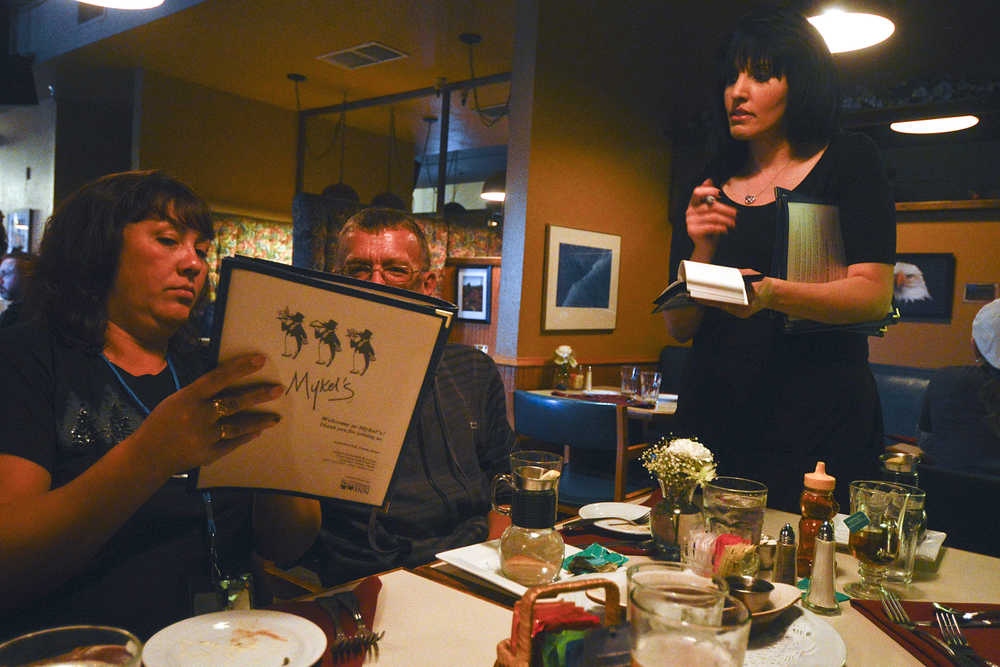
Photo by Rashah McChesney/Peninsula Clarion Margarita Panchenko, of Kamchatka, helpsViktor Zoloutkhin, of Kamchatka, order during dinner at Mykels Wednesday Sept. 10, 2014 in Soldotna, Alaska.
