
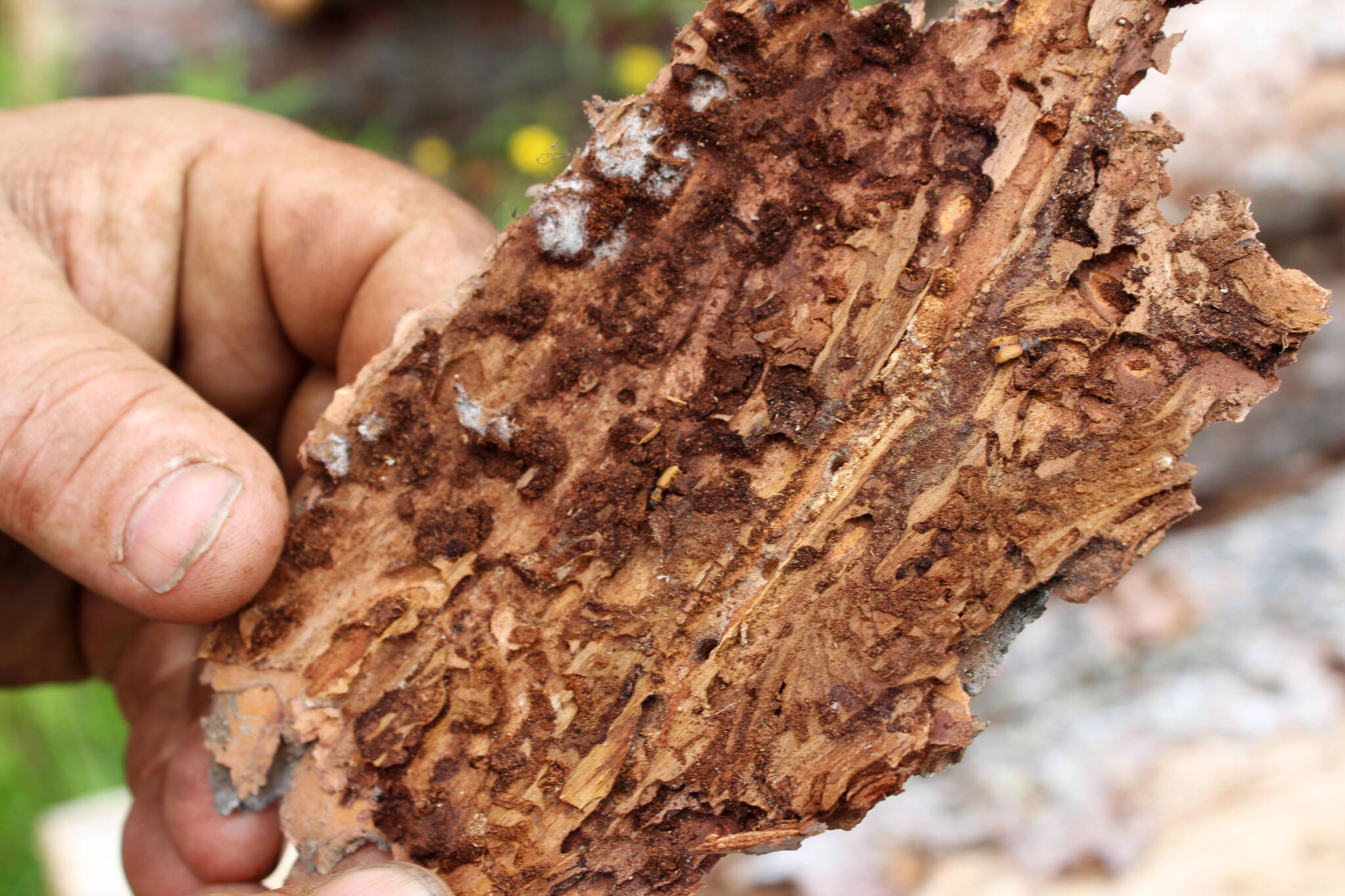
The Kenai Peninsula Borough is one step closer to turning the Kenai Peninsula’s spruce bark beetle problem into an opportunity to harvest timber. That’s following the borough assembly’s approval of legislation last week that frames forest treatment options and allows spruce trees that are dying or susceptible to dying to be taken down.
More than 1.6 million acres of land in Southcentral Alaska have experienced spruce bark beetle infestation, including 21,000 acres of forested land that is managed by the Kenai Peninsula Borough, according to the ordinance. The dead and dying White and Lutz Spruce trees affected by the beetles are hazardous; they’re prone to falling over and are especially susceptible to fires.
The legislation follows months of outreach efforts by the borough’s land management to help spread awareness about a proposed timber harvest and sale program, which would focus both on the removal of infested trees and on reforestation.
On average, each acre of spruce can yield about one-half to one merchantable cord, which the borough defines as anything that can be used as a saw log or produce lumber. That’s according to Kenai Peninsula Borough Land Management Agent Dakota Truitt, who has spearheaded the project. There are between 6 and 20 cords of fuelwood per acre, on average.
Long term, it’s hoped the program will create a forest management plan for the borough and establish legacy forestry infrastructure, Truitt said.
Truitt wrote in an April 21 memo to assembly members that the borough’s next step — after approval of the initial ordinance — will be to hire by July a temporary forester who would focus on beetle mitigation projects. If all goes according to plan, she wrote, timber sales would begin in early 2023.
In addition to reducing fire risks, the borough believes there may be an opportunity to generate revenue through the program that could then be put toward reforestation efforts.
“(The Kenai Peninsula Borough) is losing a valuable timber resource which could be utilized for fuelwood, fiber wood, lumber, or house logs for building which could stimulate the local economy by providing forest products to the marketplace,” the ordinance says.
The longer the borough waits to take action on the infected trees, however, the less valuable the wood becomes.
Truitt has maintained since her first presentation on the project to the borough assembly that the program will not be particularly lucrative, but has said revenue generated from the sale would be put back into reforestation efforts, the second phase of the program. Under the legislation, the borough mayor would provide quarterly updates on timber activities and any money generated as a result.
The ordinance also says that the borough will consult private landowners whose property shares a border with borough land before a sale report for the borough unit is finalized. “Detailed” plans of operations for all units will be submitted to the Alaska Division of Forestry for review before anything on the unit is harvested.
Cooper Landing resident Theo Lexmond told assembly members last week that the ordinance should have stronger language related to the borough regulation of logging roads in the affected areas, which he said could become the site of “unregulated camping activity.”
“An intact logging road left unwatched and unregulated by the borough after logging will, in the Cooper Landing area with certainty, invite unregulated camping activity with attendant drinking, shooting, trash and abandoned smoldering campfires,” Lexmond said.
Multiple assembly members said having logging roads improves public access to borough land and allows for better response to fires.
“We shouldn’t be trashing those lands,” said assembly member Richard Derkevorkian. “Giving the public access, I think, is a big benefit of those logging roads. There’s not a lot of roads in Alaska, as we all know. I don’t think we should be closing down any that we have.”
Assembly member Jesse Bjorkman, who represents Nikiski, said one of the reasons the 2019 Swan Lake Fire, which burned more than 150,000 acres near Cooper Landing, was particularly severe was because of the “buildup of fire fuels in the forest.” He also said that, where he grew up in Michigan, recreational camping opportunities deterred people from camping illegally.
“We still have very significant problems with fire fuel buildup all over this peninsula,” Bjorkman said. “I think our number one priority should be dealing with those fire fuels because it endangers the life and property of the residents and visitors here on the peninsula.”
As recommended by the Cooper Landing Advisory Planning Commission, the assembly approved last week language in the ordinance that says forest treatments will be planned to regulate logging infrastructure, in addition to establish and preserve it. Other language added said public access will be preserved “when determined to be in the public interest.”
Assembly approval of the ordinance comes as other central peninsula municipalities work to mitigate the spread and dangers of the current spruce bark beetle outbreak. The City of Kenai plans to open a slash disposal site as soon as next week for locals and is actively taking down trees infested with spruce bark beetles. The City of Soldotna received more than $150,000 to take down dangerous trees on city property.
More information on the impacts of spruce bark beetles can be found on the Alaska Division of Forestry’s website at forestry.alaska.gov/insects/sprucebeetle. More information about the borough’s timber harvest program can be found at kpb.us/forestmanagement.
Reach reporter Ashlyn O’Hara at ashlyn.ohara@peninsulaclarion.com.
