
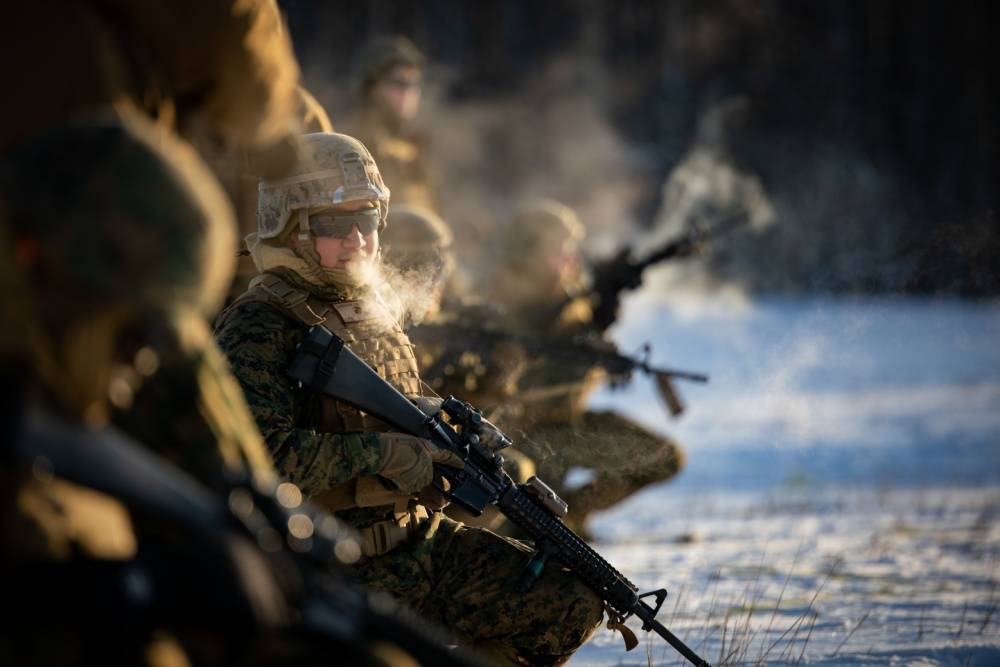
As the Navy released its new strategy for the Arctic, members of Alaska’s congressional delegation expressed support for the increased emphasis on the rapidly thawing region.
The release from the Department of the Navy, titled “A Blue Arctic,” details high-level strategy for augmented operations above the Arctic Circle as national competition for resources unlocked by the ice begins to ramp up.
“The Department of the Navy, under the leadership of Secretary Braithwaite, clearly recognizes the critical importance of Alaska within this geo-strategic region, and I commend them for releasing this strategy today,” said Sen. Dan Sullivan, R-Alaska, in a news release. “Although I believe the department’s new blueprint lacks some of the urgency needed to drive the development of critical capabilities that are required to effectively compete with our rivals in the Arctic, it rightfully acknowledges the need to evolve our forces to more adeptly project and sustain naval power throughout the high latitudes.”
[Alaska leaders condemn violence at US Capitol]
The plan is a high-order strategy, focusing on generalities rather than specific logistical or operational changes for the sea services operating in and around Alaska — the Coast Guard, Marine Corps and Navy. Among those are three core pillars: operate across the full range of military missions, work together with local and Indigenous communities to build security in the region, and adapt to operations in the Arctic.
“The Arctic is changing. In the coming decades, we must ensure that its waters are navigable, and that our Armed Forces are equipped with the training and equipment necessary to keep the peace in a rapidly evolving climate,” Rep. Don Young, R-Alaska, said in a news release. “We must remember that the United States is not the only country working to pursue new opportunities in the Arctic — our adversaries are as well.”
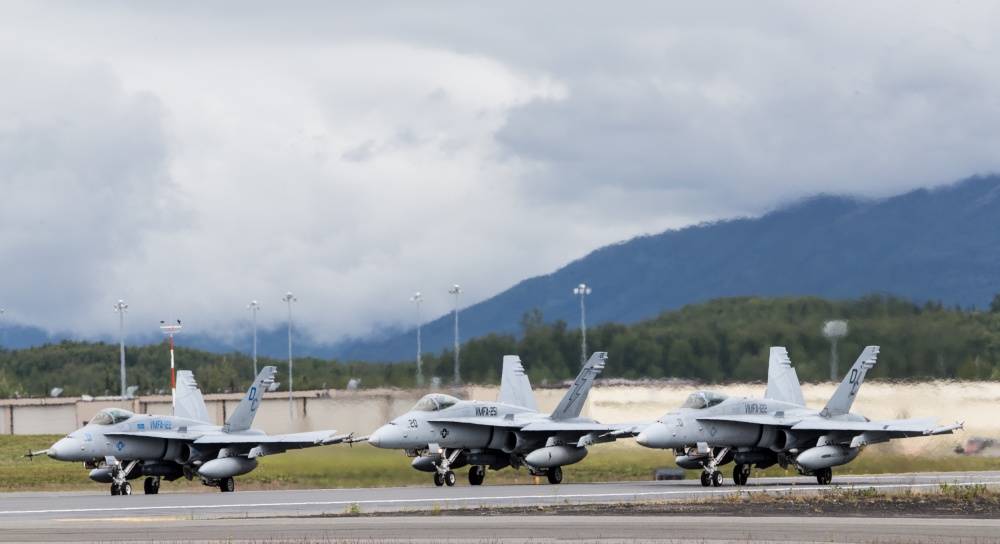
U.S. Marine Corps / Lance Cpl. Koby I. Saunders U.S. Marine Corps F/A-18C Hornets assigned to Marine Fighter Attack Squadron 251 prepare to take off from the flightline during Red Flag-Alaska 17-2 on Joint Base Elmendorf-Richardson, Alaska, in June 2017.
The strategy highlights the desire for peace and a rules-based Arctic as receding sea ice makes mineral and biological resources more accessible to those nations that have the technology and strength to exploit them.
“The coming decades will witness significant changes to the Arctic Region,” the strategy states. “Encompassing about six percent of the global surface, a Blue Arctic will have a disproportionate impact on the global economy given its abundance of natural resources and strategic location.”
Trade routes are also expected to open up, allowing access to shipping lanes previously closed by sea ice. The U.S., Russia and China have all invested in expanded icebreaker fleets to support operations in the north. Russia, especially, the strategy says, is expending vast amounts of resources to modernize its Northern Fleet.
Some think the ball could be moving faster, though.
“I believe the department’s new blueprint lacks some of the urgency needed to drive the development of critical capabilities that are required to effectively compete with our rivals in the Arctic. It rightfully acknowledges the need to evolve our forces to more adeptly project and sustain naval power throughout the high latitudes,” Sullivan said. “I look forward to working with current and future leaders of the U.S. Navy to close the gaps, adjust our force posture, and modernize equipment to ensure that America’s Navy-Marine Corps team can — alongside our allies — secure our nation’s vital security interests.”
Many of Sullivan’s efforts include attempting to enhance the Coast Guard presence in Alaska, including, eventually, homeporting one or more icebreakers in the state. The Coast Guard’s two remaining icebreakers —one of them in the yards for repairs after a major fire — are homeported in Seattle. The other, the USCGC Polar Star, is currently deployed in the Arctic. Without basing capable of supplying the logistical needs of warships operating in Alaskan waters, they’ll have to make their way all the way back to Dutch Harbor or possibly even Seattle.
“I want to sincerely thank the U.S. Navy and everyone involved for diligently working on researching and assembling this vital document,” Young said. “As the only Member of Congress from inside the Arctic Circle, I will continue doing all that I can to keep Alaska front and center in America’s Arctic strategy.”
• Contact reporter Michael S. Lockett at (757) 621-1197 or mlockett@juneauempire.com.
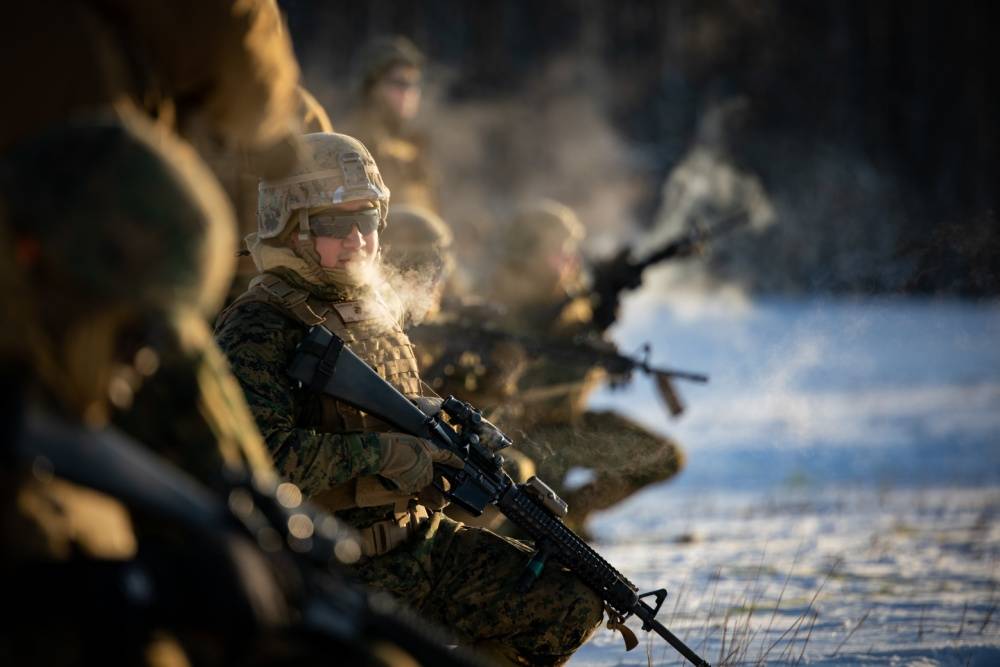
Cpl. Jose M. Barragan, a bulk fuel specialist with 7th Engineer Support Battalion, 1st Marine Logistics Group, prepares to conduct a live-fire and maneuver range in Fort Greely, Alaska, Feb. 11, 2020, prior to exercise Arctic Edge 20. (U.S. Marine Corps / Lance Cpl. Christopher W. England)
