
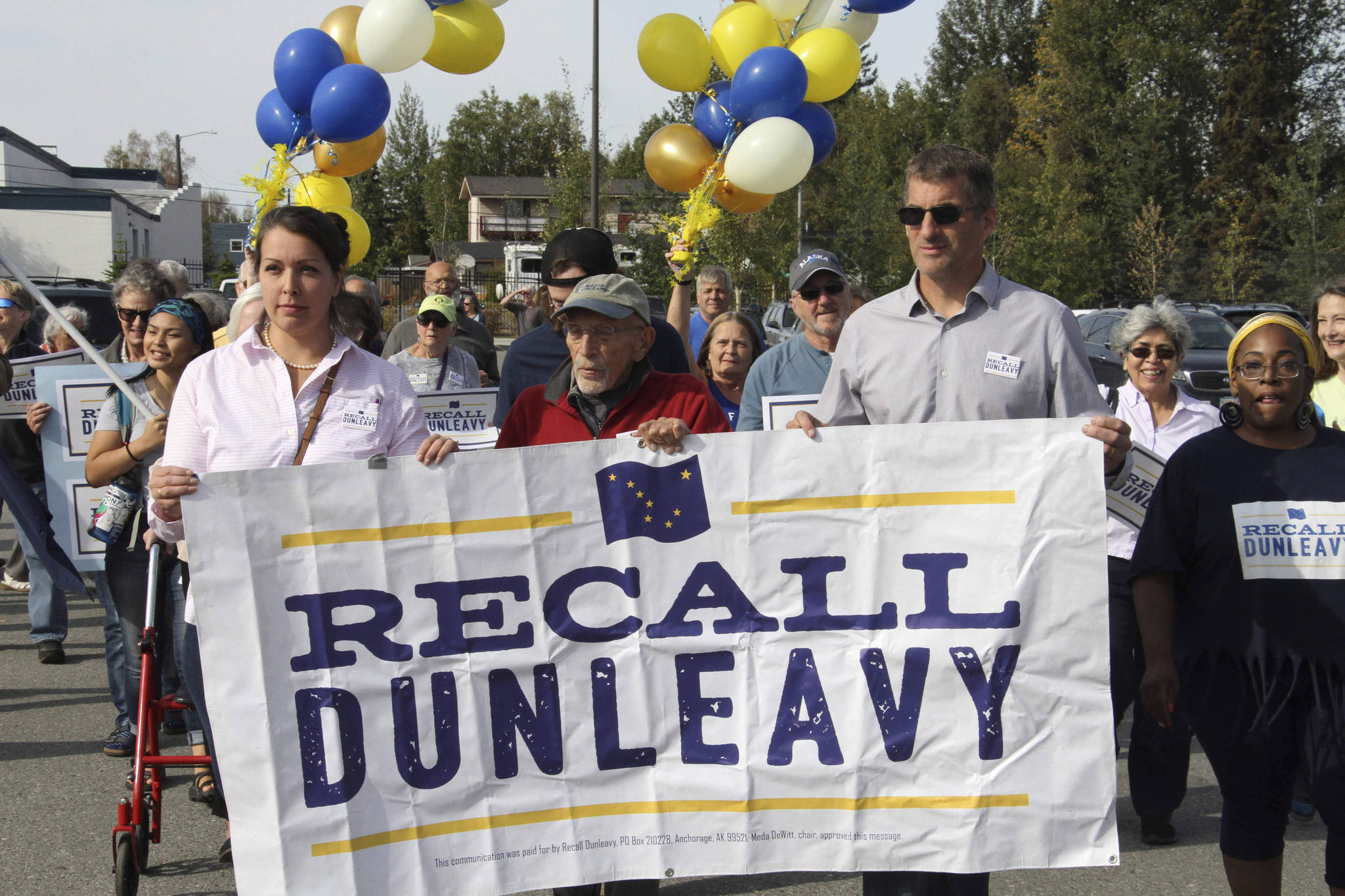
JUNEAU — The campaign aimed at recalling Alaska Gov. Mike Dunleavy said Wednesday it is ceasing that effort, with a gubernatorial election looming next year and the group short of the signatures needed to force a recall vote.
The Recall Dunleavy group said that as of Saturday it had gathered 62,373 signatures, shy of the 71,252 needed. But Joelle Hall, a member of the group’s steering committee, said the group would have wanted additional signatures as a cushion in case some were thrown out.
Collecting signatures during the pandemic has been difficult, she said. Hall called the decision to halt the recall effort strategic and wise.
Meda DeWitt, the group’s chair, in a statement called on Alaskans to “rededicate their efforts to denying” Dunleavy another term.
Cynthia Henry, chair of recall opposition group Keep Dunleavy, said she was “surprised it took them so long to realize that they just couldn’t get the signatures.”
“They know, as we do, that a recall vote would have failed,” she said.
Hall disagrees, though it’s all hypothetical at this point. Hall, president of the Alaska AFL-CIO and a veteran of state politics, said Dunleavy “was saved by a worldwide pandemic. If there hadn’t been one, he would already be recalled. We’ll never know that, but based on the zeal. … I have never in my life seen anything like what was happening at the beginning of this.”
The recall effort took off in 2019, fueled by public outcry over vetoes and budget cuts proposed by the Republican governor. While recall supporters quickly gathered signatures for an initial phase, their application was rejected, prompting a legal fight the group eventually won.
Dunleavy moderated or relented on some of the 2019 proposals or cuts. Then there was the pandemic.
A statement released by Dunleavy’s office said the governor “is doing what he was elected to do, managing Alaska, especially during these difficult times. He continued to manage the state through the pandemic, statewide economic difficulties, as well as long standing issues that must be resolved. He always believed his record would withstand any recall effort.”
One of the stated grounds for recall was Dunleavy’s veto of $334,700 from the appellate court budget, an amount the administration said was commensurate to state funding for abortions. He vetoed that amount from budgets in 2019 and 2020 after the Alaska Supreme Court struck down as unconstitutional a state law and regulation seeking to define what constitutes medically necessary abortions for Medicaid funding.
Documents from Dunleavy’s budget office in 2019 said the “only branch of government that insists on State funded elective abortions is the Supreme Court.”
Superior Court Judge Jennifer Henderson last year ruled that Dunleavy had unconstitutionally used his veto powers to punish the courts.
Dunleavy in July appointed Henderson to fill a vacancy on the Alaska Supreme Court, after initially saying he wanted a new list of candidates. The bylaws of the Alaska Judicial Council, which screens and nominates judicial applicants, allow reconsideration of nominees sent to a governor in limited circumstances, such as if there is a death.
Henderson was one of three finalists advanced to Dunleavy by the council, which had not responded to his request by the time he announced the appointment.
It wasn’t the first dustup over the nomination process. The group seeking to recall Dunleavy listed the failure to make a timely appointment of a Superior Court judge in 2019 as another of its grounds for seeking his ouster.
Dunleavy recently filed a letter of intent to seek reelection. Others who have announced plans to run for governor include former Gov. Bill Walker, an independent whom Dunleavy succeeded in 2018; former state Rep. Les Gara, a Democrat; and Libertarian William “Billy” Toien.
It was unclear how much money either side of the recall effort had raised because little public reporting was required during the signature-gathering phase.
Thomas Lucas, campaign disclosure coordinator with the Alaska Public Offices Commission, said by email Wednesday that he recently notified the groups on either side of the recall that the governor’s filing means he is now a candidate and that this would trigger requirements to identify top three contributors in communications.
Lucas said money raised by the groups cannot be used to contribute to any candidate.
According to the National Conference of State Legislatures, two governors have been recalled by voters — California Gov. Gray Davis in 2003 and North Dakota Gov. Lynn J. Frazier in 1921. California’s current governor, Gavin Newsom, faces a recall election next month. In 2012, then-Wisconsin Gov. Scott Walker withstood a recall election.
