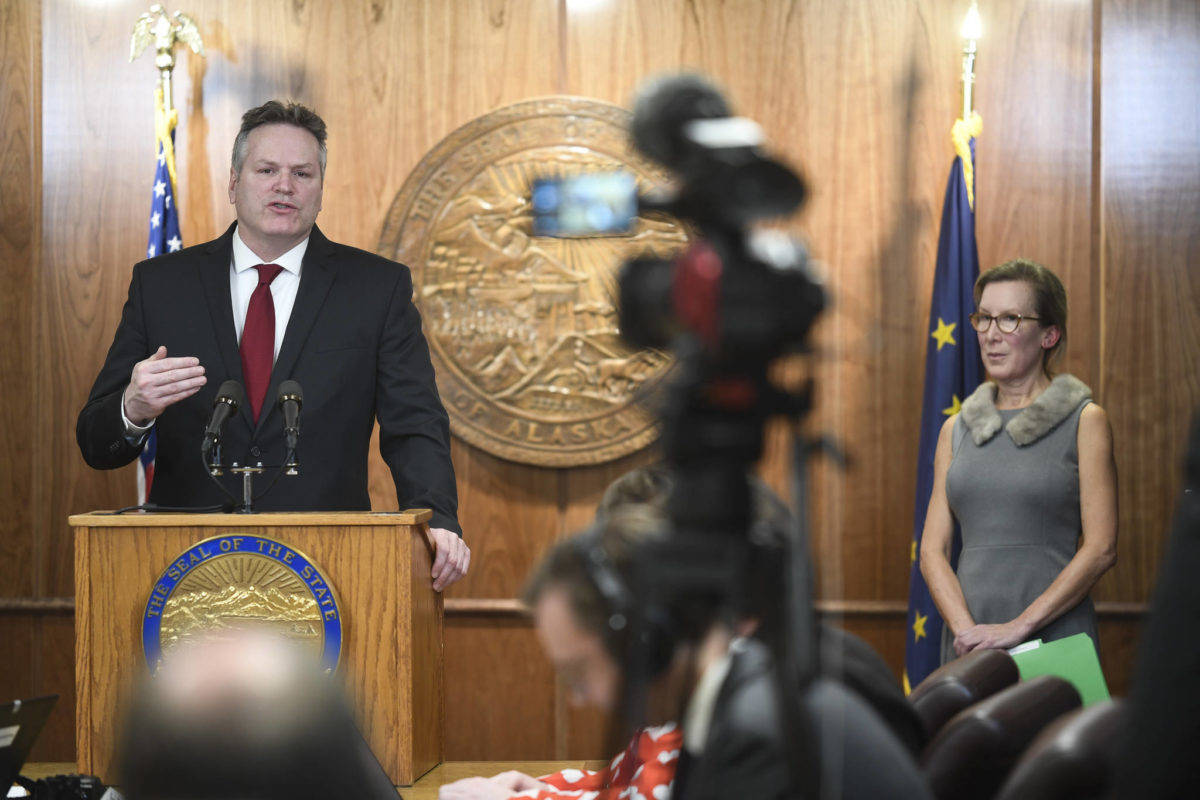
Gov. Mike Dunleavy announced Tuesday that he would not veto funds for Head Start and pre-K programs from the Legislature currently under consideration by his office, a reversal from earlier this summer when cuts to those programs were included in the $444 million vetoed from the state budget.
Dunleavy said that he intends to sign the bill sometime this week, and when he does, money for Head Start Grants, Early Childhood Grants, Parents as Teachers Grants and Best Beginning Grants will be included.
At a press conference at an elementary school in Anchorage, Dunleavy said that he had vetoed the funds in the first place because the state was experiencing a financial crisis and that a conversation needed to be had about which programs Alaskans valued most.
“We have a $1.6 billion dollar reduction,” the governor said. “We needed to have the conversation with Alaskans, what do they value? For years we’ve gone through this cycle of budgets and often times were saved by oil prices and production but I think most of us realize that now that that’s not going to be the case. So our approach was to try and reduce the budget but to try and get feedback from folks as to what programs they really value.”
The governor said that his cuts were an attempt to close the $1.8 billion deficit, “without taking the (Alaska Permanent Fund dividend) and without using taxes.”
The intention behind vetoing so much from the budget, Dunleavy said, were not to inflict harm but to force Alaskans to identify the programs they felt needed to be preserved in an environment where drastic cuts needed to be made.
“I’ve been in the Legislature,” the governor said in response to a question asking if he regretted making the vetoes in the first place. “You don’t get to this point unless you veto. You don’t have this conversation unless you veto, most people think it’s not going to happen, that we’re going to be saved by oil prices.”
When the cuts were announced his administration began to receive feedback from all over Alaska, he said, feedback that wasn’t dismissed.
“We’re not done but what became pretty clear is that Alaskans value our elders, our seniors, and we value our children, our youngest, and that’s our future,” he said.
The governor’s cuts prompted massive protests throughout the month of July and galvanized a recall campaign. Dunleavy said that for decades in Alaska it seemed as if every state program was important. “We wanted to lay out a menu of items that could’ve been reduced. We wanted to hear from the Legislature and we wanted to hear from Alaskans what is important,” he said. “We had to get Alaskans to really determine what really important to them. Kids are, seniors are, public safety is.”
When asked if the governor was going to look at cutting these same programs next year, the governor said that he hoped that wouldn’t be the case but, “if oil drops to $30 a barrel we’re all gonna have a different conversation,” he said.
Dunleavy said that he regrets the angst the uncertainty with the budget has caused, which was one of the reasons his administration felt it was important to make the announcement that these early education programs were not going to be cut.
However, the governor made it clear that the state financial situation dictated that more reductions were going to be made, but added that he looked forward to hearing from the Legislature and Alaskans as to what programs were most important.
The funds included in HB 2001 total nearly $8.8 million for early childhood education, including $6.8 million for Head Start and $1.2 million for Early Education Grants, according to the bill’s text.
In a press release Tuesday afternoon, Rep. Chris Tuck, D-Anchorage, said, “the fiscal challenges facing our state are man-made, but they are not children made. I want to thank the Governor for recognizing that fact.”
Head Start is the largest early education provider in the state, Tuck’s press release said. The restoration of these funds ensures spots for 540 students as well as 150 jobs statewide.
“The research shows that spending money on a child’s early education is a great investment in the future. By committing to signing HB 2001 with the early education money included Governor Dunleavy is recognizing the importance of that long-term investment.”
Amber Frommherz, the Head Start Director for Tlingit and Haida in Juneau, previously told the Empire that if Dunleavy were to go through with the cuts, at least three local Head Start locations in Juneau would have to close.
• Contact reporter Peter Segall at 523-2228 or psegall@juneauempire.com.

 E-Wallet Purchase (Add Funds)
 Term Subscription