
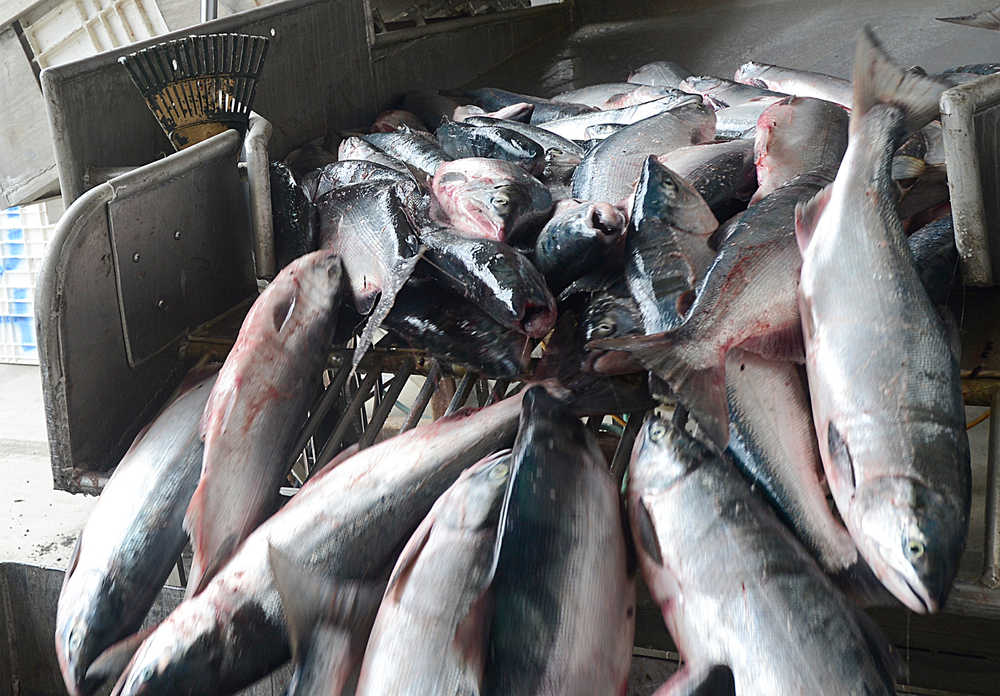
Alaska is set to receive $20.8 million for the 2012 salmon fisheries disasters, but how the money will be used is still being decided.
First the State of Alaska and the Association of Village Council Presidents, or AVCP, must work on how to split the funds between Cook Inlet and Yukon-Kuskokwim stakeholders, said Art Nelson, policy and outreach director for the Bering Sea Fishermen’s Association.
AVCP President Myron Naneg said the two parties have yet to meet.
“We haven’t had the chance to sit down with them yet,” Naneng said March 11.
Nelson said that the State of Alaska and AVCP are considered the disaster “requestors” so National Marine Fisheries Service, or NMFS, is working with those two entities to figure out the split. If they don’t come up with something, the agency could make a decision on its own.
AVCP and the State of Alaska requested fishery disaster status for the poor king salmon runs on Yukon and Kuskokwim rivers and in Cook Inlet in 2012, although the Yukon designation also applied to 2010 and 2011, and the Kuskokwim designation also applied to 2011.
When the disaster declaration was being made, Alaska Department of Commerce, Community, and Economic Development Commissioner Susan Bell gave a letter to the federal government with a breakdown of the impacts on affected fisheries.
According to that information, commercial fishery permit holders lost about $16.8 million in direct ex-vessel revenue in the years included in the disaster designation.
Once there’s a split between regions, discussions will turn to how to use the money.
Congress appropriated the money, and NMFS will work with interested parties and Alaska’s congressional delegation to decide who will administer the funds and develop a spending plan.
According to NMFS Alaska Region spokeswoman Julie Speegle, the State of Alaska has administered most past Federal Fishery Disaster Relief programs through the State’s Department of Commerce (or its predecessor, the Department of Community and Regional Affairs), except for the 2010 Yukon River disaster, which was administered by the Oregon-based Pacific States Fisheries Commission.
As of March 7, the state had not yet decided if it would pursue administering the 2012 funds.
ADFG Deputy Commissioner Kevin Brooks said Fish and Game was not actively pursuing the role, and Sharon Leighow, a spokeswoman for Gov. Sean Parnell said it was too early to say whether the Governor’s Office or Department of Commerce, Community and Economic Development would do so.
“We are still working with congressional delegation to understand authorities and NOAA (National Oceanic and Atmospheric Administration) policy guidance,” Leighow wrote March 7.
Pacific States Executive Director Randy Fisher said his organization would be willing to take the role again, but hadn’t yet heard if they would be needed.
Speegle wrote in an email that a rough plan for how the money will be used will likely be in place by mid-March.
“Discussions are underway now between NOAA, the State of Alaska, and Alaska’s Congressional delegation to understand the options for eligible disaster relief and determine the entity best suited to carry out this activity,” Speegle wrote in a March 3 email.
Based on past experiences, Speegle said it could take about 75 days following the submission of a grant application, proposal and spending plan for the money to be distributed.
Speegle said the funds could be used for direct payments to fishermen, infrastructure projects, habitat restoration, vessel or permit buybacks and job training.
Molly Dischner can be reached at molly.dischner@alaskajournal.com.
