
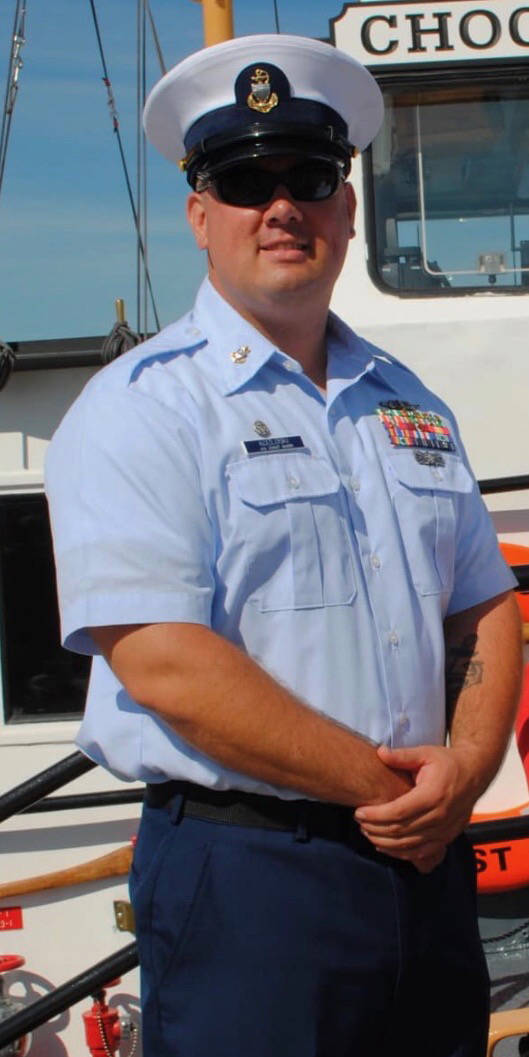
Improper operation of a crane in the buoy yard of the U.S. Coast Guard Cutter Hickory in January caused a crane to roll over and kill a crew member of the Hickory, a report released Tuesday concluded. The Major Incident Investigation board report also cited leadership deficiencies aboard the Hickory that contributed to inadequate crewmember training.
On Jan. 31, while Hickory crew moved buoys and other items in the yard at the Homer Harbor, a Shuttlelift crane rolled over, with the boom hitting Chief Warrant Officer Michael Kozloski on the head while he stood talking to another crewmember within the area of the crane operations.
Rear Admiral Matthew T. Bell Jr., commander of the 17th Coast Guard District, Juneau, has temporarily relieved the Hickory’s captain, Lt. Cmdr. Adam Leggett, of duty. Cmdr. Charter Tschirgi has assumed command of the Hickory.
Kozloski, 35, of Mahopac, New York, died of his injuries. He is survived by his wife of 15 years, Brienne Kozloski and their four young children, Madeline, Bayleigh, Cassidy and Michael.
The report found that Kozloski did not wear a hard hat, but at the time also had not been involved in crane operations. The crane operator jumped from the crane as it rolled over and was not injured. The operator and a rigger wore hard hats.
The report’s author, Capt. Travis Rasmussen, U.S. Coast Guard Base Honolulu, called the unsafe operation of a Shuttlelift crane “the last link in an error chain of consistent and long-standing leadership deficiencies and complacency with shore side heavy lift operations.”
“Command positions overseeing Coast Guard units, such as the Cutter Hickory, are among the most important and challenging assignments in our service,” Bell said in a press release on Tuesday. “Commanding officers are entrusted with tremendous authority and responsibility to ensure operational success, good order and discipline, and crew safety.”
Coast Guard officials met with Kozloski’s widow in Homer on Tuesday morning to notify her of the report, said Lt. Brian Dykens, a Coast Guard public information officer for the 17th district. Officials also met with the Hickory crew on Tuesday to brief them on the report.
After the incident, the Hickory crew member who operated the crane had his blood and urine tested. According to the report, those tests found tetrahydrocannabinol, or THC, in his urine. That’s the active ingredient in cannabis. A hair analysis also was done in late February. That test result showed the crew member regularly used marijuana. While the report called the crane operator’s regular cannabis use concerning, Rasmussen wrote that he could not find sufficient evidence to show “immediate or residual effects of marijuana use were adversely affecting the (crane) Operator at the time of the incident and substantially contributed to the mishap.”
However, under the Coast Guard’s zero tolerance policy of the use of federally controlled drugs, the crane operator will be discharged from the Coast Guard, Dykens said. While cannabis is legal to grow, sell and possess in Alaska, it remains a federally controlled drug.
“Wrongful use of controlled substances is unlawful and contradicts core values of honor and respect and devotion to duty,” Dykens said.
The 25-page report came about following a Major Incident Investigation done by Rasmussen and three other board members, all Coast Guard officials. The investigation started Feb. 1, with the report finished on April 19 and publicly released on May 21.
According to the report, these factors contributed to the fatal incident:
• Senior enlisted and officer leadership permitted the use of the Shuttlelift crane by nonqualified operators;
• A difference in perceived risk of cutter operations versus shore side operations, with less emphasis placed on training and qualifications that would lead to safe shore based operations;
• Leadership complacency and a lack of oversight and monitoring of shore side heavy lift operations.
“The error chain associated with this mishap is extensive and indicates how far reaching the leadership deficiencies and complacency had become at the unit,” Rasmussen wrote. “… In my opinion, it was not a question of if a mishap would occur but when.”
The Hickory had been moored in Homer since Christmas 2018, and on Jan. 31 preparations were underway for a planned cruise on Feb. 1. Because of rain and snowmelt, the ground had been soft in the buoy yard. Some crew members had been under pressure to clean up the buoy yard, the report said.
The crane operator did not extend or press down outriggers on the crane, extendable legs that would give the crane more stability. Citing Occupational and Safety Hazard Administration guidelines, the report said “that cranes must be assembled on ground that is firm, drained and graded sufficiently.” The Shuttlelift’s load rating and range diagram showed that using outriggers makes a significant difference in lifting capacity. The load being lifted, buoy bells on a pallet, also had not been balanced.
While operating the crane and moving the pallet, the crane operator told investigators he thought he saw Kozloski make a pointing hand motion and interpreted that to mean placing the load in a different location. Rasmussen said he didn’t find evidence that Kozloski directed the crane operator at the time of the mishap, and that Kozloski most likely waved his hand as part of a conversation with another crew member.
“Risk assessment of increased awareness of the crane-operating envelope by personnel within the buoy yard may have avoided the tragic outcome of this mishap,” Rasmussen wrote.
The crane rolled because of operation errors by the crane operator, the report concluded. The operator tried to lift a load that exceeded the parameters of the crane. The operator may have lowered the boom to set the load down further away as a result of the perceived hand motion by Kozloski. The crane tipped over because “the increased operation radius exceeded the stability limit for the ML (mishap load),” Rasmussen wrote. The load capacity would have been four times greater if outriggers had been properly deployed, he wrote.
The Major Incident Investigation report will be formally reviewed and approved at Coast Guard headquarters in Washington, D.C. A Mishap Analysis Board also is doing a safety analysis of the crane rollover, Dykens said. Those board actions and reports will be used to improve Coast Guard safety procedures.
“Both of those together will help put together a report of how the Coast Guard can make corrective actions,” Dykens said.
Reach Michael Armstrong at marmstrong@homernews.com.
