
A cohort of about 15 people clustered in the George A. Navarre Admin Building in Soldotna last week for an informational meeting about ranked choice voting. The meeting, organized by Rep. Ben Carpenter, R-Nikiski, came about two weeks before the Aug. 16 election — when Alaska voters will use the ranked choice voting system for the first time. In that election, Alaskans will vote in both the state’s special general and regular primary elections. Both races will be on the same ballot.
Changes to Alaska’s electoral systems were approved by voters as Ballot Measure No. 2, which passed narrowly in 2020 with 50.55% of votes cast. That measure created an open primary system and ranked choice general election and aimed to increase transparency about the use of “dark money” — or campaign funding from undisclosed sources — in Alaska elections.
Among the concerns voiced by attendees at last week’s event were whether the 50% ranked choice threshold matters during open primaries — no, and whether you can leave one “choice” column blank — yes.
Carpenter also clarified the different ways a ballot could become “exhausted,” meaning removed and no longer counted. For example, if voters skip two rankings, only the candidates ranked before the skipped columns will be counted. If a voter skips one ranking column, their choices move up.
If voters give more than one candidate the same ranking, those rankings do not count. If voters rank a candidate more than once, that candidate will still only receive one vote. Examples of invalid votes can be found at elections.alaska.gov/RCV.php.
Carpenter said the biggest problem with ranked choice voting, in his opinion, is having to strategize for each race instead of just picking one candidate. That strategy, Carpenter said, includes voters considering whether or not they want to potentially add or take away votes from a candidate who is not their first choice.
“What I’ve just presented now indicates that you have to have a strategy for each one of your races, rather than just going in and picking the best person for the job, which is a very simple process,” Carpenter said.
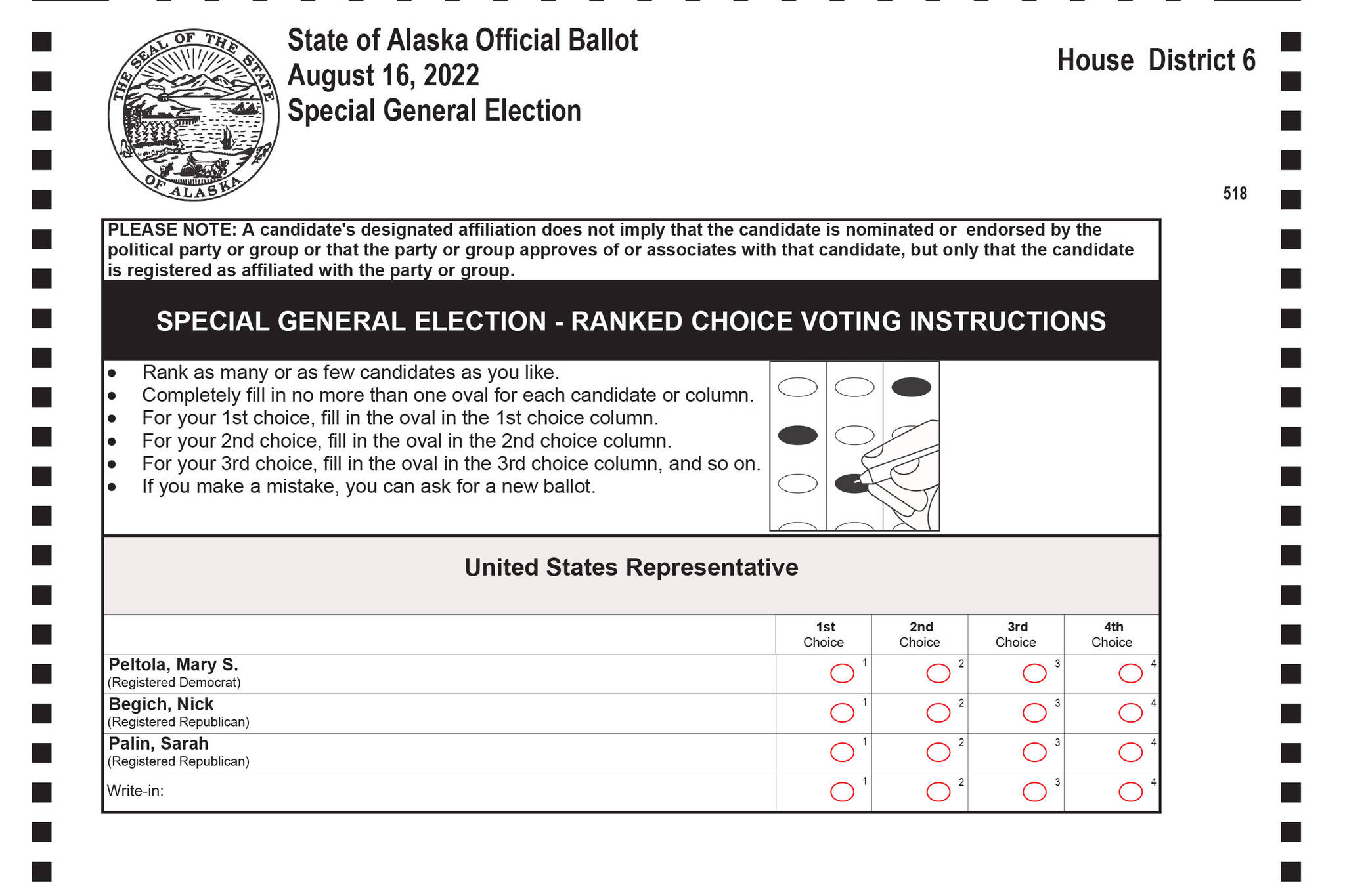
On one side of the Aug. 16 ballot, voters will rank candidates vying to fill the remainder of the late Don Young’s term in the U.S. House of Representatives. Candidates will rank candidates Nick Begich III, Sarah Palin and Mary Peltola on that side of the ballot using Alaska’s new ranked choice voting system.
The ranked choice ballot shows a grid of bubbles, with one row for each candidate and one column for preference order. Voters fill in the bubble in the “1st Choice” column that corresponds to their first-choice candidate. Voters then move to the second column and fill in the bubble that corresponds to their second-choice candidate, and so on. Voters can rank up to four candidates, or just rank one, two or three candidates.
If a candidate receives more than 50% of the first-choice votes, that candidate would be declared the winner of the election.
If no candidate receives more than 50% of the first-choice votes, the candidate who received the least number of first-choice votes is eliminated. Then, the voters who ranked the eliminated candidate as their first choice would have their second-choice candidate votes distributed to the remaining candidates. The process will continue until one candidate emerges with more than 50% of the votes.
On the other side of the ballot, Alaskans will vote in the state’s regular primary election. For each race, voters will vote for one candidate. This year’s primary races include those for U.S. senator, U.S. representative and governor and lieutenant governor, as well as for seats in the Alaska Legislature.
Candidates running for the U.S. House on the regular primary side of the ballot are running for the next two-year term of Alaska’s at-large seat in the U.S. House. That term is different from the one that ends in 2023 and that Don Young was to finish out.
That race, like the June 11 special primary election, will be an open primary, meaning all voters will vote the same primary ballot regardless of their political party. The top four vote-getters from the primary will then move on to the general election, regardless of party affiliation. If there are fewer than four candidates running in the primary, all will move to the general election.
Ultimately, Carpenter encouraged attendees at Thursday’s meeting “not to overthink” ranked choice voting.
“Your choice when you go into the ballot box is to bubble the bubble for the people who are favorable in whatever order you deem,” Carpenter said. “If you don’t want to bubble for unfavorable people, then you don’t have to. There was never a requirement that you go into the ballot box in the first place.”
Soldotna Prep School, located at 426 W Redoubt Ave. in Soldotna, offers early voting and is open from 9 a.m. to 4 p.m. Monday through Friday. That location has ballots for State House districts 5, 6, 7 and 8.
Also, absentee in-person voting is also available at the Kenai City Clerk’s office at 210 Fidalgo Avenue from 9 a.m. to 4 p.m. Monday through Friday. That location has ballots for State House district 5, 6, 7 and 8.
More information about this year’s state elections, as well as sample ballots by state legislative district, can be found on the Alaska Division of Elections website at elections.alaska.gov.
Reach reporter Ashlyn O’Hara at ashlyn.ohara@peninsulaclarion.com.
Correction: This story has been updated with the correct hours of operation for early voting at Soldotna Prep School. That location offers early voting from 9 a.m. to 4 p.m.

Rep. Ben Carpenter, R-Nikiski, leads an informational town hall about ranked choice voting inside the Betty J. Glick Assembly Chambers on Thursday, Aug. 4, 2022 in Soldotna, Alaska. (Ashlyn O’Hara/Peninsula Clarion)
