
The Kenai Peninsula Borough’s land management division is beginning to craft legislation that would seek a borough timber sale and forest management plan intended to help combat the borough’s latest spruce bark beetle outbreak.
Kenai Peninsula Borough Land Management Agent Dakota Truitt and Land Management Officer Marcus Mueller, who are leading the project, convened with members of the public Tuesday at the Donald E. Gilman Kenai River Center in Soldotna for the last of three public engagement events meant to help spread awareness about and collect community input on the program. The proposal was first presented to the Kenai Peninsula Borough Assembly last month, where it was pitched as an opportunity to expand timber harvesting within the borough and to craft a forest management plan.
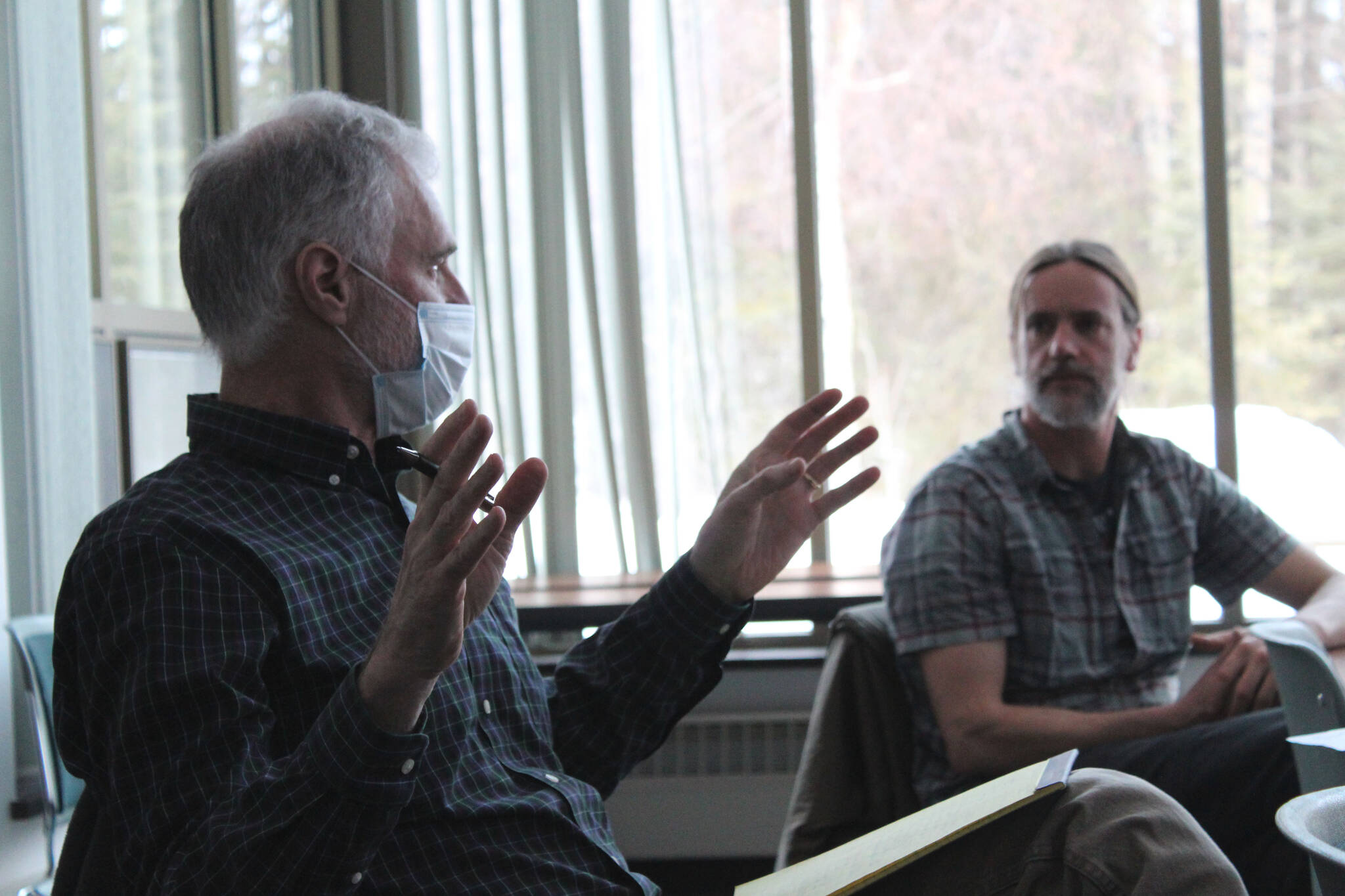
Cooper Landing resident Theo Lexmond attended Tuesday’s meeting to share his thoughts on the proposed program. Lexmond said he and his wife own property in Cooper Landing, and had concerns about the future of the borough’s logging roads, which he said are used for “illicit, unregulated camping.”
The proposed program is two-pronged: Phase One includes the removal of infected trees from borough land, while Phase Two will focus on reforestation efforts.
Lexmond said that he and his wife have found smoldering campfires and trash while walking around logging roads in the past, and asked whether the borough planned to decommission such roads as part of reforestation efforts.
“When these things are happening behind your home, you get pretty darn concerned about it,” Lexmond said.
Trevor Kauffman, a former borough land management agent and forester for the State of Alaska, countered that logging roads are “expensive investments” in forest infrastructure and have residual value to the borough. Kauffman has also served as a wildland firefighter and operational leader and said, alternatively, he has experienced frustration when, while firefighting, he’s encountered roads that have been recontoured.
“I’m really kind of shocked by this idea that every road needs to be torn out,” Kauffman said.
Kauffman also questioned the borough’s assessment of how valuable infected trees really are. To estimate how lucrative a mass timber sale project is, the borough multiplied the value of the wood by the number of acres impacted by spruce beetles.
At $31.71 per cord, the borough estimates the value of the merchantable timber on the 21,000 acres of peninsula land infected to be between $330,000 and $666,000. That is separate from the value of fuelwood which, at $22 per cord, the borough estimates to be between $2.77 million and $9.24 million.
The longer the borough waits to take action on the infected trees, however, the less valuable that wood becomes. Truitt has maintained since her first presentation on the project to the borough assembly that the program will not be particularly lucrative, but said Tuesday any revenue generated from the sale would be put back into reforestation efforts, the second phase of the program. The first phase will focus on the removal of infected trees from borough land.
To make the program happen, the borough will need a new ordinance authorizing forest management. According to a program timeline presented by Truitt on Tuesday, the project team hopes to have draft legislation ready by May, to get the authorization by July and to send out a timber sale brochure in December. Timber sale offerings would begin next March, with implementation of the program slated for next summer.
Truitt said Tuesday that, throughout the public comment process, a lot of the feedback that has been received has been about what the implementation of the timber sale product will look like in action. Since the project was first presented to the assembly, Truitt said, a site-based approach to treatment prescriptions emerged as something that should be incorporated into the final plan.
“We came in with this broad idea, like, ‘Hey, we want to deal with the spruce bark beetle problem,’” Truitt said, adding that public input has helped hone the program.
As of 2020, more than 150,000 acres of forest had been impacted by spruce bark beetle infection on the Kenai Peninsula, including about 21,000 acres of forested land between Cooper Landing, Kenai and Soldotna, Truitt said.
Spruce bark beetles kill trees by boring through bark and feeding in a tree’s phloem, according to the National Park Service. Phloem is the innermost layer of the bark and transports compounds produced through photosynthesis to other parts of the tree.
By disrupting that process, beetles are able to starve the tree and cause it to die. That death is accelerated by a fungus brought by the beetles that prevents the movement of water through the tree.
A common indicator of beetle presence is boring dust, similar to sawdust, which collects at the base of the infected tree and in bark crevices. The dust is pushed out of holes in the bark where beetles enter and clear tunnels under the bark. Pitch tubes, or red globs on the surface of the tree bark, are seen where the tree has tried to push the beetles out.
Residents can further take an active role in reducing spruce bark beetle populations by knowing how to treat and store their spruce firewood. The Alaska Division of Forestry offers guidance on their website about the best conditions for wood at each stage of infection.
More information about the borough’s timber sale project will be available on a website dedicated to the program, set to go live later this week. Additional information about spruce bark beetle mitigation can be found on the Kenai Peninsula Borough’s Land Management Division website.
More details about the project can be found at kpb.us/forestmangement. Public comments on the program can be submitted on the site.
Reach reporter Ashlyn O’Hara at ashlyn.ohara@peninsulaclarion.com.
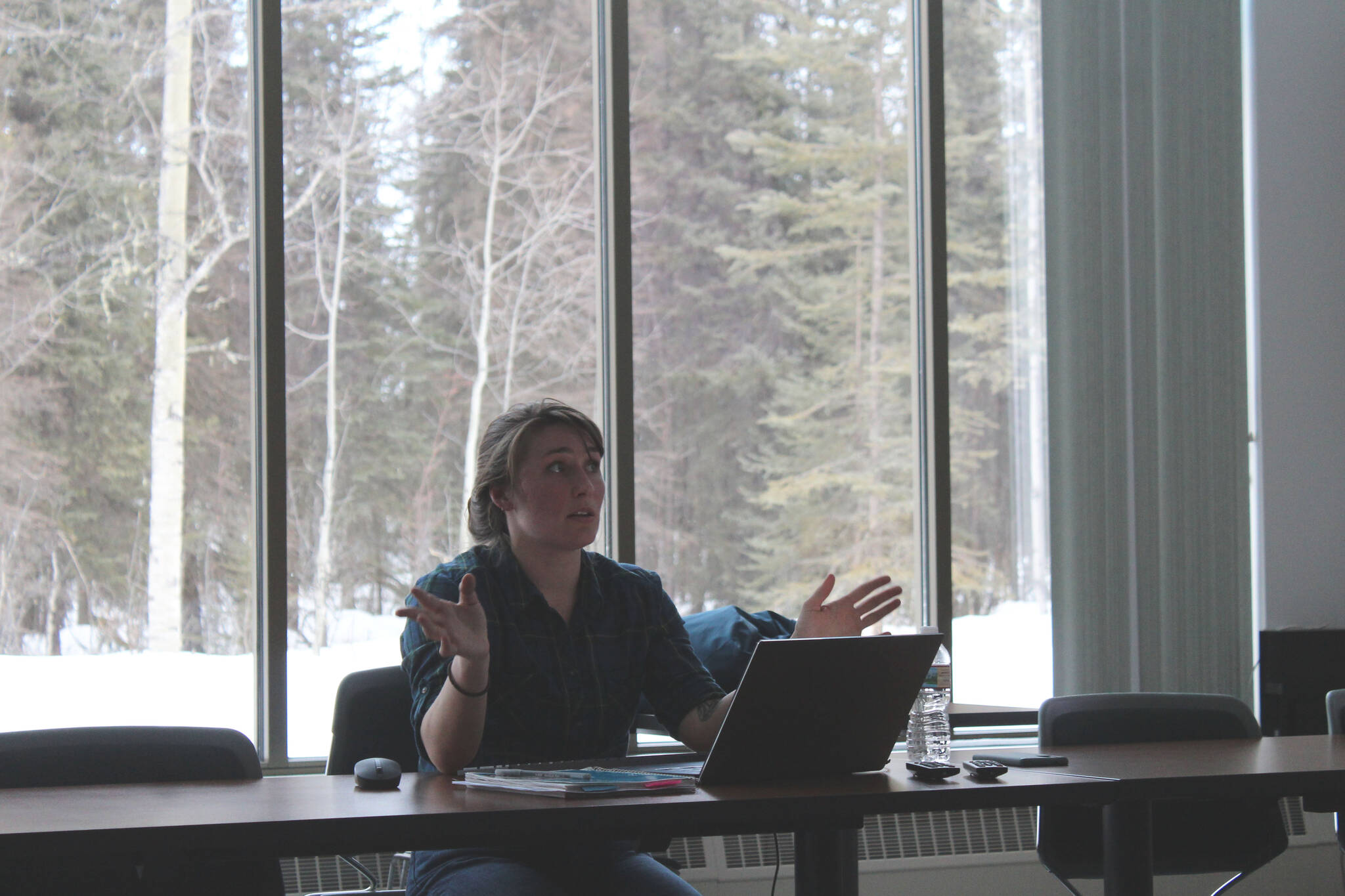
Kenai Peninsula Borough Land Management Agent Dakota Truitt presents information about the borough’s new timber sale and reforestation project at the Donald E. Gilman Kenai River Center on Tuesday, March 22, 2022, in Soldotna, Alaska. (Ashlyn O’Hara/Penisula Clarion)
