
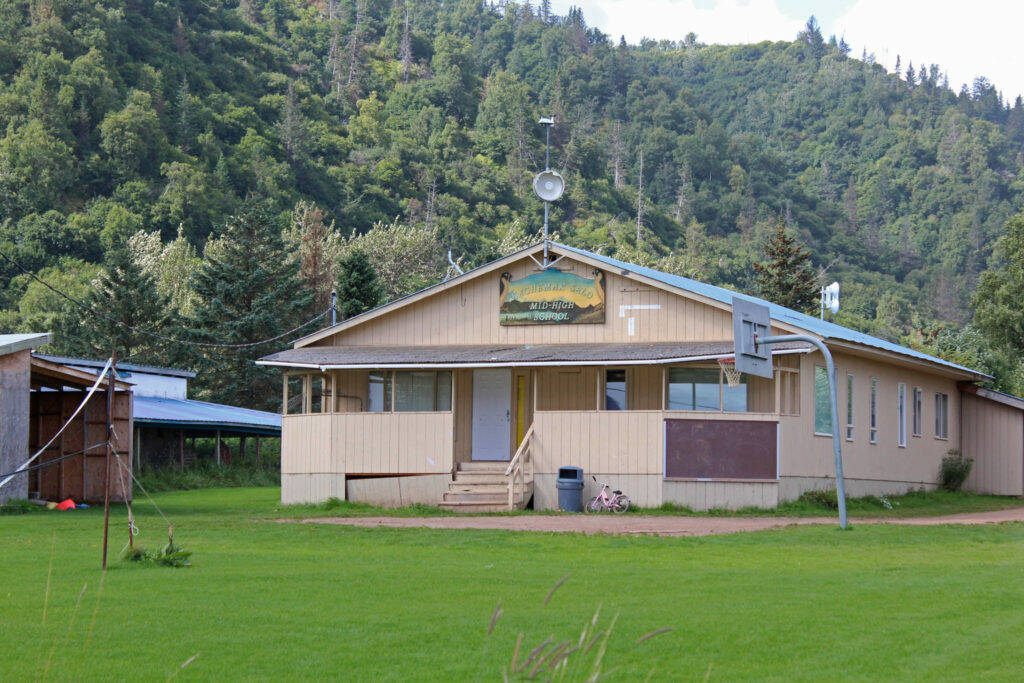
Eight years after the state gave the Kenai Peninsula Borough money to replace a school in the remote community of Kachemak Selo, the future of the project remains in limbo.
The borough and state have gone back and forth over the best way to build a new school for the village, located at the head of Kachemak Bay, and this week they were still at odds over how to move forward.
The clock is ticking, though, for the borough to make a decision. The grant money — $10.87 million — must be spent by June 30, or the money will stay with the state. The grant deadline has already been extended once, for seven years in 2017, with no groundwork done on a new school since.
Now, the borough is reviving a request first made several years ago: extend the grant deadline again and switch the state department under which the grant was awarded so the borough can build Kachemak Selo a multipurpose building, rather than a school facility.
A multipurpose building, the borough says, would be less expensive and simpler to construct while still meeting the needs of the students. Senate President Gary Stevens, who represents the district containing Kachemak Selo, cast doubt this week on whether the borough’s request was doable.
A new school in Kachemak Selo has been recognized as a need by the Kenai Peninsula Borough School District and the borough for more than a decade. Community members first asked the borough to consider improving their school in 2012 via a petition signed by 40 residents of the village.
The borough and school district asked the state for money to build the school in 2013 and it moved up the state’s list of priorities until it was funded in Alaska’s capital budget for fiscal year 2017.
For years, the school’s roughly 30 students have been served out of three residential buildings, none of which are owned by the borough or school district and all of which are in disrepair and out of code compliance. The district made the decision earlier this year to shutter one of the two remaining school buildings, which had a slanted floor and a bowed-in roof.
“It’s embarrassing that KPBSD school children were going to school in a saturated building that should have been condemned before it was,” Kenai Peninsula Borough Mayor Peter Micciche said Monday of the building.
He successfully spearheaded an effort last week to formally request that the Alaska Legislature move the grant money from the Alaska Department of Education and Early Development to the Alaska Department of Commerce, Community and Economic Development.
Doing so would mean the borough doesn’t need to adhere to the state’s educational specification, which has more stringent requirements than other buildings not primarily used as a school facility, such as a multipurpose community building.
“If we were to build a DEED ed spec school, we simply don’t have enough money to construct that facility,” Micciche said Monday.
The money awarded by the state in 2016 was intended to cover 65% of the project’s estimated $16.72 million price tag. That estimate was reduced in accordance with student population projections to $15.4 million. As a condition of the grant, the borough is on the hook for the other 35%, or about $5.39 million. Of that local match, the borough has already set aside in previous budgets $3 million.
The borough in 2018 tried unsuccessfully to bond the full $5 million match; 58% of voters opposed the proposal. The school district considered adding K-Selo to a 2022 bond proposal that funded $65.5 million worth of school projects, but worried it could jeopardize the rest of the projects.
The borough has about four months to come up with the rest of the local match funding if the project goes ahead as a school or risk losing the $10 million in grant funds.
Stevens said Monday there are several obstacles to changing the grant as requested by the borough.
First, he’s not sure it’s legal. The initial grant, Stevens said, was awarded with the understanding that the money would be used to build a school, not a community building. Grant money, he said, is also not eligible for reappropriation and the state finances are tight.
“That’s a legal question,” Stevens said. “Can that money be transferred to Commerce and not (be) used for a school? The rationale was that it would build a school.”
Second, there are other projects in the state that Stevens said have the same level of need as K-Selo and that could do a lot more with the $10 million the borough is trying to hold on to. For the same amount of money, the state could award grants that would fund new school construction in the Lower Kuskokwim and Yukon-Koyukuk school districts.
“(There are) lots and lots of schools that need help, so that’s the problem we’re facing here,” Stevens said. “It’s not money that has been given to the borough to do anything they want with it … It really doesn’t work that way.”
Stevens also said he and other lawmakers are worried about the precedent that would be set by the state making an exception for the Kenai Peninsula Borough because it can’t come up with its share of the money.
“There are concerns that (this would be) precedent setting and would this then lead to every school district in the future saying, ‘We don’t have the money, would you pay for it?’” Stevens said. “We don’t want to be a part of it.”
The borough still has time, Stevens said, to come up with the rest of the money. He’s also looking into whether the project scope can be reduced, such that the amount of money the borough would need to contribute is also reduced. That’s on top of communicating with the commissioners of both state departments to see whether it’s possible to move the grant funds.
Ultimately, though, Stevens said the best way to get a new school built in K-Selo is for the borough to come up with its share. The state has already demonstrated that it understands what’s at stake for the community by awarding the grant in the first place.
“The community has to step up to the plate, or it’s unlikely it’s going to happen and the kids just suffer,” he said. “We’re going to try and find a way to work around it. I’m not really very positive that there are ways to do that, but we’ll try.”
Micciche on Monday said it would be “irresponsible” for the state to not help pay for a new school in the community. He floated the idea of a community and school hybrid building model as one the state could pursue in other rural areas of the state, where he said schools already function as a de facto community hub.
“It’s the state’s responsibility,” he said. “They lived up to their responsibility in funding that school back in 2016. It has not become less important. It’s become more of a dire necessity than it was back then.”
In the meantime, Micciche said he’s optimistic and that he’s working with Stevens to determine a viable path forward that will result in a school for K-Selo.
“We’ll tackle problems as they arise,” he said. “Right now I have a pretty high degree of confidence that good people will see the wisdom of appropriation.”
The borough on Tuesday night received permission from the state to purchase the piece of land on which the existing K-Selo school sits. It marks the first time the borough has acquired any land for the project and is being celebrated by the school district as a step in the right direction.
Reach reporter Ashlyn O’Hara at ashlyn.ohara@peninsulaclarion.com.
This reporting from the State Capitol was made possible by the Alaska Center for Excellence in Journalism’s Legislative Reporter Exchange. Alaska news outlets, please contact Erin Thompson at editor@peninsulaclarion.com to republish this story.
