
The Kenai Peninsula Borough’s Land Management Division is ready to turn the Kenai Peninsula’s latest spruce bark beetle outbreak into an opportunity to expand timber harvesting opportunities and craft a forest management plan.
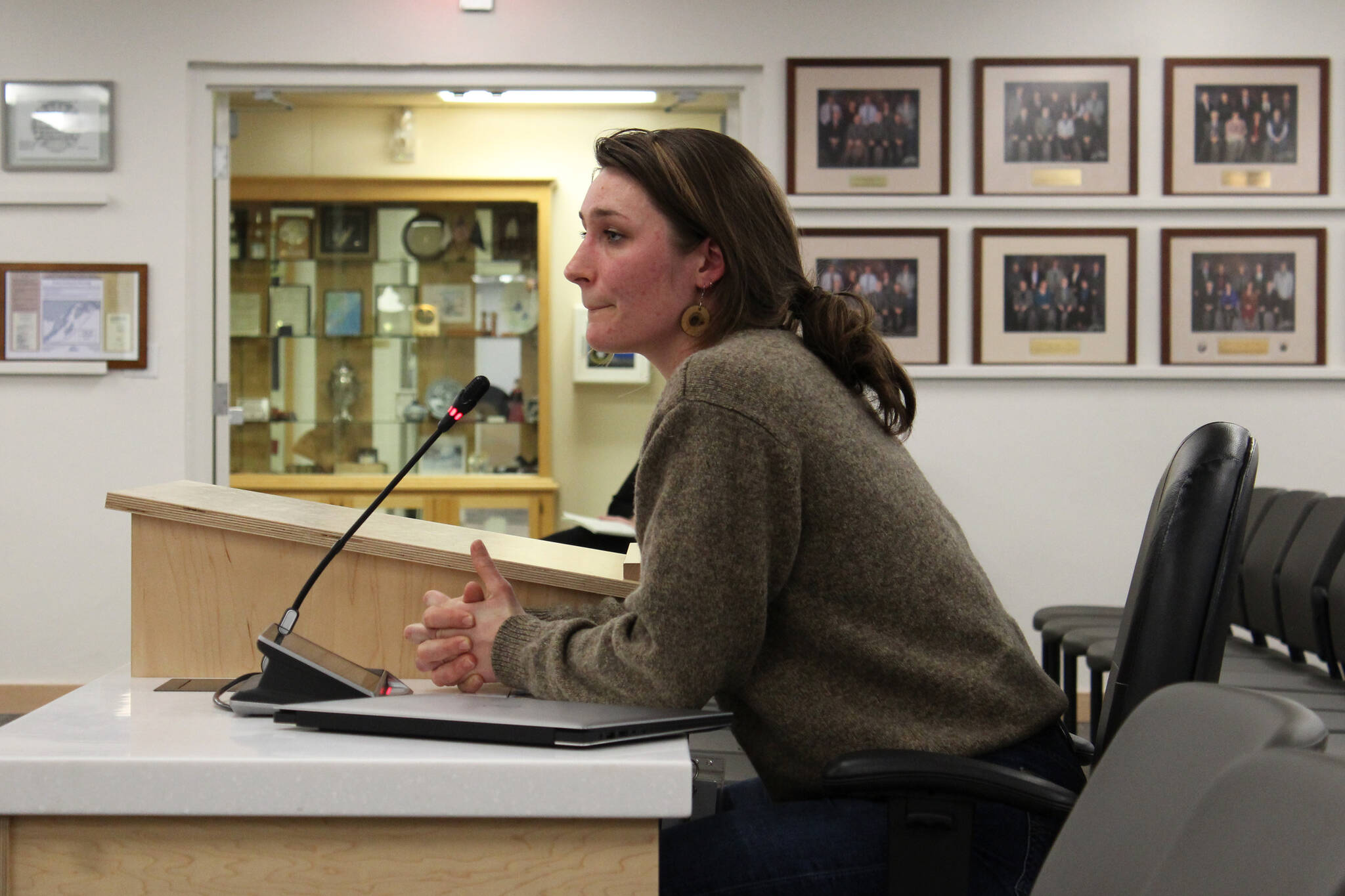
A proposal for a new mass timber sale and reforestation program was presented by Kenai Peninsula Borough Land Management Agent Dakota Truitt to the Kenai Peninsula Borough Assembly during the body’s Tuesday meeting. Truitt said that the borough does not currently have a spruce bark beetle or forestry program, as the most recent similar program was phased out following the last spruce bark beetle outbreak.
Among the short-term goals of the program, Truitt said, are to seek authorization from the assembly for timber sales, to kick off active forest management work using the local workforce and to explore grant opportunities to help support the work.
The borough sent a request for funds to U.S. Sen. Lisa Murkowski’s office last year in response to the spruce bark beetle outbreak. While that project was not directly funded, Truitt said the borough is using the same structure to apply for other grants.
Truitt said that the long-term goals of the program include the development of a forest management plan for the borough, mandatory reforestation and legacy forestry infrastructure within the borough. The project is two-pronged: Phase One includes the removal of infected trees from borough land, while Phase Two will focus on reforestation efforts.
On average, each acre of spruce can yield about one-half to one merchantable cord, which the borough defines as anything that can be used as a saw log or produce lumber. There’s between six and 20 cords of fuelwood per acre on average. The value of that lumber, Truitt said, is high. Fuelwood includes firewood as well as other manufactured products such as fuel for pellet stoves and boilers.
“That’s a lot of wood biomass per acre that we’re looking at,” Truitt said.
As of 2020, more than 150,000 acres of forest had been impacted by spruce bark beetle infection on the Kenai Peninsula, including about 21,000 acres of forested land between Cooper Landing, Kenai and Soldotna, Truitt said.
However, 2021 data indicate that those numbers have grown to almost 200,000 acres of forest land on the peninsula and 1.4 million acres across all of Southcentral Alaska.
“It’s significant,” Truitt said Tuesday.
Multiplying the value of the wood by the number of acres impacted by spruce beetles allows the borough to estimate how lucrative a mass timber sale project is.
At $31.71 per cord, the borough estimates the value of the merchantable timber on the 21,000 acres of peninsula land infected to be between $330,000 and $666,000. That is separate from the value of fuelwood which, at $22 per cord, the borough estimates to be between $2.77 million and $9.24 million.
As trees continue to succumb to infestation, however, the less valuable they become. Treatment costs range from $450 an acre to $2,000 an acre if the borough uses service contracts to thin tree stands.
“Realistically some of our forested lands have already gone too far — we will have to utilize service contracts — but some are right for timber sales to utilize that wood before it’s deteriorated to a point of no value,” Truitt said.
There’s also the associated hazards that come with dying trees, such as susceptibility to forest fires. The Swan Lake Fire in 2019, for example, resulted in the loss of 167,000 acres of forest and cost around $46 million in fire response efforts, Truitt said.
“If we’re looking at it as a total sum, the cost of producing these timber sales and capitalizing on forest products is going to be less than the cost of treating the forest, same as the service contracts, which is still substantially less than the cost of this fire response and potential infrastructure loss,” Truitt said.
After infected trees have been removed will come reforestation. For several reasons, including supply chain issues and the long germination period for natural regrowth, Truitt said the plan is to invest revenue generated from the sales back into reforestation efforts.
Still, Truitt said economic gains are still expected for the borough through the program.
“By taking this action towards forest management, we’re building a stream of economic opportunities that, because of this additional resource utilization, result in market expansion and industry development,” Truitt said. “This development would allow us as land managers to create forest management plans and ultimately feed forest resources back into the industry to create a sustainable timber management plan.”
To make the program happen, the borough will need a new ordinance authorizing forest management, which Truitt said the land management division hopes to bring before the borough assembly in May following a lengthy public engagement process.
In the meantime, there are ways borough residents can be proactive about mitigating the impacts of the current spruce bark beetle outbreak on their own properties.
Spruce bark beetles kill trees by boring through bark and feeding in a tree’s phloem, according to the National Park Service. Phloem is the innermost layer of the bark and transports compounds produced through photosynthesis to other parts of the tree.
By disrupting that process, beetles are able to starve the tree and cause it to die. That death is accelerated by a fungus brought by the beetles that prevents the movement of water through the tree.
A common indicator of beetle presence is boring dust, similar to sawdust, which collects at the base of the infected tree and in bark crevices. The dust is pushed out of holes in the bark where beetles enter and clear tunnels under the bark. Pitch tubes, or red globs on the surface of the tree bark, are seen where the tree has tried to push the beetles out.
Residents can further take an active role in reducing spruce bark beetle populations by knowing how to treat and store their spruce firewood. The Alaska Division of Forestry offers guidance on their website about the best conditions for wood at each stage of infection.
More information about the borough’s timber sale project will be available on a website dedicated to the program, set to go live later this week. Additional information about spruce bark beetle mitigation can be found on the Kenai Peninsula Borough’s Land Management Division website.
Reach reporter Ashlyn O’Hara at ashlyn.ohara@peninsulaclarion.com.
