
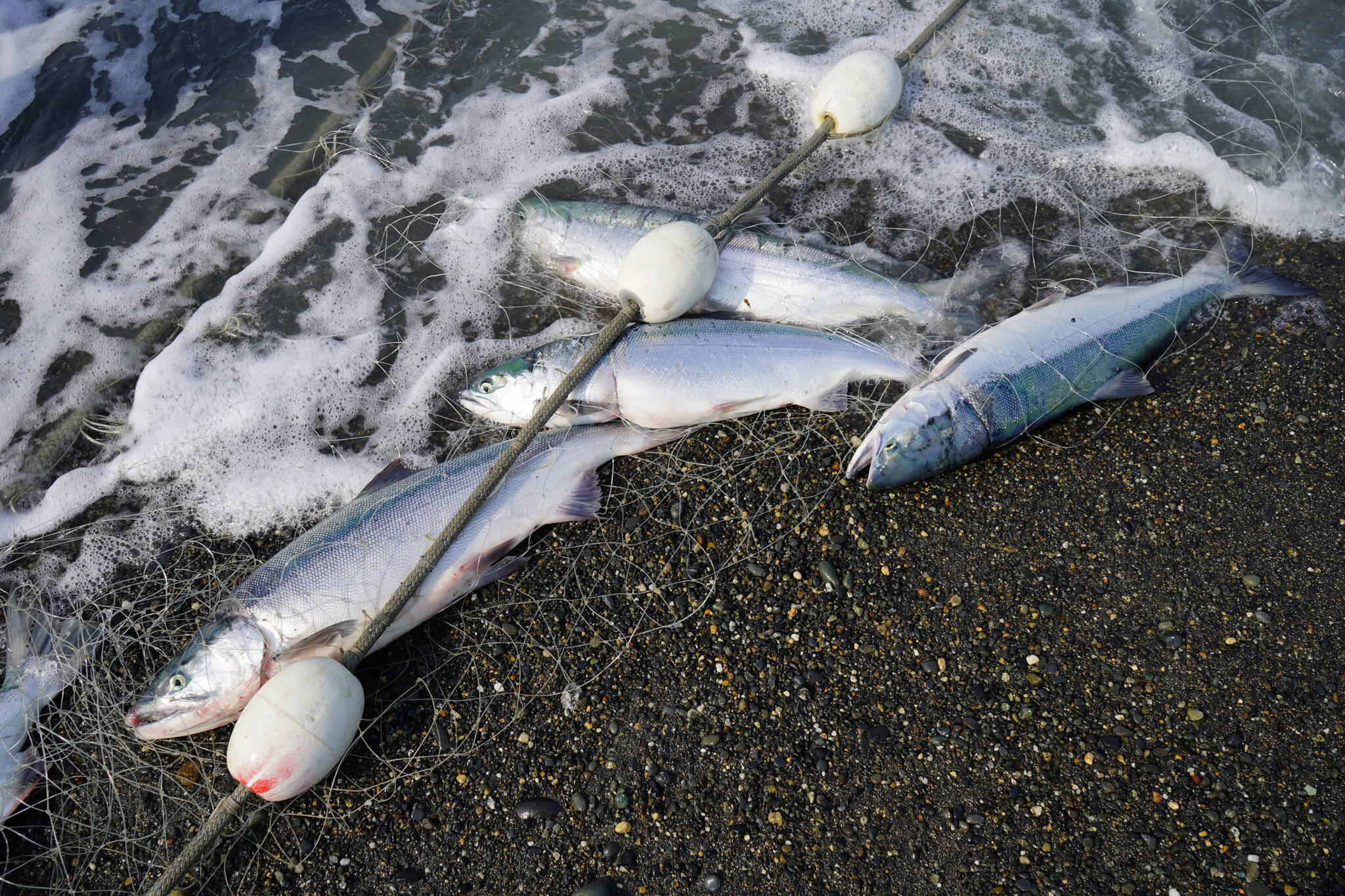
Proposals set to be considered by the State Board of Fisheries this winter were published last week. To be reviewed are 255 proposals, 186 of which target the Upper Cook Inlet area. Seeing the most attention are Kenai River late-run king salmon and the east side setnet fishery.
Many proposals describe changes to the Kenai River Late-Run King Salmon Management Plan, which earlier this year triggered unprecedented full-season closures of both the king salmon sport fishery and the east side setnet fishery.
Those closures happened because the king salmon run was forecast to fall below the optimal escapement goal for the species, which is set by the board. The goal is between 15,000-30,000 “large” king salmon, or those greater than 34 inches in length. Forecasts indicated that the goal would not be met, and so the fisheries were closed and other restrictions were implemented for other groups who were still fishing.
Even with the full closure of the east side setnet fishery and king salmon sport fishing, only around 14,000 fish were counted this year, according to data available from the State Department of Fish and Game.
King consternation
Proposals include changes to the escapement goals for the species, modifications to the paired restrictions on the setnet fishery, new setnet-specific harvest limits for king salmon, prohibitions on the use of motorized vehicles in the river and even full closures of commercial guiding activity in the Kenai and Kasilof rivers.
Those seeking opportunity for setnet fishers say that sockeye salmon are their target stock, not king salmon. Kenai River sockeye salmon have, in each of the last four years, entirely surpassed their sustainable escapement goals — this summer, more than a million sockeye were counted above the upper bound of the goal for the species on the river.
A proposal submitted by the Kenai Peninsula Fishermen’s Association seeks the use of the sustainable escapement goal for Kenai River king salmon rather than the optimal escapement goal, but also proposes the creation of a limited opportunity for setnet fishing when an escapement of 12,000 kings are forecast. That opportunity, their proposal reads, would be for one net per permit for two 12-hour periods per week, “based on the abundance of sockeye salmon returning to the Kenai and/or Kasilof Rivers.”
“Collateral king mortality is accepted in all other fisheries in their quest to harvest sockeye and coho salmon, but not the Eastside Setnet Fishery,” the proposal reads. “With the current Late-Run King Salmon Management Plan, the ESSN has been completely allocated out of the sockeye fishery.”
The proposal points to liberalizations by the department this summer for other fisheries targeting “plentiful” sockeye, taken while the setnet fishery has been entirely closed.
Another proposal by the same association suggests managing the east side setnet fishery with harvest limits for king salmon during times of low abundance. When the total escapement is forecast to be greater than 11,750 but fewer than 15,000, they propose setnet fisheries be open, but if more than 200 large Kenai River late-run king salmon are harvested in the Kenai River/East Foreland or Kasilof River sections, those sections will be closed immediately.
That proposal describes the optimal escapement goal of large salmon as unrealistic in the face of declining sizes across a much wider area than the Kenai River.
“The current Optimal Escapement for the late-run Kenai Chinook goal of 15,000 large late-run chinook salmon is unattainable and based on fantasy rather than science,” the proposal reads. “If it is not removed or revised, the East Side Setnet Fishery will never fish again.”
Multiple other proposals similarly target the large qualifier on both the optimal and sustainable escapement goals for king salmon.
A proposal by Paul Shadura II seeks a shift to managing based on all kings escaping, and says that based on the large king qualifier that was established in 2020, only one of the last 10 years would have achieved the goal.
“The problem is that the current plan does not take into consideration the current peer reviewed science that proves that salmon all over Alaska and the Pacific Ocean are shrinking,” Shadura writes.
Other proposals describe gear modifications like shallower nets. A study is being run on the Kenai Peninsula on a site down Kalifornsky Beach Road to collect data as to whether shallower nets can more specifically target sockeye without catching king salmon. Gary Hollier, on whose site the study is being run, proposes a limited opening with the use of those shallower nets if the preseason estimate falls between 13,500 and 15,000 large king salmon.
Similar proposals seeking the use of shallower nets in the setnet fisheries were submitted by the Kenai River Sportfishing Association and Kenai River Professional Guide Association.
Another proposal suggests using “flagged nets,” which are nets turned 90 degrees and anchored parallel to the current. That proposal says that king salmon are often caught because the current pushes them into the net — that if the net were parallel to the current they could hit the net and still swim away.
A riverful of reds
Some proposals also target sockeye salmon management.
Creating a sockeye salmon optimal escapement goal that is far lower than the existing sustainable goal of 750,000 to 1.3 million is supported by three proposals. They say that the lower goal will better incentivize the department to manage against high sockeye salmon escapement. Conversely, the Kenai River Sportfishing Association proposes raising those goals, saying that recent high escapements have indicated that maximum sustained yield of sockeye on the Kenai River is “substantially greater than previously thought.”
A proposal by the Central Peninsula Fish and Game Advisory Committee targets “intent” of the Kenai River Late-Run Sockeye Salmon Management Plan. They seek a change to language in the plan that directs the department to manage sockeye fisheries to minimize harvest of other species, including late-run Kenai River kings. Their proposal would change that language to direct the department to manage “common property fisheries with a reasonable opportunity to harvest salmon resources.”
On the Kasilof River, KRSA proposes establishing a Kasilof Late-Run King Salmon Management Plan to ensure escapement of king salmon. Their proposal includes paired restrictions for set and drift nets whenever the king salmon fishery on the river is closed. The proposal reads “conservation of Kasilof River king salmon shall take priority over not exceeding the upper end of the Kasilof River sockeye optimal escapement goal.”
The department proposes a change to language in the Russian River Sockeye Management Plan that would allow the commissioner to increase the bag and possession limit based on projections that the escapement goal will be met — as opposed to existing regulation that allows increases only when the goal is projected to be exceeded.
Coho concerns
Proposals by the Kenai/Soldotna Fish and Game Advisory Committee seek changes to the coho salmon fishing season — specifically reducing coho salmon bag limits and restricting bait in the fishery based on the state of the king salmon fishery.
Those proposals are among several targeting coho salmon fishing, many other proposals seeking restrictions on the fishery and otherwise protecting the species by other closures during the offseason to protect the stock.
Awaiting board review
Proposals will be reviewed and either accepted or rejected at the Upper Cook Inlet Finfish meeting of the Board of Fisheries in February. The Kenai/Soldotna Fish and Game Advisory Committee unanimously decided at their last meeting in April to ask the board to meet and hold the Upper Cook Inlet meeting on the Kenai Peninsula, like other regional meetings set to be held by the Board this winter in Kodiak and Homer. Despite that request, the meeting will be at the Egan Convention Center in Anchorage.
Advisory committees will meet this winter to begin discussing their official recommendations on each of the proposals, which will be weighed by the board alongside public testimony during their meeting. Those committee meetings, like the board meeting, will be open to the public. More information, including the full proposal book, can be found at adfg.alaska.gov.
Reach reporter Jake Dye at jacob.dye@peninsulaclarion.com.
