
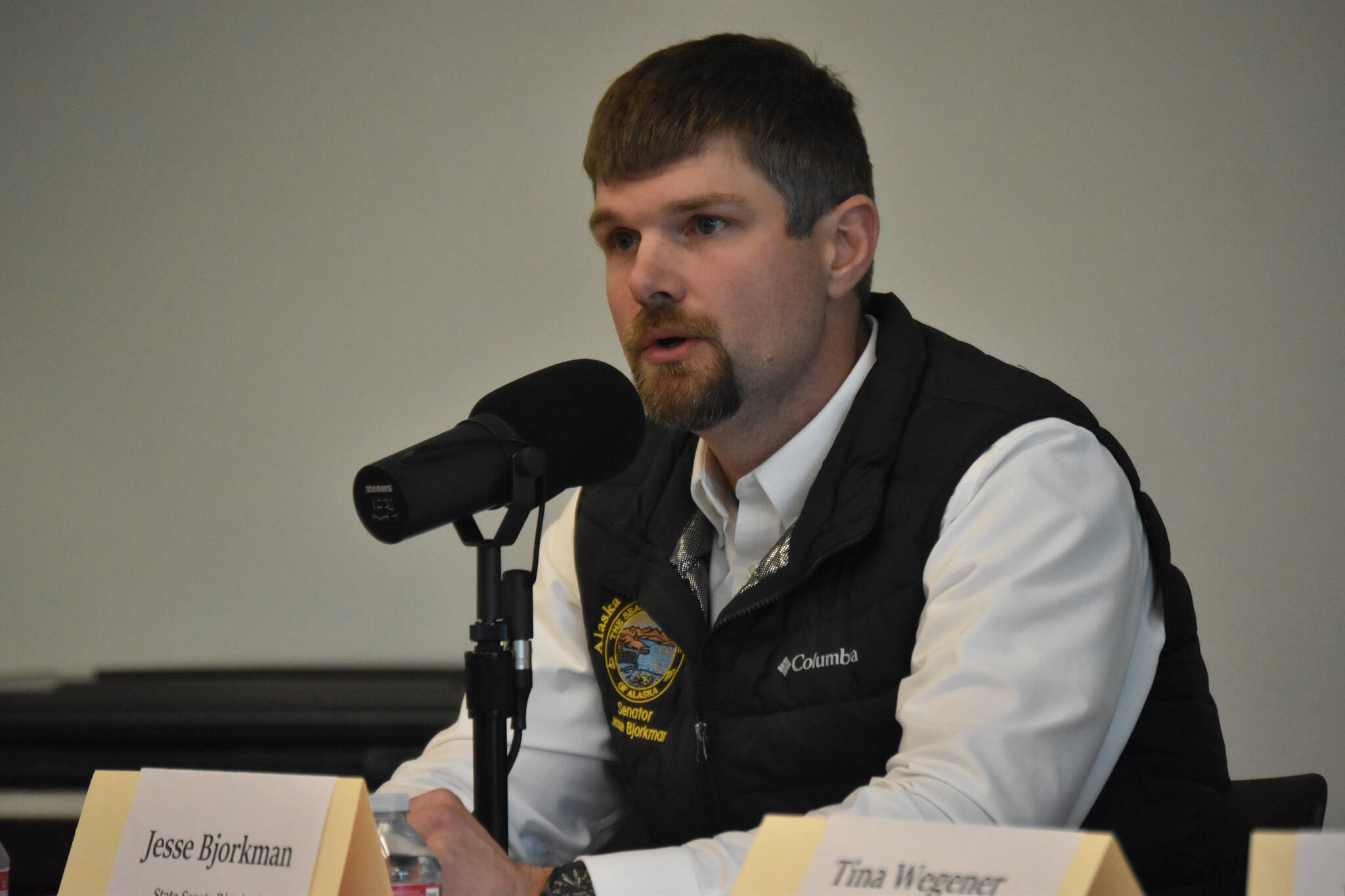
At a candidate forum moderated by the Peninsula Clarion and KDLL 91.9 FM on Monday, two of the three candidates for the Alaska Senate District D seat met to discuss Alaska’s economy, energy, education and goals for the next session in the Alaska Legislature.
Incumbent Sen. Jesse Bjorkman and challenger Rep. Ben Carpenter, both Republicans from Nikiski, are running for the seat. Bjorkman has held the seat since 2023, while Carpenter has served in the Alaska House of Representatives since 2019. Sterling Democrat Tina Wegener is also running for the seat and was invited to the forum, but declined to attend.
Whoever is elected to the seat will serve a four-year term ending in January 2029.
Bjorkman described himself as “a dad, a husband, a person who loves this community.” He said he believes in “limited government and maximum freedom,” with investment in roads, schools, public safety and natural resources. In his first two years in the Legislature, he said, he’s seen tax cuts for farmers, tax protections for property sales and creation of a local lumber grading program.
Carpenter described himself as a small business owner, a veteran, a husband, father and grandparent. He said that Alaska families are struggling — including his own — and that the state needs to address its economy and finances to provide relief. He said that his opposition to government growth is what differentiates himself from the incumbent.
“We can grow our economy, we can get low-cost energy, and those things will be good,” he said. “We will continue to suffer if government continues to grow past our economy’s ability to pay for itself.”
Meeting financial challenges
A “spending limit” was at the center of Carpenter’s ideas for the financial future of the state. He said that the Legislature has become used to “spending all sources of revenue that come to it.” That’s part of a broader fiscal plan that Carpenter has championed in recent years calling for protections to the Alaska Permanent Fund dividend and instituting a 2% statewide sales tax, among other things. If each element of the plan were implemented, he said “families would pay less for their government than they do right now.”
Bjorkman agreed that changes should be made to the dividend, but said that he opposes the idea of a permanent sales tax that “will be forever.” He said that investment in critical infrastructure, like schools and public safety, will promote the growth of the economy.
“I want our state to grow because our economy can grow on the foundation of infrastructure that’s built — roads, quality schools that are accountable, public safety that can protect people’s property and provide a safe environment,” Bjorkman said. “These are things that we need to change and we need to invest in if we expect things to happen differently in our communities.”
Carpenter said that to reduce state spending, he previously introduced legislation to “deep dive” into each of the state’s departments and look for unoccupied positions that have failed to be filled over time, but which are allocated for in the budget each year.
“With better management and better policy will come better budgets,” he said. “Taking a whack at the budget like we did in Gov. Dunleavy’s first budget is politically untenable.”
Fueling the future
Shifting to energy, Carpenter pointed to government regulations as stymieing development of oil and gas. He cited a bill passed in the House but not the Senate last session — which would have reduced royalties for Cook Inlet producers — as part of a solve to the problem of a looming natural gas shortage.
“We’ve priced ourself out of producers in the Cook Inlet,” he said. “That has been a government-induced problem that we have had. One of the things that we need to do is get government out of the way so producers can go out and find gas.”
Bjorkman agreed that promoting gas production locally is “my number one priority” in the next session. He said that, despite moves like royalty relief, some of the producers are “concerned that there’s not the gas in the ground that’s recoverable to get enough gas to meet our demand.” He said that in addition to giving incentives for development, the state needs to take “an all-of-the-above approach on energy” to produce as much gas and electricity as possible.
That can mean any projects that “create reliable and affordable energy,” he said, but must be market driven rather than “based on government mandates.”
Long term, Bjorkman said, the solution is a natural gas pipeline from the North Slope to Nikiski to “provide Alaska’s gas to Alaskans.”
“We have to complete that project, or we are going to face staggering rates of energy costs, because we’ll have to import our energy,” he said.
Carpenter said that natural gas will be imported in the short term, and that as a result users will pay more for their energy.
“There are no alternatives in the short term,” he said. “The long term is building a pipeline.”
He said that there are plans being developed, that there will be a pipeline “when industry finds it feasible to do so.” Legislature investment in the pipeline might “sweeten the pot.”
“We are reliant upon private industry to decide to finance and use their own money to build that pipeline,” Carpenter said. “The worst possible thing would be to turn that over to the state government and ask them to build it.”
Educating Alaska’s students
Education funding, Carpenter said, is a conversation that has recurred constantly in his years in the Legislature. The problem of school funding, he said, shouldn’t be addressed by “throwing money at the current system.”
He said that the funding problem in the Kenai Peninsula Borough School District is driven by parents taking their kids out of the local program and choosing other options — taking their per-student funding with them.
“Parents and kids are still here on the Kenai Peninsula, they’re just choosing other options for schools,” he said. “If the school district was to modify its policies and attract parents back into the school district, then the amount of money that they would be receiving through our state funding formula would increase.”
Bjorkman said that he supports an increase to the base student allocation, because that’s “stable funding that is predictable and allows school districts to spend money in a wise way.” He said that the recent trend of annually adding one-time school funding is “the most wasteful way that we can spend state dollars on education.”
“One-time money gets spent on one time stuff,” he said. “When we have stable, strategic funding for education, we can do more to bring kids back to school.”
Alaska’s public schools, he said, are lacking the resources they need to function. Reforms and improvements to education demand “more educators in classrooms available to teach kids.”
In March, the Legislature failed by a single vote to override a veto by Gov. Mike Dunleavy on a bill that would have increased state funding for schools, among other things. Bjorkman voted to override; Carpenter voted to uphold the veto.
Bjorkman said Monday that children in Alaska “could have learned more this year if that permanent funding would have been in place.”
“Kids don’t get a second chance at second grade,” Bjorkman said. “Until our state properly invests in education in a way that’s capable of producing the outcomes that we want, you won’t see better results.”
Carpenter said he voted in favor of the veto because the bill didn’t provide enough support for charter schools. He said parents are “the primary educators” who need to take ownership of education. Charter schools work, he said, because parents control the policies, curriculum, budgets and leadership.
Tackling a changing fishery
On declines of salmon returns and impacts on local industry and fisheries, Bjorkman said he was looking at trawlers “pillaging the bottom of our oceans” as part of the problem. With the setnet fishery closed, up to $75 million is lost each summer. With the silvers and kings missing from the rivers, the sport and guide industries feel it too. He said more funding should be allocated to the State Department of Fish and Game to better monitor and research those ailing stocks.
Carpenter agreed that trawling is “likely part of the problem,” but said that the state should take further action to help the king salmon come back. That could include, he said, “inriver support,” hatcheries or a moratorium on fishing. He said he favors letting state fishery managers give input on what moves are necessary to protect the resource.
“We’ve got a population of fish that is suffering,” he said. “It’s complex, but we do know that if we keep fishing, we very well could run the whole species into extinction.”
Carpenter likened the state to a large ship and said that in his time in the Legislature he’s consistently worked to change its course.
“Oil revenue is a fraction of what it was,” he said. “We have to make some systemic changes to recognize that that is a problem for us. We need to modify how we’re doing business — at the budget and the state level, our spending decisions — to reflect that. The Legislature has thus far been unwilling to have those conversations.”
Bjorkman said that the state needs to recognize its needs and take steps to create the outcomes that people want. He said the government needs to spend on the things that “can make our state function and prosper.”
“I am not for more and more government spending,” he said. “I’m for strategic investment in the things that people want, need and care about.”
The full recording of the forum can be found on the “Peninsula Clarion” Facebook page. It can also be heard as “Kenai Conversation” on kdll.org or on podcast services.
Reach reporter Jake Dye at jacob.dye@peninsulaclarion.com.
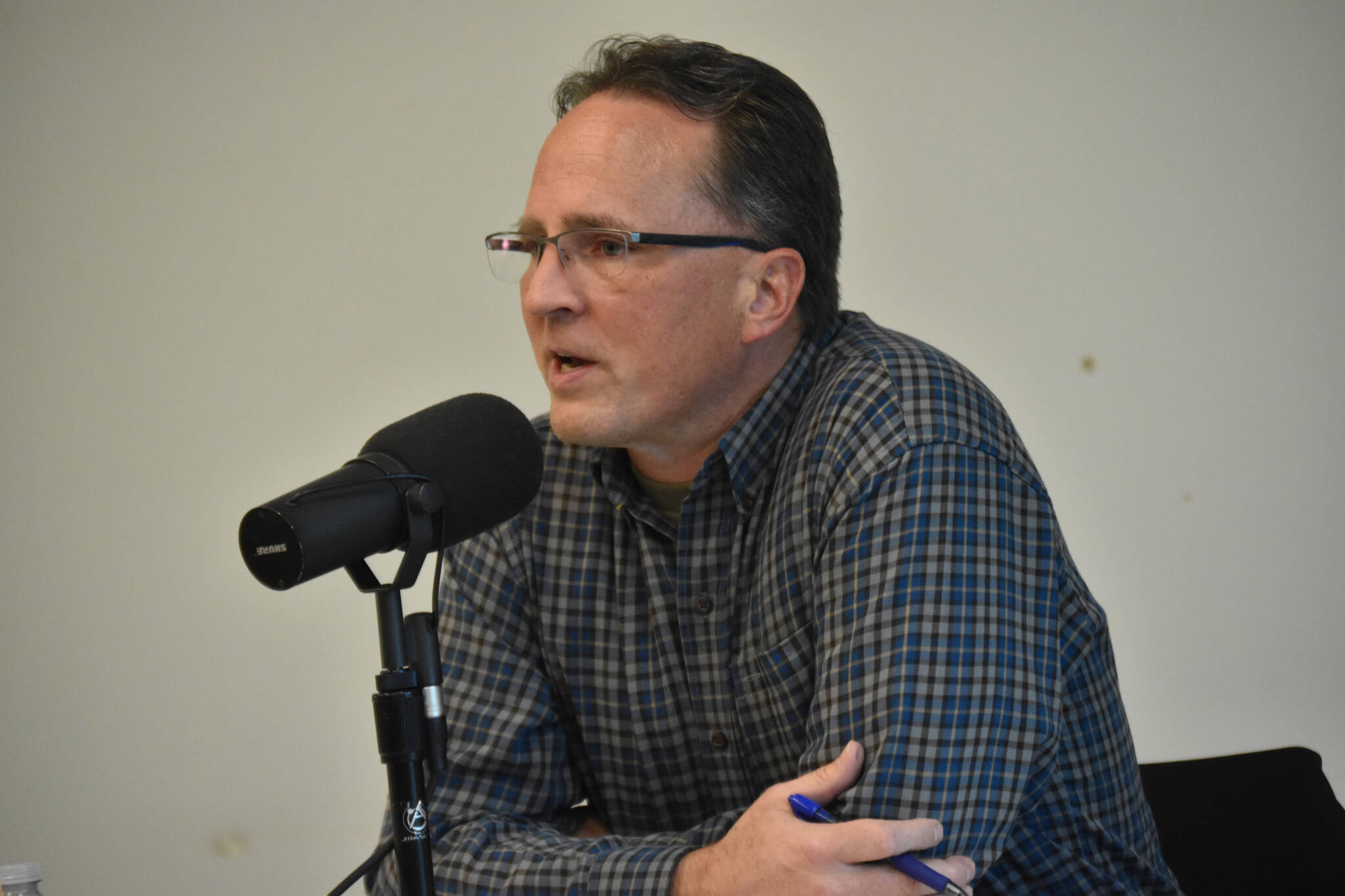
Alaska House Rep. Ben Carpenter (R-Nikiski) speaks at Senate District D candidate forum hosted by the Peninsula Clarion and KDLL 91.9 FM on Monday, Oct. 7, 2024, at the Soldotna Public Library in Soldotna, Alaska. (Photo by Erin Thompson/Peninsula Clarion)
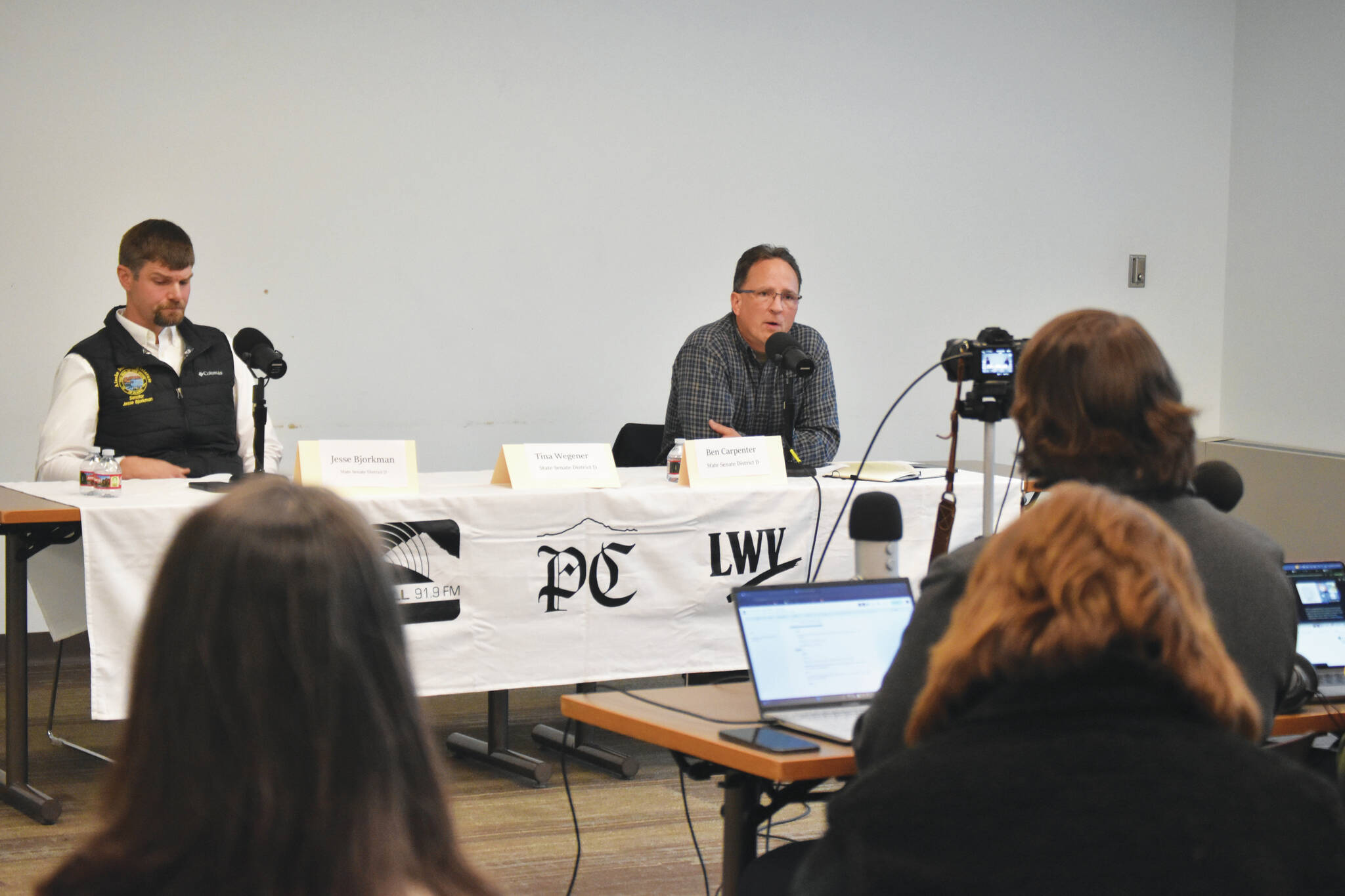
Photo by Erin Thompson/Peninsula Clarion Alaska State Sen. Jesse Bjorkman (R-Nikiski), left, and Alaska House Rep. Ben Carpenter (R-Nikiski) participate in the Senate District D candidate forum hosted by the Peninsula Clarion and KDLL 91.9 FM on Monday at the Soldotna Public Library.
