
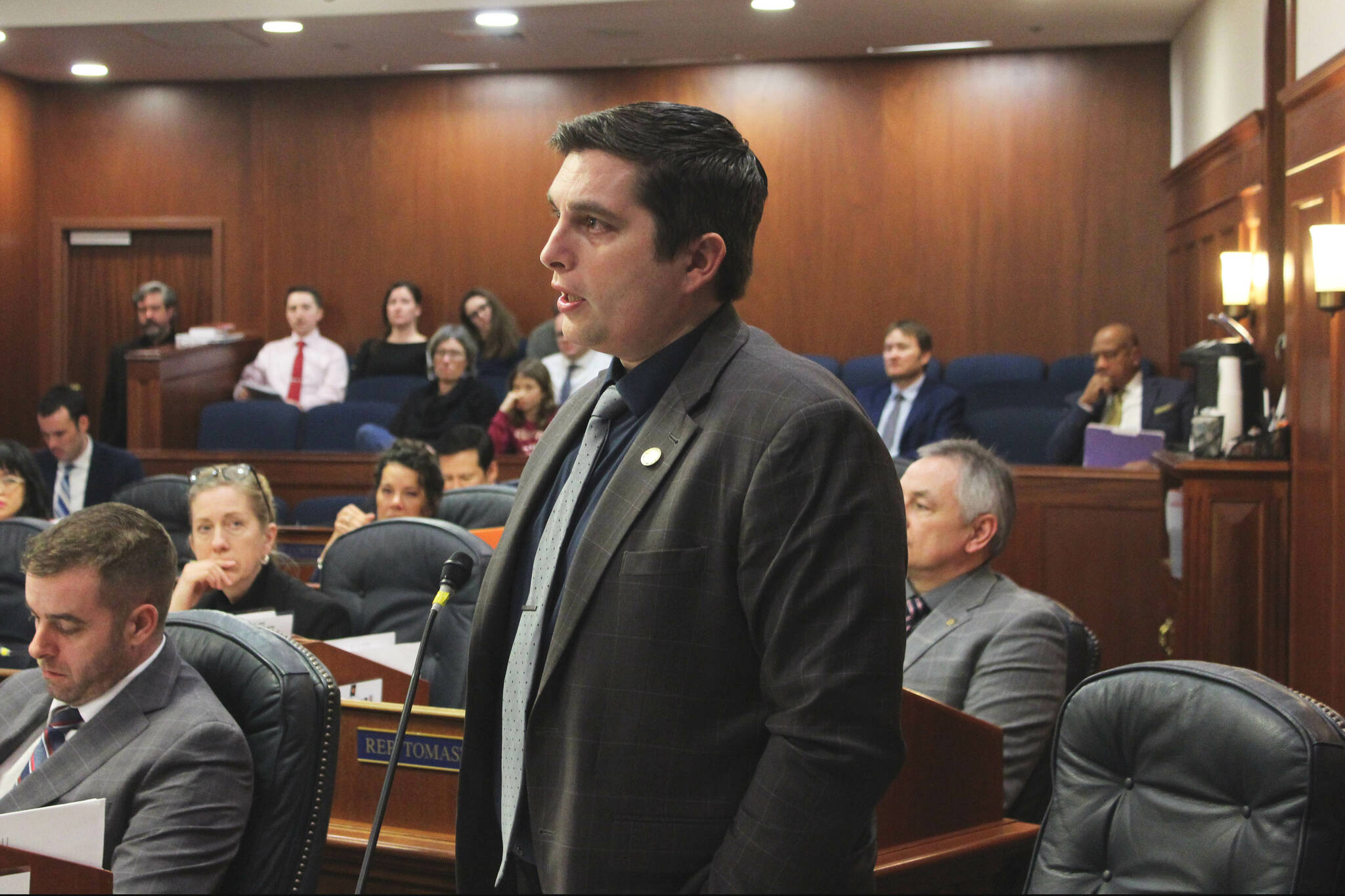
Rep. Justin Ruffridge, R-Soldotna, speaks in support of a bill increasing state funds for public education in the Alaska House of Representatives on Thursday, Feb. 22, 2024 in Juneau, Alaska. (Ashlyn O’Hara/Peninsula Clarion)

Rep. Justin Ruffridge, R-Soldotna, speaks in support of a bill increasing state funds for public education in the Alaska House of Representatives on Thursday, Feb. 22, 2024 in Juneau, Alaska. (Ashlyn O’Hara/Peninsula Clarion)

Bill seeking to bump use of Alaska Performance Scholarship clears the House with unanimous support

The money is awarded to high-performing high school graduates to help pay for postsecondary education at participating institutions in Alaska

JUNEAU — Alaska’s graduating high school seniors could receive more state scholarship money and would be told more often about the opportunity to apply under a bill passed in the House that makes significant changes to the Alaska Performance Scholarship.

That money is awarded to high-performing high school graduates to help pay for postsecondary education at participating institutions in Alaska. Award amounts range from $2,378 to $4,755 per year depending on a student’s grade point average, standardized test scores and high school class schedule.

The money is paid out from the Alaska Higher Education Investment Fund — established in state statute for the purpose of paying student grants and scholarships — and is awarded each year for up to four years. Students eligible for the largest scholarship award, for example, could receive up to $19,020 to put toward their education.

The number of students using the program, though, has steadily declined since it was established in 2011. Only 17% of students in 2023 were eligible for the program — the lowest rate since its inception. Of those eligible for the scholarship, only one in three use the program, on average.

In the Kenai Peninsula Borough School District, about 14.8% of high school graduates were eligible for an Alaska Performance Scholarship in 2023. The percentage of KPBSD students eligible jumped in 2020 and 2021, when the state waived standardized test scores as a requirement for the scholarship.

The bill passed in the House on Monday seeks to reverse those trends by increasing the scholarship award amounts, bolstering the way students are notified about the scholarship and its requirements and adding vocational education to the types of classes considered for eligibility, among other things.

For the lowest scholarship level, the award amount would increase from $2,378 per year to $3,500 per year. For the middle level, annual awards would increase from $3,566 to $5,250. For the highest scholarship level, the amount would increase from $4,755 to $7,000 per year.

The bill also allows students to increase their award amount if their grade point average in college increases and eliminates from the program’s eligibility requirements that students submit standardized test scores, such as from the SAT or ACT.

The state estimates it will pay out $2.3 million more in scholarship awards for the upcoming fiscal year if the bill is passed, in anticipation of an increase in the number of newly eligible students who apply for the program.

Rep. Justin Ruffridge, a Soldotna Republican, co-chairs the House Education Committee and presented the bill for House consideration Monday. The legislation, he said, is intended to increase the number of students who take advantage of the scholarship program and stay in Alaska.

“The Alaska Performance Scholarship has been in Alaska since 2011 and unfortunately has seen a precipitous decline in its usage in the last few years,” he said. “One of the good things about the Alaska Performance Scholarship is that it does keep students in Alaska and especially students that choose to use the program.”

The bill was received warmly by lawmakers prior to receiving a rare 39-0 vote.

Rep. Andi Story, D-Juneau, praised the inclusion of career and technical education language in the bill and said the scholarship is a necessary incentive for Alaska to be competitive for high performing students.

“We’re really modernizing the Alaska Performance Scholarship right now for today,” she said. “We are in competition — our best and brightest students who take these four years of rigorous curriculum (are) getting offers from other states to come and go to their colleges.”

After Monday’s vote, Ruffridge said the legislation is an example of how things “should be done,” in Juneau, as evidenced by the 39-0 vote in support.

“When you do the work, which is build consensus, find the pieces that are important to each person, be willing to go back to the drawing board on different avenues that you might have missed, you really can craft, I think, good legislation,” he said.

The House bill has a companion in the Senate — sponsored by Sen. Forrest Dunbar, D-Anchorage — that has already been considered by and voted out of the Senate Education and Finance committees. That bodes well for the bill’s future in that chamber. If the Senate concurs with the version passed in the House, it will go to Gov. Mike Dunleavy for consideration.

Reach reporter Ashlyn O’Hara at ashlyn.ohara@peninsulaclarion.com.

This reporting from the State Capitol was made possible by the Alaska Center for Excellence in Journalism’s Legislative Reporter Exchange. Alaska news outlets, please contact Erin Thompson at editor@peninsulaclarion.com to republish this story.

More in News

David Ross is sworn in as Kenai Police Chief on Tuesday, May 31, 2016 at Kenai City Hall. The Alaska Association of Chiefs of Police named Ross the 2025 Police Chief of the Year, recognizing over two decades of service. Photo by Megan Pacer/Peninsula Clarion
Kenai police chief named 2025 Police Chief of the Year

The Alaska Association of Chiefs of Police recognized David Ross for his more than two decades of leadership.

The cast of Nikiski Middle School’s upcoming performance of “Alice in Wonderland” is pictured on Dec. 2, 2025. The upperclassmen-directed play opens on Friday, with additional showtimes Saturday and next weekend. Photo courtesy of Carla Jenness
Nikiski Middle School debuts student-led “Alice in Wonderland”

The show opens on Friday, with additional showtimes this weekend and next.

On Tuesday, the Kenaitze Indian Tribe unveiled Kahtnu Area Transit, a public transportation service open to the entire Peninsula Borough community. Photo courtesy of Kahtnu Area Transit
Kenaitze Indian Tribe unveils Kahtnu Area Transit

The fixed bus route offers 13 stops between Nikiski and Sterling.

The Kenai Chamber of Commerce and Visitor Center hosts the annual Christmas Comes to Kenai on Nov. 28<ins>, 2025</ins>. The beloved event began over 40 years ago, and this year over 1,000 attendees enjoyed hot chocolate, fireworks, pictures with Santa and shopping. Photo courtesy of the Kenai Chamber of Commerce
 Photo courtesy of the Kenai Chamber of Commerce
The Kenai Chamber of Commerce and Visitor Center hosted the annual Christmas Comes to Kenai on Nov. 28. The beloved event began over 40 years ago, and this year over 1,000 attendees enjoyed hot chocolate, fireworks, pictures with Santa and shopping.
Kicking off a month of holiday festivities

Last weekend’s holiday events, including the annual Christmas Comes to Kenai and the Soldotna Turkey Trot, drew folks from all over the Kenai Peninsula.

Starting Dec. 2, Aleutian Airways will offer roundtrip flights between Anchorage and Unalakleet every Tuesday, Friday and Sunday.
Aleutian Airways to offer roundtrip flights between Anchorage and Unalakleet

Starting Dec. 2, Aleutian Airways will offer three roundtrip flights per week.

The Trump administration’s “Big Beautiful Bill” act requires the Bureau of Ocean Energy management to hold at least six offshore oil and gas lease sales in Alaska between 2026-2028 and 2030-2032. The first of these sales — known as “Big Beautiful Cook Inlet 1,” or BBC1— is scheduled for March 2026. Photo courtesy of the Bureau of Ocean Energy Management
Cook Inletkeeper launches petition against federal government

The organization is calling for transparency in Cook Inlet offshore oil and gas sales.

Winter dining has always carried more weight than the menu might suggest. In the off-season, eating out isn’t just about comfort food or convenience; it’s a way of supporting local businesses as they hold steady through the slower months. Photo credit: Canva.
The ripple effect: How local spending builds stronger communities on the Kenai Peninsula

From cozy cafés to fine-dining bistros, purchases made close to home sustain local jobs and services

Courtesy Harvest
On the Kenai Peninsula, a dormant liquefied natural gas export plant could be repurposed to receive cargoes of imported LNG under a plan being studied by Harvest, an affiliate of oil and gas company Hilcorp. The fuel would be transferred from ships to the tanks on the left, still in liquid form, before being converted back into gas and sent into a pipeline.
Utilities say Alaska needs an LNG import terminal. Consumers could end up paying for two.

Planning for two separate projects is currently moving ahead.

A map shows the locations of the 21 Alaska federal offshore oil and gas lease sales proposed by the Trump administration. (Map provided by the U.S. Bureau of Ocean Energy Management)
Trump administration proposes offshore leasing in almost all Alaska waters

A new five-year offshore oil and gas leasing plan proposes 21 sales in Alaska, from the Gulf of Alaska to the High Arctic, and 13 more off the U.S. West Coast and in the Gulf of Mexico.

Most Read