Peter Segall / Juneau Empire
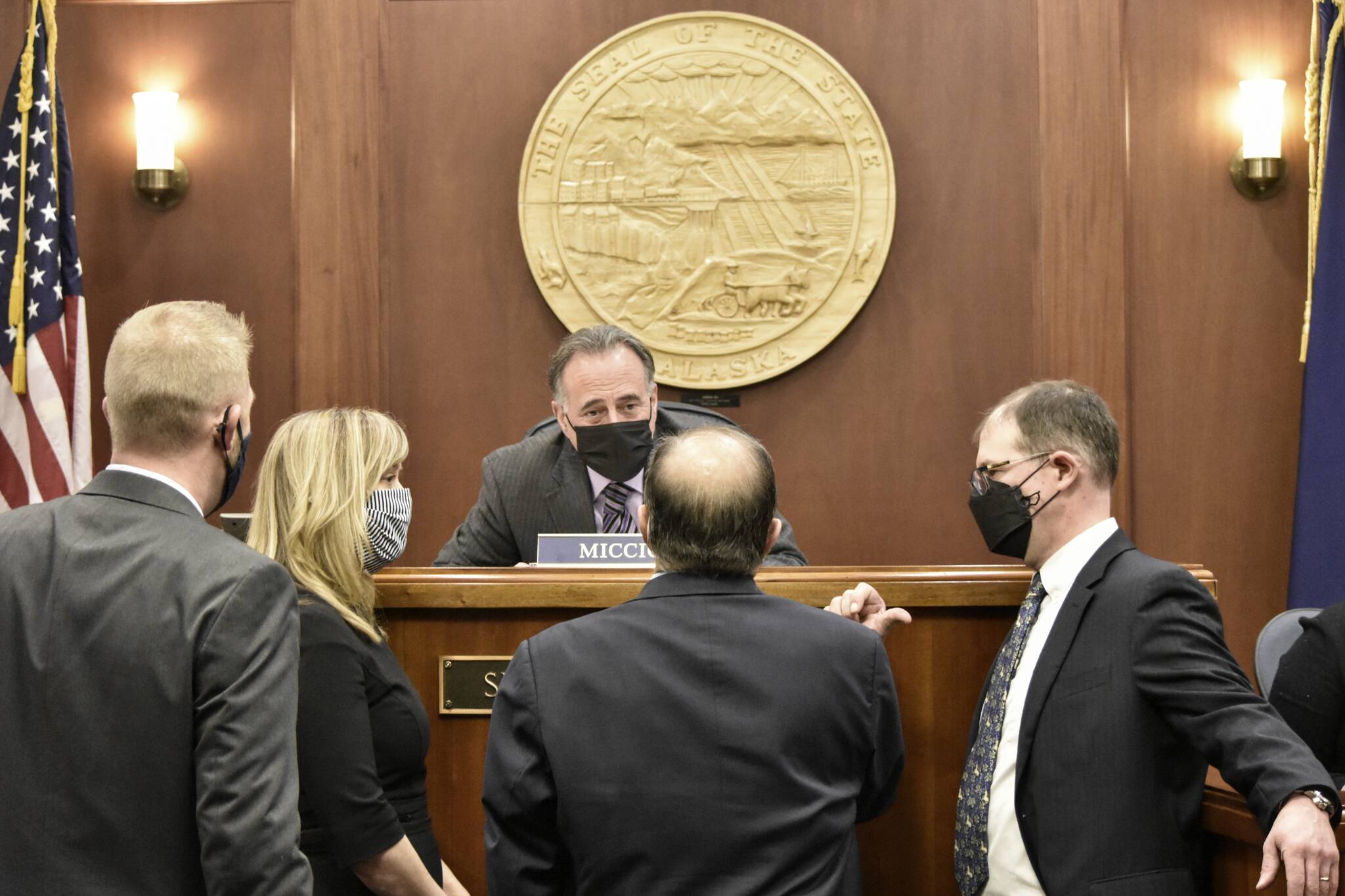
Senate President Peter Micciche, R-Soldotna, seated, speaks with senators during a floor debate on a bill to revamp the state’s alcohol laws on Tuesday. The bill was one of Micciche’s own, and Tuesday’s floor vote came after nine years of trying to pass a bill modernizing Alaska’s alcohol regulation.

Peter Segall / Juneau Empire Senate President Peter Micciche, R-Soldotna, seated, speaks with senators during a floor debate on a bill to revamp the state’s alcohol laws on Tuesday. The bill was one of Micciche’s own, and Tuesday’s floor vote came after nine years of trying to pass a bill modernizing Alaska’s alcohol regulation.

Bill aimed at refining state alcohol laws passes Senate

Years in the making, bill modernizes regulations advocates say

A bill overhauling Alaska’s alcohol laws passed out of the Senate on Tuesday, heading to the House of Representatives where further amendments are expected.

Senate Bill 9 is the result of nine years of effort by Sen. Peter Micciche, R-Soldotna, the current Senate President. According to the bill’s advocates, SB 9 is an attempt to modernize the state’s regulations in a way that balances expansion of the alcohol industry while safeguarding protections for public health and substance misuse.

Because the Senate President cannot speak to legislation on the floor, Sen. Gary Stevens, R-Kodiak, carried the bill telling his colleagues SB 9 was a simple reorganizing and reordering of the state’s alcohol laws.

“This legislation is not a special interest bill, it’s a long effort from many stakeholders,” Stevens said. “This bill modernizes (state alcohol laws) without harming existing businesses.”

The bill creates new license types for businesses that sell alcohol such as breweries and wineries and extends the activities those businesses can engage in. Tasting rooms at alcohol manufacturing business could, if the bill passes, stay open two hours later, closing at 10 p.m. and can hold classes or fundraising events.

The bill limits manufacturer licenses to one per 12,000 people but gives municipalities the option to petition the Alcohol Beverage Control Board for additional licenses.

The bill also allows for permits to be issued, allowing catering companies to serve alcohol at a certain time and place.

Sen. Jesse Kiehl, D-Juneau, offered an amendment that would lower that threshold to 7,500 people. Juneau and other larger municipalities would already be over the limit set forth in the bill were it to pass, Kiehl said on the floor. Juneau has a population of just over 32,000, according to state data, but is home to multiple breweries and a distillery.

“To go further than the status quo, to be more restrictive to the existing law, doesn’t make sense,” Kiehl said.

Kiehl withdrew his amendment, with a request that his amendment be taken up in the House.

Sen. Donny Olson, D-Golovin, also objected to the population requirements, saying that within his districts there weren’t any villages with more than 4,000 people.

Olson said he wanted to make sure, “the next person out there that has a good idea is not inhibited by the regulation that you have 12,000 people.”

All 18 senators present Tuesday voted in favor of the bill. Sens. Mike Shower, R-Wasilla, and Robert Myers, R-North Pole, were excused.

Speaking with reporters Friday, Micciche said the bill brought Alaska’s alcohol laws more in line with how the industry operates today.

Organizations that submitted letters of support for the bill include Alaska Cabaret, Hotel, Restaurant and Retailers Association; Brewers Guild of Alaska; Alaska Mental Health Trust Authority and the Alaska Peace Officers Association.

“We know that (the bill) is designed to protect Alaskans from the adverse effects of alcohol,” Micciche said. “It’s an extremely important segment of our economy and it continues to grow with tourism.”

The Senate President said over the years he’s worked with representatives from the alcohol industry, public safety and substance abuse and recovery experts to draft the bill.

“It’s not a special interest bill,” Micciche said. “It’s an everyone interest bill.”

Contact reporter Peter Segall at psegall@juneauempire.com. Follow him on Twitter at @SegallJnuEmpire.

More in News

A snowmachine rider takes advantage of 2 feet of fresh snow on a field down Murwood Avenue in Soldotna, Alaska, on Monday, Dec. 12, 2022. (Jake Dye/Peninsula Clarion)
Ice fishing opens on some Kenai National Wildlife Refuge lakes

Snowmachines are permitted for ice fishing access on Hidden, Kelly, Petersen, Engineer and Watson lakes.

The waters of Cook Inlet lap against Nikishka Beach in Nikiski, Alaska, where several local fish sites are located, on Friday, March 24, 2023. (Jake Dye/Peninsula Clarion)
Kenai asks for fishery economic disaster declaration

The Kenai City Council requested that Gov. Dunleavy declare a disaster and support a recovery plan for the Upper Cook Inlet East Side Set Net fishery.

The Kenai Peninsula Borough School District logo. (Photo courtesy of Kenai Peninsula Borough School District)
District superintendent dispels rumors about student construction

Superintendent Clayton Holland said student involvement in Seward High School construction is “based on rumor, not fact.”

Anchorage-based singer and songwriter Keeley Boyle is pictured in Anchorage<ins>, Alaska,</ins> on Sept. 26, 2023. Boyle, who was raised on the Kenai Peninsula, will use a $10,000 grant she received from the Rasmuson Foundation to create an album of songs about her grandparents’ home in Nikiski. Photo courtesy of Jovell Rennie
Musician hailing from Kenai receives Rasmuson grant

Keeley Boyle will record an album of songs about her grandparents’ Nikiski home.

Commercial fishing and recreational vessels are docked in the Homer harbor on Oct. 23, 2025. The commercial fishing industry endured a series of challenges over the year, some of them imposed by the new Trump administration. (Photo by Yereth Rosen/Alaska Beacon)
Alaska fisheries in 2025: turmoil, economic and environmental challenges and some bright spots

NOAA cuts, economic headwinds and invasive species pose problems, but there was some recovery in crab stocks and salmon harvests.

Cook Inlet near Clam Gulch is seen on Oct. 23, 2025. (Photo by Yereth Rosen/Alaska Beacon)
Disputed oil lease sale in Alaska’s Cook Inlet upheld in new Trump administration decision

After completing a court-ordered environmental study, the Bureau of Ocean Energy Management said no changes are needed for the 2022 sale that drew just one bid.

The Kenai Peninsula Borough School District logo.
School district projects $7.5 million budget deficit for fiscal year 2027

Decreased enrollment and increased property values mean less local and state funding.

The sign in front of the Homer Electric Association building in Kenai, Alaska as seen on April 1, 2020. (Photo by Brian Mazurek/Peninsula Clarion)
Homer Electric Association announces rate increase

The proposed increase, if approved by the Regulatory Commission of Alaska, will go into effect Jan. 1.

A photo of Anesha “Duffy” Murnane, missing since Oct. 17, 2019, in Homer, Alaska. (Photo provided, Homer Police Department)
Calderwood pretrial hearing rescheduled

The omnibus hearing for Kirby Calderwood was continued to Jan. 21. Trial week is currently scheduled for Feb. 17, barring finalization of a plea agreement.

Most Read