
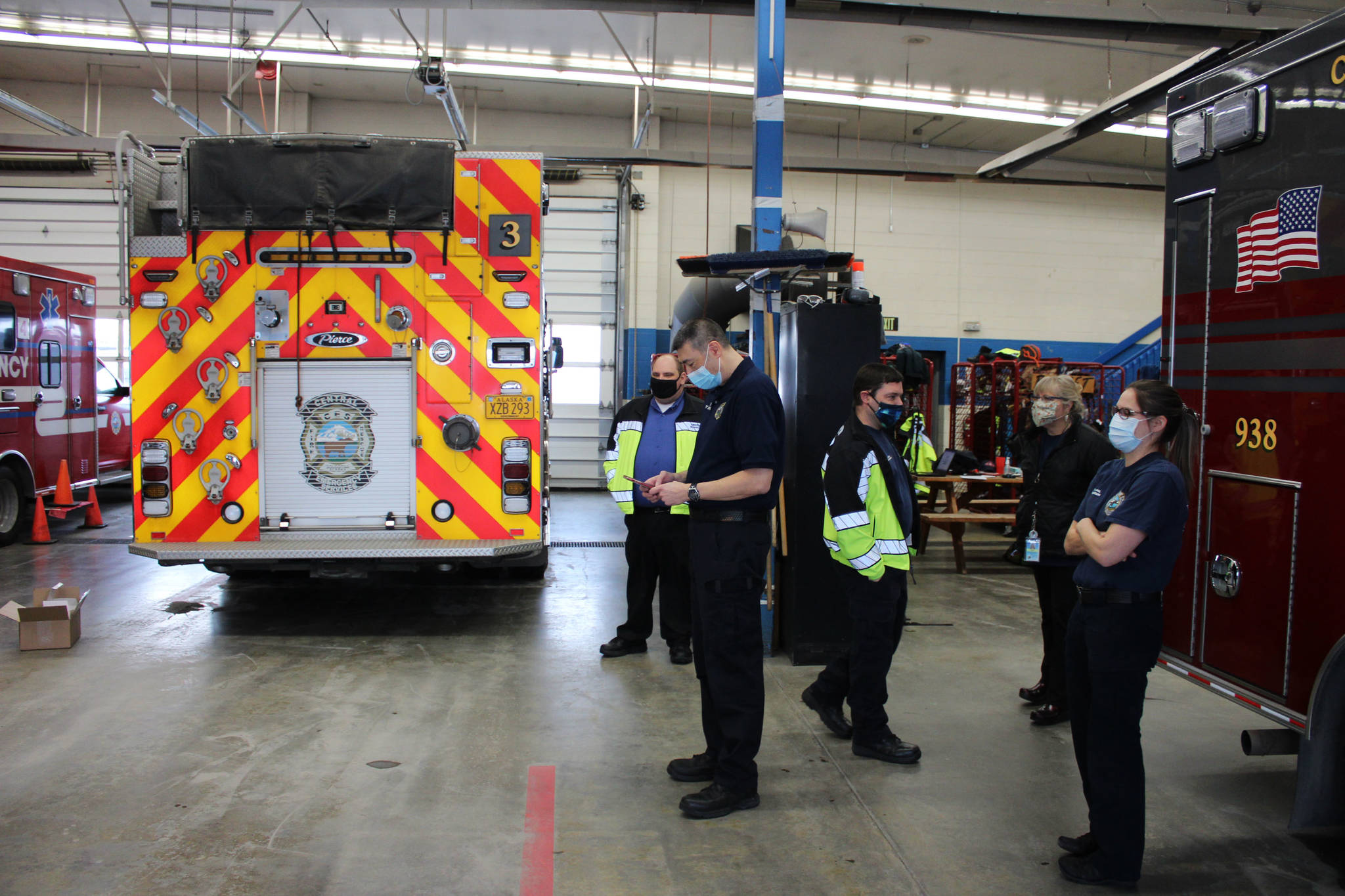
Additional staff may be coming to two borough service areas in the near future following lengthy debate over a budget amendment — which was ultimately withdrawn — that would have cut personnel positions from the borough’s FY22 budget.
The borough assembly first approved the use of federal CARES Act money to fund 13 new fire and emergency medical service (EMS) positions in service areas across the borough until the end of FY21, or until June 30. Among the impacted service areas were Central Emergency Services (CES) and Nikiski Fire Service Area (NFSA). NFSA provides fire, EMS and rescue services to about 6,000 citizens, while CES serves just over 24,000 borough residents.
Under the legislation passed by the assembly, CES was able to hire three firefighters and one senior captain and NFSA was able to hire two firefighters. Funding for those positions after FY21, however, has been unclear.
Requests for additional staff in the service areas has come from their respective boards and has been reiterated by CES Fire Chief Roy Browning and Nikiski Fire Chief Bryan Crisp, who have both testified before the assembly. In requesting the additional personnel, Browning and Crisp cited burnout among current employees and overtime costs.
Specifically, the positions to be added by CES would include three new firefighters at the Funny River Fire Station and a training position. As of June 1, when Browning testified before the assembly’s finance committee, not all of those position had been filled. Similarly, Crisp said two additional employees could be used to fully staff Nikiski Fire Station No. 3. As of June 1, both positions were still open and NFSA had received two applications from out-of-state applicants, one of whom canceled their application.
“As of right now, my crewmembers are severely burnt out working overtime,” Crisp said. “We’re short staffed all the time, so we definitely need these positions.”
Crisp said that until the two full-time positions are filled, NFSA is scaling back their focus to stations 1 and 2 and only filling station 3 when they have appropriate staffing. NFSA does not have the overtime budget to pay someone to consistently staff station 3, Crisp said, noting that they were paying $30,000 to $40,000 per pay period.
“It’s either one person there or zero people there,” Crisp said.
Browning said on the June 1 meeting of the assembly’s Finance Committee that in response to a dwindling applicant pool, which he partially attributed to the impact of the COVID-19 pandemic on certain programs like ride-alongs, CES is accepting applications for new positions on a rolling basis, as opposed to setting an application deadline.
Funding the positions for FY22 would see CES’s mill rate increase by .35 mills and NFSA’s mill rate increase by .5 mills. Mill rates are used to determine how much someone will pay in property taxes during a certain fiscal year. To calculate how much property tax they expect to pay, an individual must divide the mill rate by 1,000 and then multiply that by their property’s taxable value.
Assembly member Jesse Bjorkman, who represents Nikiski, presented an amendment to the borough budget that would eliminate the increase in personnel at CES and NFSA. In doing so, Bjorkman cited concerns about financing and called his amendment a “vehicle to discuss how [] we pay for these increased services.”
“The funding to provide for this level of increased service was transferred money from COVID funds received from the federal and state governments to the borough, which were then transferred to these service areas, which are being paid now out of fund balance to hire these new positions — eight positions in total,” Bjorkman said.
“Kind of where that leaves us for the future is figuring out if this level of service is something that the communities of Soldotna, Sterling, Kasilof, Funny River and Nikiski as well as others … want,” Bjorkman said. “Then, we’ll have to figure out after the money runs out in fund balance how we pay for these services going forward.”
Bjorkman cited the cost borough taxpayers would incur via mill rate increases if the additional positions were included in the budget and voiced his concerns about making sure the fire and EMS service provided were worth the increase in costs.
“As we look at the great service that CES and Nikiski Fire provide for our community, I want to make sure we’re not getting ahead of the public in the amount of service that we are expecting them to pay for,” Bjorkman said.
With the money that has been transferred to NFSA and CES, Bjorkman said, the borough could shift its focus from immediately hiring new personnel to offering volunteer programs and temporarily staffing Nikiski Fire Station No. 3 and the Funny River Fire Station with volunteers. Additionally, Bjorkman said they could focus on retention of fire and EMS employees in service areas across the borough.
If the borough commits to funding the eight positions, Bjorkman said, the borough needs to also commit to offering tangible services including prioritizing the staffing of Fire Station No. 3 and the Funny River Fire Station.
Bjorkman said that in bundling NFSA and CES in one amendment they both have deficits driven partially by the costs of the eight additional positions.
Multiple assembly members said they appreciated Bjorkman’s attention to tax increases, but cited various concerns about why they would vote in opposition to his amendment, including concerns about employee burnout, an already-underway hiring process and a potential decrease in insurance costs for taxpayers.
Borough Mayor Charlie Pierce said during the assembly’s June 1 meeting that it was too early to cite concerns about mill rate increases. Annual costs incurred by NFSA and CES by the addition of new positions are estimated to be about $600,000 each. That would be temporarily paid for by the respective service area’s fund balance. After that fund was depleted, funding for the positions would come from mill rate increases.
“I think you’re hearing a discussion that’s about four years too early,” Pierce said.
After more than an hour of debate, Bjorkman decided to withdraw his amendment. The assembly ultimately voted unanimously to pass the borough’s FY22 budget. Assembly meetings can be viewed on the borough’s website at kpb.us.
Reach reporter Ashlyn O’Hara at ashlyn.ohara@peninsulaclarion.com.
