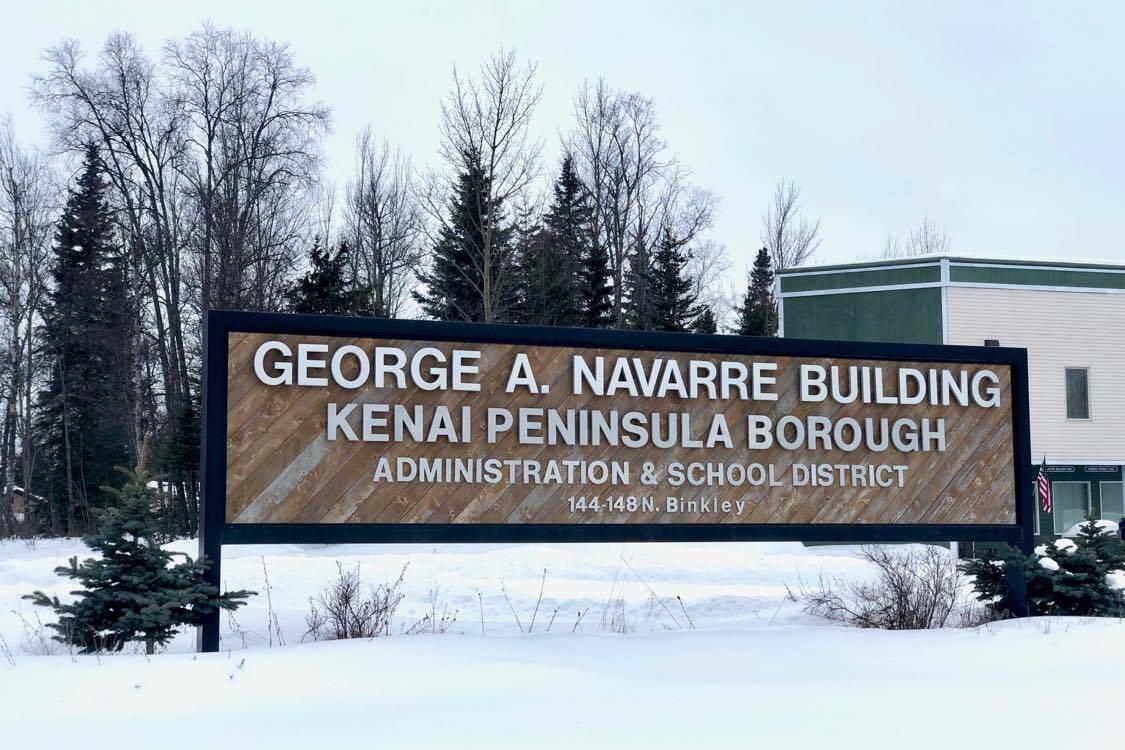
A sign welcomes employees and visitors at the Kenai Peninsula Borough administration building on Tuesday, March 17, 2020, in Soldotna, Alaska. (Photo by Victoria Petersen/Peninsula Clarion)

A sign welcomes employees and visitors at the Kenai Peninsula Borough administration building on Tuesday, March 17, 2020, in Soldotna, Alaska. (Photo by Victoria Petersen/Peninsula Clarion)

Assembly calls on state to increase K-12 funding

School districts across Alaska lobbied lawmakers heavily last session for a meaningful increase to the base student allocation

The Kenai Peninsula Borough Assembly is calling on the Alaska Legislature to increase and inflation-proof the amount of money the state spends on K-12 education per student, also called the base student allocation.

Assembly members unanimously backed — and all sponsored — a resolution during their regular meeting on Tuesday requesting that the State of Alaska “make a timely increase to the base student allocation” for the state’s public schools. The assembly passed a similar resolution last year.

Tuesday’s vote came as state lawmakers prepare to return to Juneau for the upcoming legislative session, where funding for K-12 education is expected to be a top issue. School districts across Alaska lobbied lawmakers heavily last session for a meaningful increase to the base student allocation, which — other than a $30 increase approved with the Alaska Reads Act — hasn’t changed since Fiscal Year 2017.

The Kenai Peninsula Borough School District has already announced that it is facing a $13 million budget deficit for the upcoming fiscal year and is already reviewing where budget cuts may be made if no new state funding is secured. The district last budget cycle faced community pushback over proposed cuts to programs like school pools and theaters, which the district was ultimately able to add back with one-time state money.

Assembly Vice President Tyson Cox and assembly member Brent Hibbert, who brought the resolution forward, wrote in a Jan. 2 memo that, without “stable, inflation-proof education funding” the education system in Alaska will continue to “erode.”

“A stagnant base student allocation (BSA) has significantly decreased the buying power of State allocated educational funding over the last 20 plus years,” the memo says. “Even if this Assembly decides to fully fund education to the maximum allowable amount, the KPBSD will not be able to present us with a balanced budget without eliminating programs and increasing the number of students in each classroom.”

State funding for schools partially determines how much money local governments — in the case of KPBSD, the Kenai Peninsula Borough — can contribute to their school district. The borough is given annually a minimum and maximum amount at which it can fund the school district.

The minimum amount is what it is legally required to contribute, while the maximum is how much the borough could contribute if approved by the borough assembly. For the current fiscal year, the borough assembly approved maximum funding for the district in the amount of about $54.8 million.

Assembly members amended the resolution Tuesday to strengthen the language compelling Dunleavy to sign off on a BSA increase.

“The Assembly petitions Governor Dunleavy to implement a permanent increase to the base student allocation, to include an annual inflationary adjustment, as brought forth by the Alaska Legislature with no vetoes exercised that would reduce or eliminate the State budget funds needed to successfully make the increase a reality,” the resolution says.

Dunleavy in June vetoed half of the one-time funds state lawmakers approved for K-12 education last session.

Assembly members also amended the resolution such that it clearly requested that the BSA be adjusted annually for inflation in an amount that is equal to the annual percentage change in the Consumer Price Index for Urban Alaska.

“Unless there is a BSA increase, or some more one time funding, we’re going to do this all over again,” Cox told members of the assembly’s legislative committee Tuesday. “If there’s one time funding, we’re going to kick that can a little bit further and we’re going to do it again and again and again. As long as I’m on this assembly (and) we don’t have a BSA increase, you’ll probably see one of these from me every year.”

In bringing the resolution forward ahead of the upcoming session, Cox told assembly members that the topic is expected to be picked up by state lawmakers soon after the start of session.

Tuesday’s full assembly meeting will be available to stream on the borough’s website at kpb.legistar.us.

Reach reporter Ashlyn O’Hara at ashlyn.ohara@peninsulaclarion.com.

More in News

A diagram presented by Seward City Manager Kat Sorenson during a Kenai Peninsula Borough Assembly meeting on Dec. 2, 2025, shows the expected timeline for the Port of Seward Vessel Shore Power Implementation Project. Screenshot
Seward shore power project moves into preliminary design phase

The project will create jobs, reduce cruise ship emissions and provide a backup power grid.

The U.S. Forest Service Porcupine Campground offers gorgeous views of the Kenai Mountains and Turnagain Arm, as seen here on July 20, 2020, near Hope, Alaska. (Photo by Michael Armstrong/Homer News)
Department of Natural Resources seeks public input on proposed Kenai Peninsula State Forest

DNR is gathering community perspectives during several meetings this week.

David Ross is sworn in as Kenai Police Chief on Tuesday, May 31, 2016 at Kenai City Hall. The Alaska Association of Chiefs of Police named Ross the 2025 Police Chief of the Year, recognizing over two decades of service. Photo by Megan Pacer/Peninsula Clarion
Kenai police chief named 2025 Police Chief of the Year

The Alaska Association of Chiefs of Police recognized David Ross for his more than two decades of leadership.

The cast of Nikiski Middle School’s upcoming performance of “Alice in Wonderland” is pictured on Dec. 2, 2025. The upperclassmen-directed play opens on Friday, with additional showtimes Saturday and next weekend. Photo courtesy of Carla Jenness
Nikiski Middle School debuts student-led “Alice in Wonderland”

The show opens on Friday, with additional showtimes this weekend and next.

On Tuesday, the Kenaitze Indian Tribe unveiled Kahtnu Area Transit, a public transportation service open to the entire Peninsula Borough community. Photo courtesy of Kahtnu Area Transit
Kenaitze Indian Tribe unveils Kahtnu Area Transit

The fixed bus route offers 13 stops between Nikiski and Sterling.

The Kenai Chamber of Commerce and Visitor Center hosts the annual Christmas Comes to Kenai on Nov. 28<ins>, 2025</ins>. The beloved event began over 40 years ago, and this year over 1,000 attendees enjoyed hot chocolate, fireworks, pictures with Santa and shopping. Photo courtesy of the Kenai Chamber of Commerce
 Photo courtesy of the Kenai Chamber of Commerce
The Kenai Chamber of Commerce and Visitor Center hosted the annual Christmas Comes to Kenai on Nov. 28. The beloved event began over 40 years ago, and this year over 1,000 attendees enjoyed hot chocolate, fireworks, pictures with Santa and shopping.
Kicking off a month of holiday festivities

Last weekend’s holiday events, including the annual Christmas Comes to Kenai and the Soldotna Turkey Trot, drew folks from all over the Kenai Peninsula.

Starting Dec. 2, Aleutian Airways will offer roundtrip flights between Anchorage and Unalakleet every Tuesday, Friday and Sunday.
Aleutian Airways to offer roundtrip flights between Anchorage and Unalakleet

Starting Dec. 2, Aleutian Airways will offer three roundtrip flights per week.

The Trump administration’s “Big Beautiful Bill” act requires the Bureau of Ocean Energy management to hold at least six offshore oil and gas lease sales in Alaska between 2026-2028 and 2030-2032. The first of these sales — known as “Big Beautiful Cook Inlet 1,” or BBC1— is scheduled for March 2026. Photo courtesy of the Bureau of Ocean Energy Management
Cook Inletkeeper launches petition against federal government

The organization is calling for transparency in Cook Inlet offshore oil and gas sales.

Winter dining has always carried more weight than the menu might suggest. In the off-season, eating out isn’t just about comfort food or convenience; it’s a way of supporting local businesses as they hold steady through the slower months. Photo credit: Canva.
The ripple effect: How local spending builds stronger communities on the Kenai Peninsula

From cozy cafés to fine-dining bistros, purchases made close to home sustain local jobs and services

Most Read