
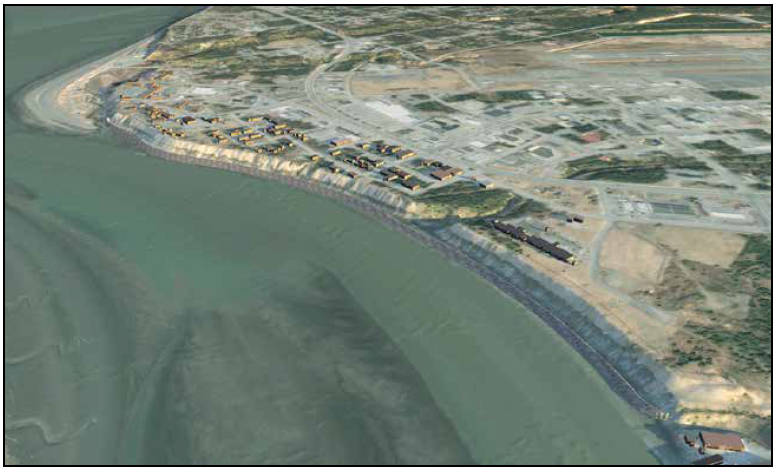
In a new report on a collaboration with the city of Kenai to halt erosion on the nearly mile-long bluff below Old Town Kenai, the U.S Army Corps of Engineers says the cost of mitigating the erosion exceeds its economic benefit but offers reasons to go forward with it anyway.
The Corps of Engineers will hold two public meetings about the report, the first on July 5 with the Kenai City Council and the second for the general public on July 6. The July 5 meeting will be at 6 p.m at Kenai City Hall, and the July 6 meeting will be held at 6 p.m. at the Kenai Visitor and Cultural Center.
The Army Corps of Engineers Kenai Bluffs Bank Stabilization Feasibility Study, released June 16 and available on the Army Corps Alaska website, compares the costs and benefits of six possible ways to halt the bluff erosion, a goal the Army Corps and Kenai have been formally pursuing together since 1999.
In the Corps analysis, costs for every project considered exceed possible benefits by margins up to $21.61 million for a plan to move the Kenai River mouth, and between $1.19 million and $1.32 million for other plans that include relocating the blufftop buildings and two variant plans to decrease the bluff’s slope by moving material from its top to its base and protecting the base with rock. The plan that the report establishes as a preference — building a rock berm at the bluff’s base and allowing falling material to naturally fill in behind it — was judged to have a negative net value of $463,000.
This analysis is based on the value that could be lost over the next 50 years of the three-feet-per-year bluff erosion, a total the Corps estimates as $22.58 million in lost land, structures and recreational opportunities. It assumes properties lose their value after being 50 percent eroded, making them an unacceptable risk for most potential buyers — a fate 59 properties could meet in the next 50 years. The Corps forecasts erosion will take 17.2 acres of land, totaling $1 million in value.
Thirty-four structures would also have to be condemned as the ground beneath them erodes, destroying an estimated $9.5 million of value. A large share comes from the Kenai Senior Center, assessed at $7.9 million in 2016, which is expected to be irreparably damaged by bluff erosion in the next 20 years. The Corps estimates bluff erosion could take $2.6 million worth of residential land, $1.63 million of commercial land, and $5.23 million of public land, at present values. The loss of streets, water, sewer and utility lines is estimated at $1.8 million in value.
The Corps report also values the lost recreational experience of the Kenai Bluff at $10.3 million. The report’s economics appendix states that the recreational analysis gave bluff top recreation higher than usual value estimates — $23.77 per visitor-day, rather than the Army Corps’ general value of $8.42 per visitor-day — “because the top of the bluff presents an opportunity to view unique regional wildlife including beluga whales, harbor seals, and porpoise.” The analysis used an estimate of 46,355 annual visits to the bluff top.
Cultural and historical sites also contribute to the value of the bluff project, though the report gives no cost estimate for their loss. The report identifies three historic houses and two archaeological sites in danger of eroding away within 50 years, and states that “at least 13 other buildings within the 50-year erosion zone along the top of the bluff appear to be historic, but have not been evaluated.”
Project costs
Against the potential loss of the estimated $22.58 million total value, the report compares six project possibilities ranging from the $34.48 million berm at the bluff’s base to the $592 million plan to move the mouth of the Kenai River 3,500 feet to the south by digging a new channel on the southern edge of the city-owned wetland south of the river mouth, then converting the present river mouth to wetland by filling it with the excavated material.
The Corps also considered a possibility in which “all buildings estimated to lie within the area expected to erode over the 50-year period are purchased or removed from the area through a plan likely to include demolition of existing facilities,” according to the report. This would cost about $40.4 million, including the cost of documenting the historic and archaeological properties.
The plan proposed in past discussions of the bluff erosion project would involve decreasing the slope of the bluff by removing material from its top and grading it against the base, then shielding it from wave erosion with a layer of rock. The Corps report considers two versions of this “armored toe” design — one that would cost $54.5 million and another that costs $58.1 million. Both designs would require about 25 blufftop structures to be bought out or moved.
The simplest and cheapest possibility considered is the one the report favors as a preference: building a stone berm at the base of the bluff to protect the falling material that would then settle behind it to create a more gradual and stable slope over the next 3–15 years.
For the possbilities requiring rock fill, the report states that the rock would likely be transported from Kodiak’s Granite Cove Quarry or the Seward Rock Quarry. The construction will probably be done via barge and halted from March 15 through May 15 “to avoid potential disturbance to endangered Cook Inlet beluga whales during the period when they are most likely to be foraging within the Kenai River estuary.”
All the projects involve loss of land — the least is in the cases of the river relocation and the protective berm, in which 3.4 bluff top acres are expected to fall away as the bluff stabilizes.
Because the study finds that costs exceed the economic benefits of the project, the Army Corps is justifying the project based on non-monetary value.
“Non-monetary benefits that may be considered to include such things as public health and safety; local and regional economic opportunities; and social and cultural value to the community,” the report states, summarizing a supporting section of Army Corps rules.
Though the report includes measures of property damage that could be prevented by halting the bluff erosion, it states that “none of these effectively represented the resource of significance or damages prevented under each alternative.”
“Stabilizing the bluff would help preserve the social identity associated with Old Town Kenai residents and bluff residents specifically,” the report states. “Primarily, this identity would be recognized by the larger Kenai community, but it is also recognized by many others around the state of Alaska. While the mouth of the Kenai River is famous even outside Alaska, the type of people who live there may not be well known beyond the borders of the state. Many residents of the state of Alaska recognize that the City of Kenai is very diverse and that the people of Kenai are proud of the city’s history, opportunities for recreation, inherent beauty, and world-class natural resources. Protecting the bluff provides resiliency in protecting the city’s diversity, recreational opportunities, beauty, and access to resources.”
In previous interviews, Corps representatives said the group’s national leadership has accepted this plan document, which is now open to public comments for 30 days. The comment period will end July 16.
Under the current schedule for the bluff erosion project, the Corps plans to issue a construction contract in June 2020 and complete work in 2022, according to a timeline given in the report.
Reach Ben Boettger at ben.boettger@peninsulaclarion.com.
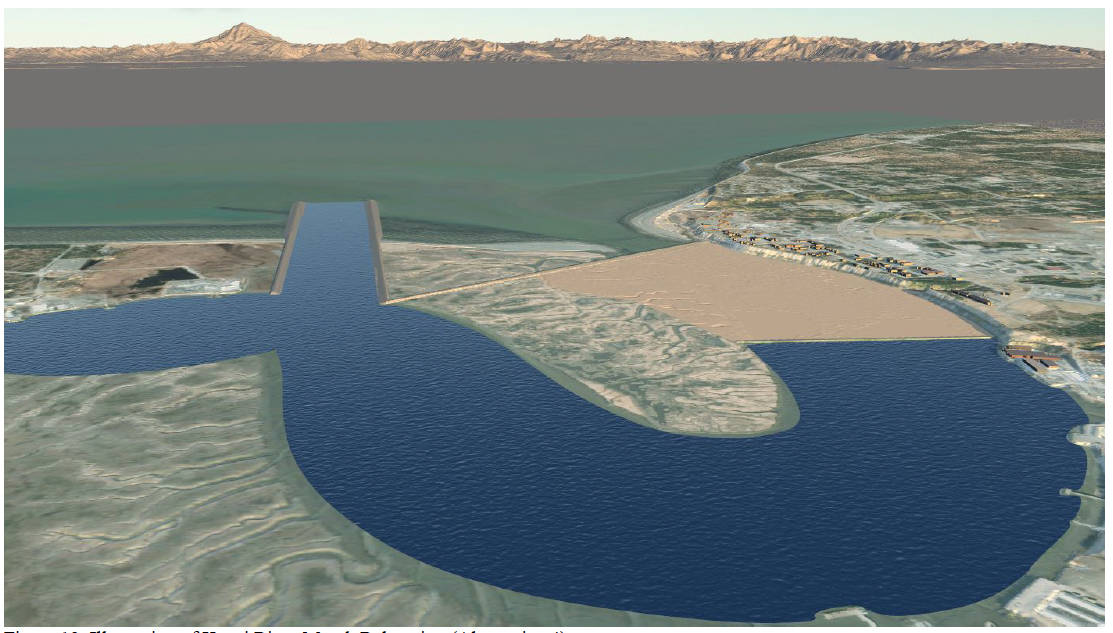
This computer-generated graphic, included in a U.S Army Corps of Engineers report on the Kenai bluff erosion project, illustrates a rejected plan to mitigate bluff erosion by moving the mouth of the Kenai River.
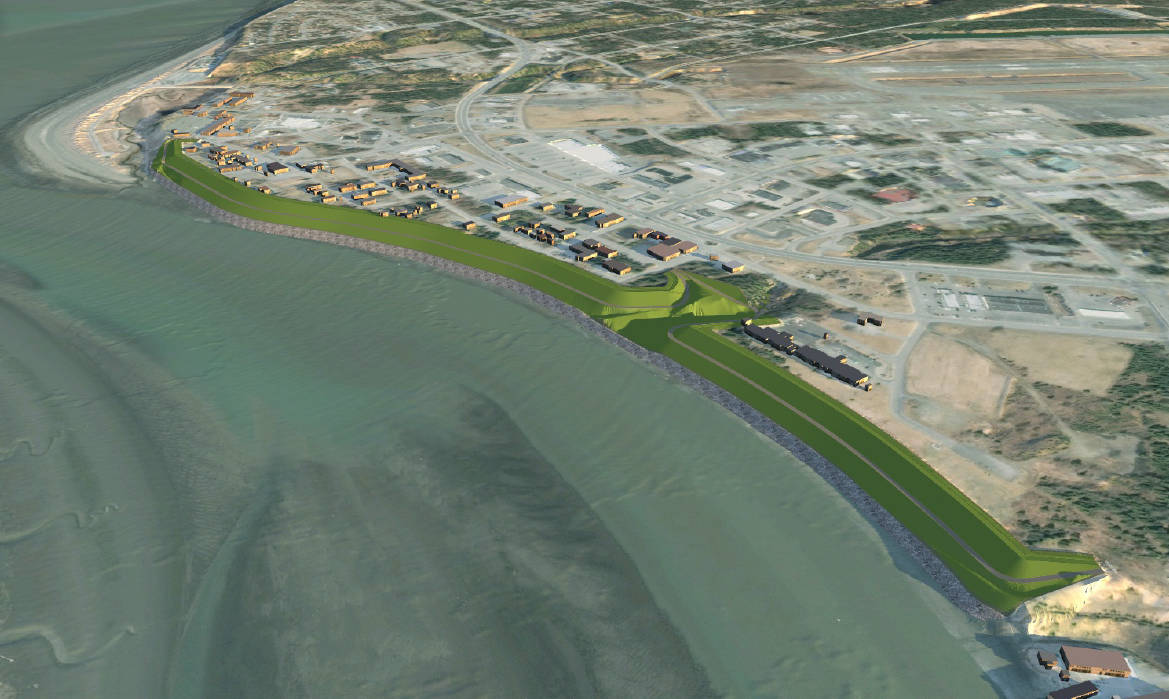
This computer-generated graphic, included with a U.S Army Corps of Engineers report on the Kenai bluff erosion project, illustrates a rejected plan to regrade and vegetate the bluff, laying a rock barrier at its base to protect against eroding waves.
