
Editor’s note: At the bottom of this story is a response from the Kenai River Sportfishing Association regarding their inclusion on the AFCA donation page.
After the Alaska Fisheries Conservation Alliance submitted 43,000 signatures on June 10 to the Alaska Division of Elections seeking a 2016 ballot initiative that would ban setnets in urban areas of the state, the organization scrubbed its website to remove a link to a group it has previously claimed isn’t related to the effort.
Although the AFCA shares several board members with the Kenai River Sportfishing Association, or KRSA, including the latter’s founder Bob Penney, the group has strenuously denied the two groups are linked based on their different tax-exempt status.
AFCA is a 501(c)6, which allows it to take part in political campaigns and issue advocacy while KRSA is a 501(c)3 which is not.
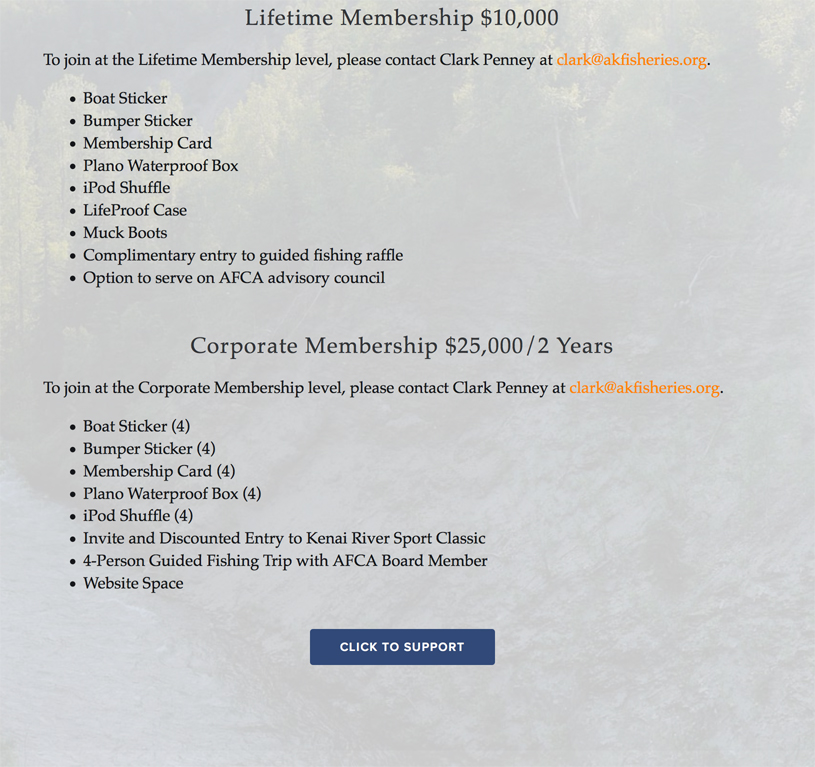
As of the morning of June 10, the AFCA website was offering an invitation and discounted entry to the Kenai River Classic run by KRSA for corporate level sponsors donating $25,000 or more.
When asked about this connection at a press conference following the submission of signatures, Penny explained that law would forbid such an offer.
“AFCA is a 501(c)6 organization,” Penny said. “KRSA is a 501(c)3. It is not allowed by law to do any such action like this.”
After the press conference, the offer was taken off the website but the Journal of Commerce was able to take a screen capture earlier in the day.
According to Clark Penney, executive director of the AFCA and the son of Bob Penney, the board of directors asked Northwest Strategies to take that offer down months ago, but it had not done that until Wednesday.
Northwest Strategies has been paid $11,000 so far by AFCA to “monitor, assess and coordinate” media coverage for the group.
Pending the outcome of an Alaska Supreme Court ruling, the initiative could be on the Alaska Primary Election Ballot as early as August 2016.
After the initiative was filed in late 2013, former Lt. Gov. Mead Treadwell rejected it in January 2014 as an allocative measure, which is prohibited under the state constitution. The group appealed and won a reversal in Superior Court that allowed it to begin collecting signatures.
The State of Alaska, however, is appealing the lower court decision, and AFCA attorney Matt Singer said June 10 there will likely be an oral argument Aug. 26 or Aug. 27, during which AFCA will argue that the initiative has nothing to do with allocations.
“This ballot initiative is about one way of catching fish,” said Singer. “It’s just about this one irresponsible way to catch fish.”
By law, AFCA needed to submit 31,000 signatures from three-fourths of Alaska’s House districts, or 10 percent of the amount of Alaskans who voted in the last general election.
The signatures were collected statewide, but the money behind them is not.
To get them, AFCA paid Scott Kolhaas, chair of the Alaska Libertarian Party, $87,000, or $2.02 per signature, according to transaction reports from the Alaska Public Offices Commission.
The reports also show that AFCA raised $116,500 for their statewide initiative as of the end of the first quarter. Of that, $97,000 was a direct contribution from Penney, and the vast bulk of the rest came from sources on the Kenai Peninsula or Anchorage. The only money that didn’t was $200 from two donors in Oregon.
Other large donors include AFCA board member Earl Frawner and Ed Rasmuson of Anchorage; each donated $8,700.
When asked why the ballot initiative had no grassroots financial supports from any of the four other non-rural, non-subsistence areas AFCA is targeting for setnet bans, Penney said they simply needed juice to get going.
“The start of this has to start someplace,” said Penney. “We haven’t reached out for any further financial donations until this passes the Supreme Court. Once that passes, then we’ll be in a position to have this on a ballot, and that’s what we’re all waiting for.”
AFCA has mounted the campaign against setnets for declared conservation purposes, although commercial fishermen have assailed the measure as simply a means to reallocate salmon from their industry to the guide industry. Cook Inlet would be disproportionately impacted as the only area covered by the initiative where commercial setnetting occurs on any substantial scale.
At their press conference, AFCA members cast setnets in hellish imagery, “predatory means of fishing,” “walls of death,” and “indiscriminate killers” that must be banished to ensure the future of chinook salmon.
“AFCA was formed with conservation in mind,” Penney said. “In fact, it’s part of our middle name.”
AFCA President Joe Connors, a former setnetter from 1978-1983 and current Kenai River sportfishing lodge owner, said, “It’s time for setnets in urban Alaska to go away. Setnets are decimating other fish species in Alaska. They are more appropriate for rural subsistence fishing because there is less pressure on the resource.”
On AFCA’s website in the description of the initiative, the group says that setnetters are wasting incidentally caught fish.
“Commercial set nets indiscriminately catch any fish that passes upstream, including species that are threatened or in decline,” the website states. “When non-targeted species are caught, these fish are considered by-catch and legally cannot be sold or used, thus going to waste.”
Under their permits, setnetters are allowed to retain and sell all five Pacific salmon species that are caught in their nets. When asked by the Journal if commercial setnetters are allowed to retain and sell incidentally caught chinook salmon, the board members present answered in the affirmative, but Connors said, “It’s not the primary goal for salmon fishing. King salmon have traditionally been a sport fish.”
The members are quick to point out that eight U.S. states have banned setnets already, and that Alaska is simply the latest to take up the issue. Texas, Alabama, Florida, Louisiana, New York, and California have all banned setnets, and Washington and Oregon have enacted severe setnet restrictions.
DJ Summers can be contacted at daniel.summers@alaskajournal.com.
Response from Kenai River Sportfishing Association:
KRSA does not have any involvement in the initiative or AFCA, although some members are supportive and have been working with the campaign as is their right as private citizens.
Bob Penney is actively involved in the initiative and is one of the people responsible for initiating it, but this does not relate to his involvement with KRSA or his participation as a KRSA Board member, of which he is currently one of eighteen.
Many Alaskans take active political stances and also serve on boards, but that does mean the boards they sit on subscribe to their political views on all things.
KRSA does not support the initiative, although a small number of members have asked us to, and continues to remain neutral in every aspect of the initiative including internal discussions and public comments.
KRSA never agreed to any offer through AFCA of a discounted registration or sponsorship for the Kenai River Classic.
KRSA was never told of the offer in question and had no knowledge of it until it was brought to our attention by the article.
As a 501 (c) 3 charitable non-profit, KRSA is not allowed to make such an offer or to coordinate with AFCA on such an offer. KRSA is very mindful of its (c) 3 non-profit status and would not risk the thirty-plus years of investment as an organization by agreeing to such an offer or to coordinate with a process that would jeopardize our (c) 3 designation.
AFCA can register and purchase at full price any number of people for the Classic event (just as any other organization is able to do) and then bring them to the event as a guest of AFCA.
Without any coordination, KRSA had no way of knowing about the offer and if we had, KRSA would have immediately asked to have it removed.
I would suggest you contact Clark Penney (AFCA) and / or Northwest Strategies to find out why it was thought appropriate to make such an offer without receiving our approval (which, to reiterate once again, would have been denied.)
This issue rests fully on the shoulders of AFCA and NWS.

 E-Wallet Purchase (Add Funds)
 Term Subscription