
By James Brooks
Alaska Beacon
The three Republican-appointed members of Alaska’s state redistricting board unconstitutionally gerrymandered a map of Anchorage state senate seats to favor Republican candidates, an Anchorage Superior Court judge ruled late Monday night.
“In summary, the totality of the circumstances leads this court to conclude that the majority of the board acted in concert with at least a tacit understanding that Eagle River would again be paired in such a way as to provide it with two solidly Republican senate seats — an unconstitutional partisan gerrymander,” Judge Thomas Matthews said.
The board appealed the decision to the Alaska Supreme Court late Tuesday, but with the filing deadline for this fall’s legislative elections only two weeks away, Matthews has ordered the board to implement an alternative map no later than May 23 for this year’s elections. The board has asked for that order to be put on hold while its appeal takes place.
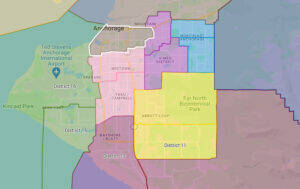
That alternative, preferred by local community councils, incumbent Republican Senate candidates and a majority of public testifiers, will create a firmly Republican state Senate district covering Eagle River and result in competitive or Democratic-leaning seats elsewhere.
Eva Gardner, who represented a group of Girdwood residents that sought to overturn the board’s map, said the plaintiffs “were pleased to receive the court’s decision late last night.”
“I think this should matter to anybody who cares about the political voice of small communities in Alaska, which is really most communities in Alaska,” said Jennifer Wingard, a member of the Girdwood Board of Supervisors and a plaintiff in the case.
“This is about not giving Eagle River — which has 5% of the vote — 10% of the Senate and 10% of the clout,” Wingard said.
This is the second time that Matthews has found that the board acted inappropriately to favor Republican candidates. In February, he ruled that the board’s first-draft map of Senate districts in Anchorage was unconstitutional and that the board’s three Republican-appointed members had secretly colluded to create it.
The Alaska Supreme Court upheld Matthews’ ruling, which ordered the board to go back to the drawing board.
The board redrew the map, but the new result linked South Anchorage and south Eagle River and drew an immediate lawsuit from Girdwood residents who opposed it. Their lawsuit resulted in Monday’s order, which drew an immediate protest from the board.
“We believe the trial court erred in its decision and that Option #2 denies JBER voters their equal protection rights under the Constitution. We will be requesting expedited review by the Alaska Supreme Court,” said redistricting board director Peter Torkelson.
The appeal identifies 14 points where the redistricting board believes Matthews made mistakes, including one that says he “erred in finding that the Board reached a secret or tacit agreement on senate pairings when the decision and rationale was plainly made and stated on the record in an open session.”
Republican members used ‘secretive procedures’
Alaska’s five-person redistricting board is the body that redraws the boundaries of the state’s legislative districts to account for changes in population as measured by the U.S. Census.
Its members are appointed by high-ranking state officials, but its work is supposed to be nonpartisan, and it’s illegal to draw the lines to favor a party or candidate.
Gov. Mike Dunleavy appointed registered Republicans Bethany Marcum and Budd Simpson. Former Senate President Cathy Giessel, R-Anchorage, appointed registered Republican John Binkley.
Former Speaker of the House Bryce Edgmon, I-Dillingham, appointed Nicole Borromeo, and former Alaska Chief Justice Joel Bolger appointed Melanie Bahnke. Borromeo and Bahnke are undeclared voters.
In the first case, Matthews cited evidence of “secretive procedures” and public comments by board members before declaring that Marcum, Simpson and Binkley had coordinated to benefit Republican-leaning Eagle River by splitting their votes between two Senate districts, in effect giving local voters a greater voice in the Senate at the expense of their neighbors.
When instructed to redo their work, board members again split Eagle River, joining north Eagle River in a senate district that also covers JBER and portions of downtown Anchorage.
The board argued that it then had no other choice but to pair south Eagle River with South Anchorage because local options had been blocked by the first court order.
‘Existence of discriminatory intent is key’
Matthews concluded that was wrong. Although the three majority board members explained in detail why they believed north Eagle River should be joined with JBER and downtown Anchorage, they failed to explain why that made more sense than joining Eagle River together in one Senate district.
“There was little discussion of the obvious pairing of the two Eagle River house districts,” Matthews said.
There was no testimony in favor of the pairing from JBER residents or from local governments or community councils in Eagle River, Matthews said, and there was significant testimony against the idea from local residents and community councils in Anchorage.
“This does not mean that JBER and Eagle River, or Girdwood and Eagle River, can never be paired together in a senate district. It is, however, highly unlikely that this Board, given its past actions, can legitimately split Eagle River into two senate districts. The existence of discriminatory intent is key,” Matthews said.
Attorney Eva Gardner, representing the Girdwood residents opposed to the new plan, provided evidence showing secret emails and phone calls between the three Republican-appointed members of the redistricting board.
Gardner said that was circumstantial evidence — there was no proof of what those communications were intended to do — and Matthews agreed, though he said it carries some weight.
“The evidence is quite clear that a pattern of markedly partisan correspondence between specific board members occurred, and aligns with the intent found during the first round of litigation,” he said.
In and of itself, that isn’t enough to rule the map illegal, Matthews said, but he concluded it was enough to shift the burden of proof from plaintiffs to the board.
Board ‘amplified conservative voices’
Board members repeatedly said that they wanted to preserve the interests of “military voters” on JBER and in nearby Eagle River, but Binkley and Marcum each said publicly that they believe military voters are more conservative.
“Although Board members repeatedly couched their reasoning in terms of ‘military voters,’ as the Board’s argument confirms, Board members either knew or assumed that JBER residents preferred the same political candidates as Eagle River, i.e., Republicans. The Board thus candidly admits that its decision to pair JBER with North Eagle River was to amplify conservative voices by creating a safe Republican senate seat,” Matthews said.
Under prior precedent, that’s unconstitutional.
In 2002, the Alaska Supreme Court wrote, “Neither military personnel nor members of any other group have any constitutional right to be divided among two or more districts to maximize their opportunity to influence multiple districts rather than control one.”
“This is precisely what the Board sought to do for Eagle River,” Matthews said.
James Brooks is a longtime Alaska reporter, having previously worked at the Anchorage Daily News, Juneau Empire, Kodiak Mirror and Fairbanks Daily News-Miner. This article originally appeared online at alaskabeacon.com. Alaska Beacon, an affiliate of States Newsroom, is an independent, nonpartisan news organization focused on connecting Alaskans to their state government.
