
Like most of the state, Alaska’s only railroad operator is coping with a steep drop in revenue in the wake of a decline in oil prices, but is hoping to build other lines of business in the meantime.
The Alaska Railroad Corporation, a state-owned corporation that operates the rail line between Seward and Fairbanks with an offshoot to Whittier, gets revenue from passenger fares, freight shipping and contracts with cruise ships to pull the ships’ rail cars along the tracks, as well as leasing nearly half of its approximately 36,000 acres of land. Though passenger operations have grown significantly since 2010, freight revenues have fallen, most notably since early 2014 when oil and gas companies began to scale back their operations in the face of rapidly falling oil prices.
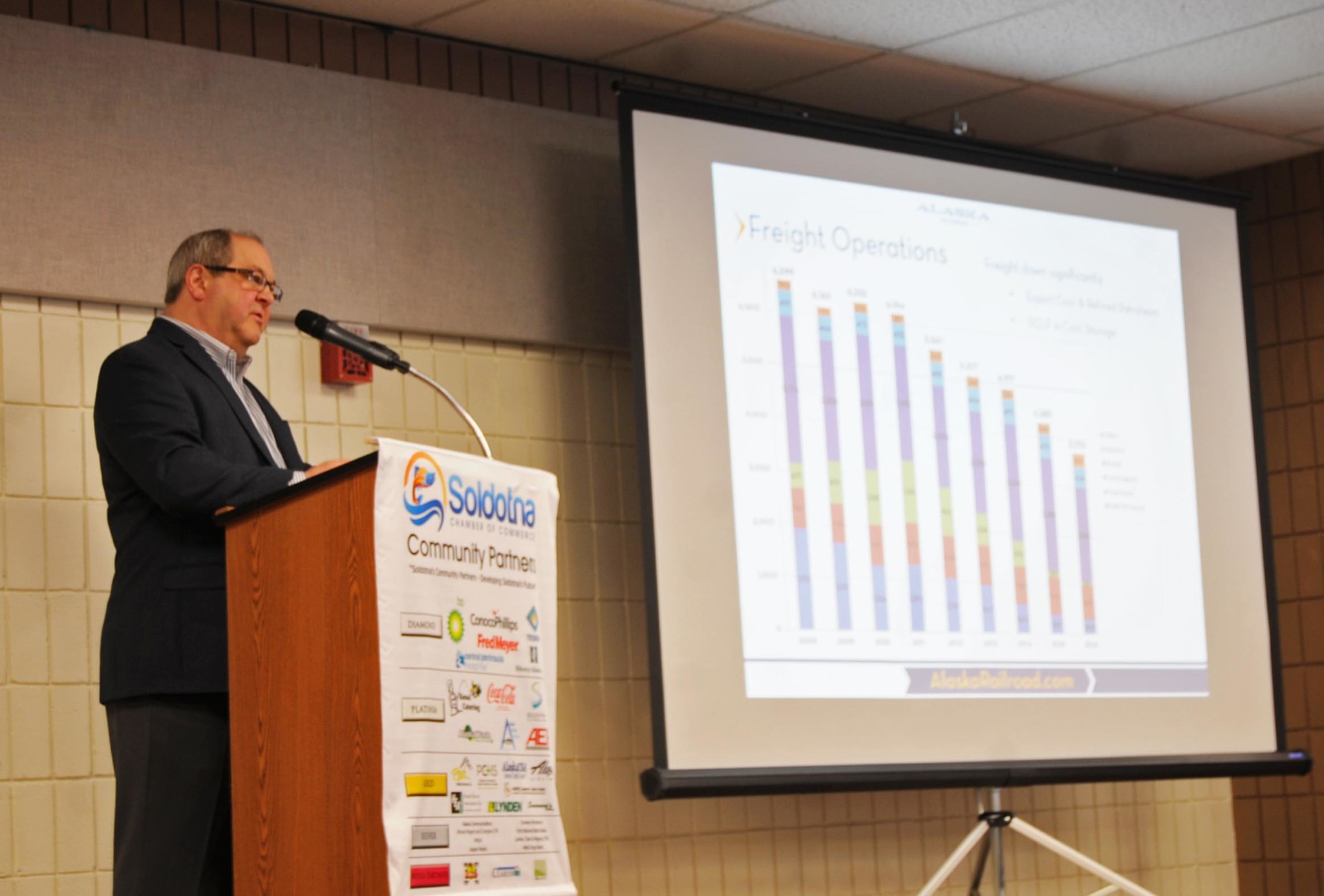
Dale Wade, the railroad’s vice president of marketing and customer service, said in a speech to the joint Kenai and Soldotna Chambers of Commerce on Wednesday that the corporation made about $4.5 million in revenue in 2016 — roughly a quarter of its net revenue a decade ago, with approximately $16.3 million in 2007. Since 2008, freight revenue has fallen 44 percent, he said.
“This is the source of most of our problems, financially,” Wade said. “This is the largest operating group — between real estate, passenger service and freight service, freight is … far and away the largest revenue source, but unfortunately it’s going the wrong way.”
Most of that is due to declines in oil and gas activity. The Alaska Railroad in the past has shipped a lot of drilling material and pipe north for the oil companies, as well as petroleum to run the operations. As companies have either withdrawn from Alaska or downsized their operations — Alaska lost a full fifth of its oil and gas jobs in 2016, according to the Alaska Department of Labor and Workforce Development — the railroad has felt the effects. Coal shipping is also down as the worldwide prices and demand for coal have plummeted, and the company hit an all-time low for shipments out of its Seward Coal Loading Facility in 2015.
The Alaska Railroad Corporation does not draw on state general funds to operate, so the losses have resulted in cuts to the company’s workforce. Last week, the corporation announced it would be laying off 31 people and cutting 49 positions in the face of a projected $4.9 million shortfall in the 2017 budget, according to an Alaska Railroad Corporation press release.
However, Wade tried to keep the outlook positive. He said the company believes the decline will ultimately be short-term and the railroad will be able to pull through. Freight cars also carry shipments of military supplies, which may grow as the military works on its F-35 planes in Fairbanks, and the railroad is often asked to weigh in on transportation bids, so the administrators often know about long-term projects ahead of time, he said. Last fall, the Alaska Railroad Corporation became the first rail company in the country to win approval from the Federal Railroad Administration to ship liquefied natural gas in rail tankers, a project the company is excited about, Wade said.
“It’s a relatively new commodity, and we pursued that in interest of supporting the need for LNG or natural gas into Fairbanks,” he said. “… (The FRA) thought we were a pretty safe railroad to try that on.”
The initial plan is to take LNG produced at Point MacKenzie north to Fairbanks, which notoriously struggles with high costs of energy. The city does not currently have access to natural gas, but shipping LNG there through the railroad could help bring down energy costs, Wade said. The initial pilot project will take eight trips with LNG to Fairbanks daily, with potential for expansion in the future, he said.
The Alaska Railroad Corporation has spent time training emergency responders along the route to respond to LNG incidents as well, Wade said.
“Up and down the railroad, every fire department along the way knows where the trains are loaded, knows how to handle LNG, what if there was an incident … it provided us a great opportunity to talk about safety and preparedness as well as successful movement of bulk LNG to the interior markets,” he said. “Eventually, we can foresee moving vast numbers of gallons of that commodity north into Fairbanks.”
Passenger services have also grown slightly. The company ended last year 7.1 percent up over 2015 and is projecting another 5 percent growth in services in 2017, he said. The company has its own marketing plan and is not too heavily affected by the state’s cuts to the Alaska Tourism Industry Association’s marketing fund, he said. The company is also working on a master plan for its property at the Seward Port, which would better accommodate the increasing cruise ship traffic heading into Resurrection Bay every summer. The corporation is still working on its plans there, Wade said.
The corporation is also working on implementing the federally mandated Positive Train Control program, which would automate and track train movement through computers for additional safety. The federal government now requires most of the U.S. rail network to have the program by Dec. 31, 2018. Though the Federal Railroad Administration and the Federal Transit Authority do provide the Alaska Railroad with some funds, they are not paying for Positive Train Control implementation, which is a source of heartburn for the corporation. The project costs $165 million in research and development and is estimated to cost between $8 million and $12 million in annual upkeep and operations, Wade said.
“It tells us that, ‘Thou shalt build a safety infrastructure,’” he said. “… safety is always important, and it doesn’t really matter whether we think we need it. It is something the federal government has mandated and we are going to comply, in 2018.”
Though the railroad is looking at some long-term challenges, Wade said the corporation has confidence in its long-term survival. Rail travel is relatively low-cost for freight compared to trucking and barging, and there has been some conversion of truck to rail, he said.
“We help hold the cost of doing business in Alaska down, and work very closely with the truck and ocean carriers that move goods throughout the state,” he said. “Any large development project will certainly involve the railroad, so we know that as a state-owned corporation, self-sustaining, for-profit, we are going to be part of the infrastructure, the build-out of the state of Alaska as we move forward.”
Reach Elizabeth Earl at elizabeth.earl@peninsulaclarion.com.
