
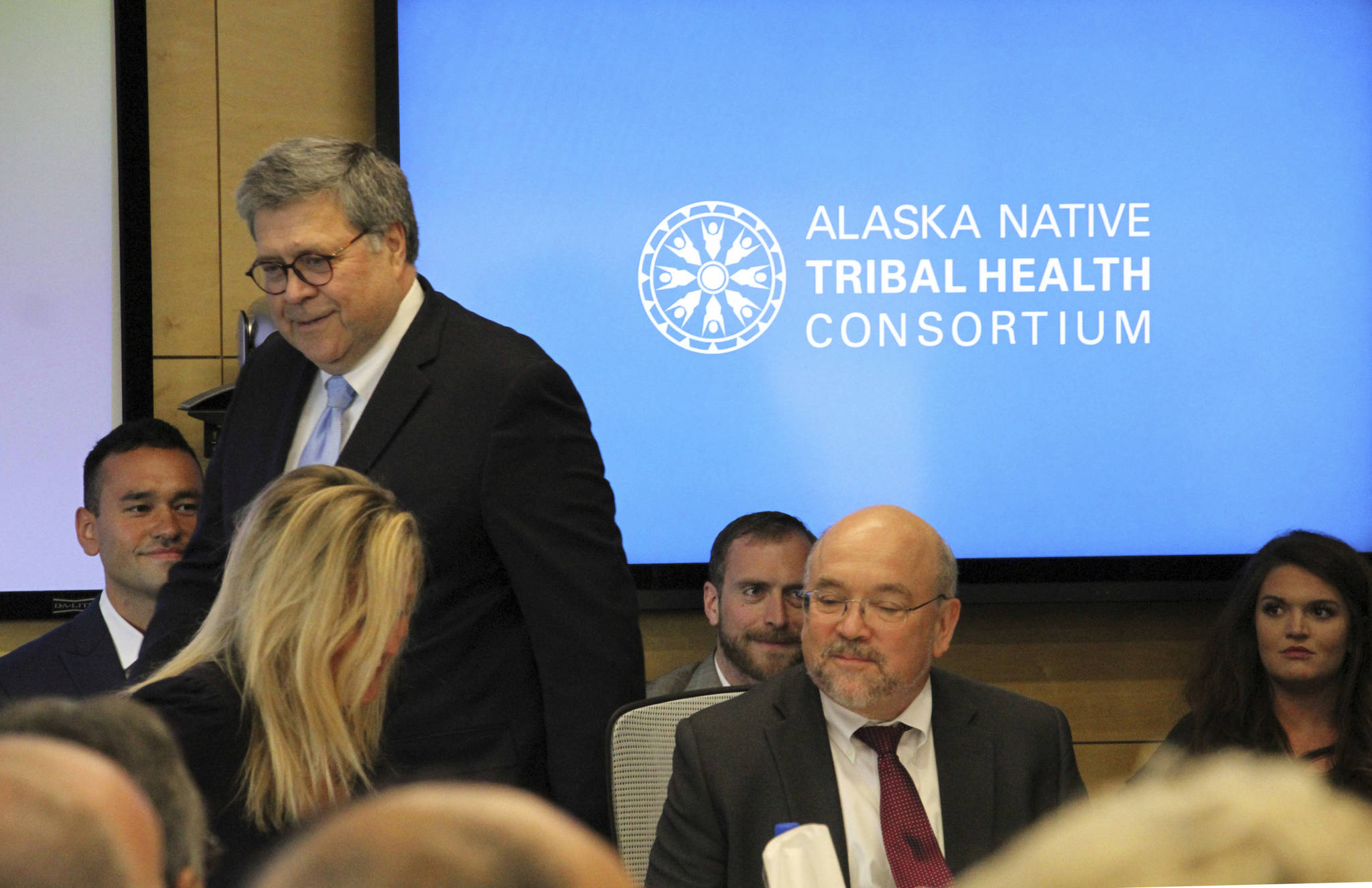
In this May 29, 2019 file photo U.S. Attorney General William Barr, standing, greets participants at a roundtable discussion at the Alaska Native Tribal Health Consortium in Anchorage, Alaska. Alaska Native villages are receiving almost $5 million from the U.S. Justice Department to combat numerous public safety problems, including no law enforcement presence in some communities. The announcement Tuesday, July 30, 2019, comes nearly two months after Barr met with tribal representatives during a visit to the state who detailed slow response times from authorities, violence against women and abuse of alcohol and drugs, including opioids. (AP Photo/Mark Thiessen, File)

In this May 29, 2019 file photo U.S. Attorney General William Barr, standing, greets participants at a roundtable discussion at the Alaska Native Tribal Health Consortium in Anchorage, Alaska. Alaska Native villages are receiving almost $5 million from the U.S. Justice Department to combat numerous public safety problems, including no law enforcement presence in some communities. The announcement Tuesday, July 30, 2019, comes nearly two months after Barr met with tribal representatives during a visit to the state who detailed slow response times from authorities, violence against women and abuse of alcohol and drugs, including opioids. (AP Photo/Mark Thiessen, File)

Alaska Native villages get $5M to combat rural violence

The award comes nearly two months after AG William Barr met with tribal representatives.

  • By Rachel D’Oro Associated Press
  • Tuesday, July 30, 2019 10:10pm
  • News

ANCHORAGE — Rural Alaska Native villages will receive nearly $5 million from the U.S. Justice Department to combat numerous public safety problems, including no law enforcement presence in some communities, the agency announced Tuesday.

The award comes nearly two months after Attorney General William Barr met with tribal representatives who told him about slow emergency responses by authorities, violence against women and abuse of alcohol and drugs, including opioids, in remote communities. The money is for hiring additional village and tribal officers and to pay for equipment and training.

The grant funding couldn’t come at a more crucial time for Sharon Williams, the tribal administrator in the southwest Alaska village of Napaskiak, one of three communities Barr visited in May. The Yup’ik community of 450 is just 7 miles from the hub town of Bethel, whose voters lifted a decades-long ban on alcohol sales in recent years.

Napaskiak and other villages ban alcohol, but Williams said the new supply of readily available booze purchased nearby is bringing more alcohol-related problems to the village, including many intoxicated people boating on the Kuskokwim River. Since 2016, there have been 11 alcohol deaths in Napaskiak alone, including a 14-year-old boy who died of alcohol poisoning in February, Williams said. The community currently has four village and tribal police, but sometimes there are none because of sometimes high turnovers, she said.

“There’s more public safety needed because there’s so many intoxicated people,” she said in a phone interview. Williams said she gave Barr a tour of the community during his hours-long visit in May. He also visited Bethel and the rural community of Nenana.

“He was very attentive,” Williams said. “He was just soaking everything in.”

In June, Barr declared a law enforcement emergency in Alaska. The declaration cleared the way for the Justice Department to award more than $10 million to fight crime in rural Alaska communities. That includes the award announced Tuesday.

Julie Kitka, president of the Alaska Federation of Natives, praised the emergency declaration and the funding. She said her group has been talking with Justice Department officials, as well as Department of Interior representatives, to look for possible solutions.

“The attention to what needs to happen as far as women, the children, men that are living in all our rural communities has to be a priority,” she said. “And we really appreciate the Department of Justice’s attention to that.”

During Barr’s visit, tribal representatives told him communities with no police presence often must wait long stretches before state troopers can arrive to investigate crimes. Often, it can take troopers hours to reach a village given the sheer vastness of the nation’s largest state, with few roads. That can stretch into days if the weather is bad.

They also spoke about the need to strengthen the authority of tribal courts serving Native communities.

Victims of domestic violence and sexual assault have limited services available in the larger rural hub communities, or none at all in the villages, participants said.

State authorities handle criminal investigations in more than 200 Alaska Native villages. A 2013 federal report found that at least 75 Alaska Native communities had no law enforcement presence. Tribal leaders have spoken candidly about barriers that victims face in seeking justice, saying some sexual assault victims must take boats or planes to urban areas to get medical forensic exams.

Barr’s visit and funding came as Congress and advocates have renewed a focus on violence against Native American and Alaska Native women. Federal statistics show they are victims of violence at astonishing rates. The most recent numbers show that more than half have faced sexual and domestic violence at some point in their lives.

More in News

David Ross is sworn in as Kenai Police Chief on Tuesday, May 31, 2016 at Kenai City Hall. The Alaska Association of Chiefs of Police named Ross the 2025 Police Chief of the Year, recognizing over two decades of service. Photo by Megan Pacer/Peninsula Clarion
Kenai police chief named 2025 Police Chief of the Year

The Alaska Association of Chiefs of Police recognized David Ross for his more than two decades of leadership.

The cast of Nikiski Middle School’s upcoming performance of “Alice in Wonderland” is pictured on Dec. 2, 2025. The upperclassmen-directed play opens on Friday, with additional showtimes Saturday and next weekend. Photo courtesy of Carla Jenness
Nikiski Middle School debuts student-led “Alice in Wonderland”

The show opens on Friday, with additional showtimes this weekend and next.

On Tuesday, the Kenaitze Indian Tribe unveiled Kahtnu Area Transit, a public transportation service open to the entire Peninsula Borough community. Photo courtesy of Kahtnu Area Transit
Kenaitze Indian Tribe unveils Kahtnu Area Transit

The fixed bus route offers 13 stops between Nikiski and Sterling.

The Kenai Chamber of Commerce and Visitor Center hosts the annual Christmas Comes to Kenai on Nov. 28<ins>, 2025</ins>. The beloved event began over 40 years ago, and this year over 1,000 attendees enjoyed hot chocolate, fireworks, pictures with Santa and shopping. Photo courtesy of the Kenai Chamber of Commerce
 Photo courtesy of the Kenai Chamber of Commerce
The Kenai Chamber of Commerce and Visitor Center hosted the annual Christmas Comes to Kenai on Nov. 28. The beloved event began over 40 years ago, and this year over 1,000 attendees enjoyed hot chocolate, fireworks, pictures with Santa and shopping.
Kicking off a month of holiday festivities

Last weekend’s holiday events, including the annual Christmas Comes to Kenai and the Soldotna Turkey Trot, drew folks from all over the Kenai Peninsula.

Starting Dec. 2, Aleutian Airways will offer roundtrip flights between Anchorage and Unalakleet every Tuesday, Friday and Sunday.
Aleutian Airways to offer roundtrip flights between Anchorage and Unalakleet

Starting Dec. 2, Aleutian Airways will offer three roundtrip flights per week.

The Trump administration’s “Big Beautiful Bill” act requires the Bureau of Ocean Energy management to hold at least six offshore oil and gas lease sales in Alaska between 2026-2028 and 2030-2032. The first of these sales — known as “Big Beautiful Cook Inlet 1,” or BBC1— is scheduled for March 2026. Photo courtesy of the Bureau of Ocean Energy Management
Cook Inletkeeper launches petition against federal government

The organization is calling for transparency in Cook Inlet offshore oil and gas sales.

Winter dining has always carried more weight than the menu might suggest. In the off-season, eating out isn’t just about comfort food or convenience; it’s a way of supporting local businesses as they hold steady through the slower months. Photo credit: Canva.
The ripple effect: How local spending builds stronger communities on the Kenai Peninsula

From cozy cafés to fine-dining bistros, purchases made close to home sustain local jobs and services

Courtesy Harvest
On the Kenai Peninsula, a dormant liquefied natural gas export plant could be repurposed to receive cargoes of imported LNG under a plan being studied by Harvest, an affiliate of oil and gas company Hilcorp. The fuel would be transferred from ships to the tanks on the left, still in liquid form, before being converted back into gas and sent into a pipeline.
Utilities say Alaska needs an LNG import terminal. Consumers could end up paying for two.

Planning for two separate projects is currently moving ahead.

A map shows the locations of the 21 Alaska federal offshore oil and gas lease sales proposed by the Trump administration. (Map provided by the U.S. Bureau of Ocean Energy Management)
Trump administration proposes offshore leasing in almost all Alaska waters

A new five-year offshore oil and gas leasing plan proposes 21 sales in Alaska, from the Gulf of Alaska to the High Arctic, and 13 more off the U.S. West Coast and in the Gulf of Mexico.

Most Read