
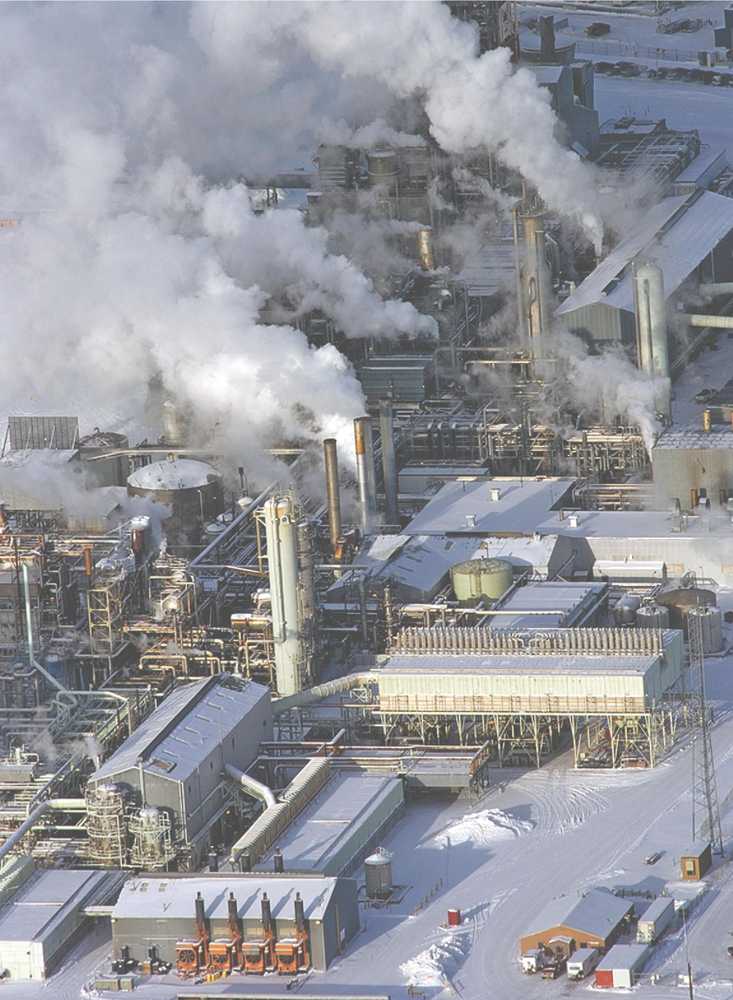
The Alaska Senate has begun its consideration of a tax credit designed to lure Agrium back to its Nikiski plant.
On Monday the Senate Resources Committee discussed House Bill 100, which would provide tax credits to ammonia and urea producers. Three of the six committee members present endorsed the bill, while the other half provided no recommendation.
Alaska presently has no in-state ammonia or urea producers, and historically there has been only one — Alberta-based Agrium, which operated an ammonia and urea plant in Nikiski until closing it in 2007, citing the dwindling supply of the natural gas used as raw material for its nitrogen products, ammonia and urea. The company’s leaders have since considered the possibility of an estimated $275 million restart of the Nikiski plant, although other Agrium investments — such as expansion of the Vanscoy Potash mine in Sasketchewan and of a nitrogen plant in Borger, Texas — have so far taken priority. Agrium currently has 7 operating nitrogen product plants — four in Sasketchewan, and three located in Texas, Argentina and Egypt, according to its 2015 annual report.
A 2005 Clarion article cites an Agrium-commissioned study by consultants the McDowell group stating that the approximately 230 jobs lost with the Nikiski plant’s closure had an average annual salary of about $80,000 — at the time, some of the highest-paying in the Kenai Peninsula Borough. The plant also took with it 5 percent of the borough’s property tax revenue, approximately $2 million.
After Rep. Mike Chenault’s (R-Nikiski) attempt to insert a credit for Agrium in a bill aimed at credits for oil refineries failed in April 2014, he introduced the current bill on Feb. 9, 2015. Its credit to an ammonia or urea producer’s corporate income tax would be equal to the state royalty payments made on gas the producer consumed. The bill was passed by the House on April 13, 2015.
The resource committee heard from Ken Alper, Director of the Department of Revenue’s Tax Division, who said the state administration did not have a position on the tax credit bill — commonly referred to as the Agrium bill — but said the bill “has a lot of things going for it.” He named the balance it would create between deferred state revenue and gas royalty income as a strength and said Agrium’s return could help Cook Inlet’s gas market by providing a large, stable buyer for natural gas. He said a stronger market could reduce the need for the state’s controversial tax credits to Cook Inlet oil and gas producers, to which the legislature is debating revisions in another bill, HB 247.
“Were this bill (HB 100) to pass, it could provide some stability to the Cook Inlet market,” Alper said. “… If there was more certainty over having the ability to sell gas, we might not need to provide quite the same level of credit support to some of these marginal projects, because they know they can invest in these platforms and so forth because they know they have a market through this Agrium facility to buy the gas.”
Agrium’s Nikiski plant closed after the company failed to reach an agreement with its gas supplier Unocal, after the latter raised its prices in 2004. Agrium’s Manager of Government Relations Adam Diamond said the supply environment of Cook Inlet is changing.
“The reason we’re looking at this project is because there’s been some positive developments in the Cook Inlet,” Diamond said. “The company needs to be confident that there’s going to be a large enough supply for the plant as well as utilities and other uses. We don’t want to get put in a situation where there’s a supply issue again.”
Alper compared the tax credit favorably with the state’s oil and gas credits, which give companies credit for exploration and development investments in addition to the actual production of oil or gas.
“One of the pros I see in this bill is that there is no cost to the state unless the project moves forward,” Alper said. “Unlike many of our other tax credits, it’s not tied to the expenditure, it’s tied to the completion of the project, and then the project itself purchasing gas produced from an Alaska lease.”
The bill’s fiscal note cites a study prepared for Agrium by the McDowell Group, calculating that a reopened Agrium plant would annually consume gas worth about $15 million in state royalties, giving it that much possible tax credit. However, the fiscal note estimates Agrium’s annual corporate income tax liability between $3 million and $4 million. Under the present draft of the bill, the credit could not drop Agrium’s liability below zero — as is allowed in current oil and gas credits, creating a system were companies are reimbursed by the state for credits in excess of their tax liability.
Agrium’s Kenai plant manager Steve Wendt pointed out that the $15 million estimate was based on a gas price of $5.70 per thousand cubic feet of gas, which he said was in the high range of gas costs — as of Monday, Wendt said, the maximum gas price was $1.82 per thousand cubic feet, and the resulting value of the tax credit would therefore be less.
Resource Committee member Bill Wielechowski (D-Anchorage) asked Alper if he had analyzed whether or not Agrium would actually need the tax credit to reopen the Nikiski plant, a question that has been part of discussion since the credit’s introduction. Alper said his department had not analyzed the question.
“I don’t know if this tax credit… is going to be the final tipping point to make this project pencil out,” Alper said. “… Order of magnitude-wise, it’s not that big a credit compared to the scale of the project, so I don’t know the extent to which it’s going to move the needle for them at all.”
Wielchowski asked a similar question to Wendt and Diamond, the two Agrium representatives present at the hearing.
Wendt said the project of reopening the Nikiski plant was “very challenged,” saying that the price of urea was at a 10-year low.
“It’s not a slam dunk that this project is going to go,” Wendt said. “… We originally planned to be up and running this year, but the slow development of gas and the decline of commodity prices has made it much tougher for us, so we’ve had to look at other options, and continue to work to make it something that could compete against other internal projects within Agrium that the board would consider. At this point we’re not putting it forward to the board, and the $3 million or $4 million we would get is significant in many ways — not just financially, but also just as an important piece to know that the state of Alaska is behind the project.”
Senators Peter Micciche (R-Soldotna), Chair Cathy Giessel (R-Anchorage), and Vice-Chair Mia Costello (R-Anchorage) recommended passage of the bill, while Senators Wielechowski, John Coghill (R-North Pole), and Bill Stoltze (R-Chugiak) made no recommendation.
The Senate’s Finance Committee and Labor and Commerce Committee will also consider the bill.
Reach Ben Boettger at ben.boettger@peninsulaclarion.com.
